By Karis Tavernier-Nicholas
Madame de Pompadour (1721-1764) is often remembered as the official mistress of King Louis XV, yet this reputation obscures her most enduring achievement as one of the most influential artistic patrons in eighteenth-century France. From her relatively humble beginnings as Jeanne Antoinette Poisson, she had essentially been groomed for the role of the King’s mistress. At a time when women possessed little formal political authority, and with the need to navigate court politics, Pompadour leveraged artistic patronage as a form of power. Arts such as portraiture and porcelain, Pompadour helped define the Rococo aesthetic that came to symbolise eighteenth-century France, while simultaneously cementing her close relationship with the King, particularly following the end of her official role as his maîtresse-en-titre.
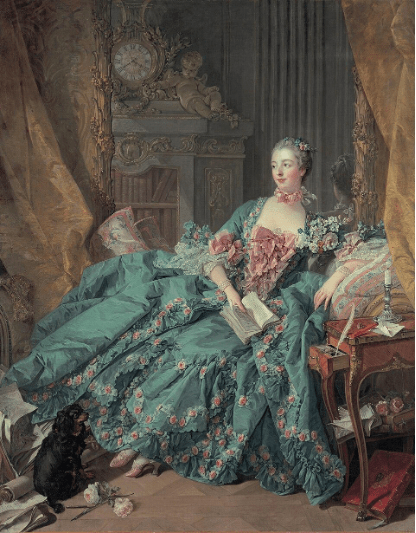
Emerging in the early eighteenth-century, Rococo developed out of the rigidity of Baroque, becoming closely associated with ideals of femininity. Rococo favoured a pastel colour palette as well as asymmetry, domestic settings and natural ornament. Critics dismissed the style as frivolous, revealing how aesthetic judgements were often intertwined with gendered assumptions. However, it can be seen everywhere in portraits of Pompadour by the eighteenth-century painter, François Boucher. For the very same reason that critics derided Rococo, Pompadour arguably utilised it in portraits to soften her image and present herself as less of a threat. She had exceptional influence over the King, not least because of her close proximity to him on a regular basis, and it was something that concerned courtiers and other members of the royal family.
Just a few years into her position as the King’s mistress, public opinion on Pompadour — which had once been favourable, especially when compared to her predecessors — had soured. This appears to have been the result of a campaign to defame her, originating in the royal household. Outrage had first occurred due to Pompadour’s appointment as maîtresse-en-titre, the formal role of chief mistress to the King of France, which bestowed upon its holder an official and powerful position at court. This was granted to her despite her low-birth. Ladies at court were thus upset that they would have to endure the humiliation of deferring to a woman who was their social inferior.
Furthermore, Pompadour’s close ties to financiers in Paris was viewed with suspicion, owing to what they had to gain from the influence afforded by her new position. Her dismissal of Philibert Orry, who held the position of Controleur-Général des Finances (Controller-General of Finances), can be understood in light of the marquise’s allegiance to the Pâris brothers, whose involvement in France’s state affairs Orry had consistently opposed. This signalled that her preferences, including in matters of state, carried greater weight than ministerial experience or competence. Pompadour’s political influence at court was unprecedented for a woman without formal office and was a transgression from the social expectation for women to be subservient.
Pompadour’s influence at Louis XV’s court is depicted in Boucher’s Portrait of Madame de Pompadour (1756). The French mistress sits within luxurious surroundings, her Rococo furniture on display. Roses are scattered across the floor and perched upon her writing desk, matching the roses that adorn her dress. The association with the rose symbolically conveys Pompadour’s powerful command of the King’s love. Her desire to be associated with intellectuality is clear from the open book she clutches, the volumes lining her bookcase in the background, and the presence of writing materials and her personal seal, all of which indicate her role as an active patron and political powerhouse.
The painting was completed in 1756, the same year as the signing of the Treaty of Versailles. This political act saw France ally itself with its former enemy Austria, ending centuries of hostility between the two countries. Pompadour had been directly involved in the negotiations, and had played the role of architect in constructing the Treaty. However, the Treaty instigated the Seven Years’ War (1756-1763) which depleted France’s finances and, unsurprisingly, Pompadour’s public reputation suffered. In this context, Boucher’s use of a soft pastel colour palette and natural motifs assigned to the Rococo style was a strategic move; he was trying to restore the allure of an increasingly unpopular Pompadour.
https://en.wikipedia.org/wiki/Louis_XV#/media/File:Louis_XV,_King_of_France_(1710-1774)_edited_2.jpg
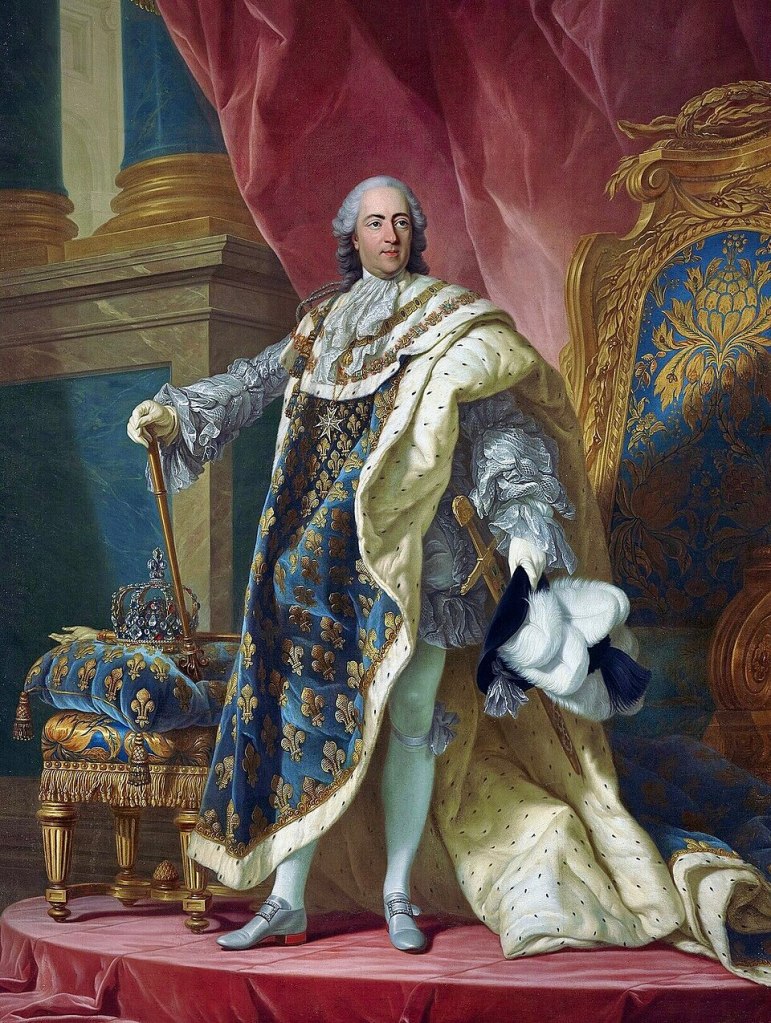
Pompadour’s sexual relationship with the King had by this time come to an end, yet it had remarkably evolved into a significant friendship through which she continued to wield influence. In Madame de Pompadour and the Theatres of Power, Thomas E. Kaiser argues that Louis XV and Pompadour developed a relationship of mutual dependence. Beyond ‘satisfying his sexual needs’, Louis had come to rely on Pompadour for ‘maintaining his mental equilibrium’, while Pompadour’s political authority depended upon the King’s continued favour. This relationship led contemporaries ‘to conclude that Pompadour had crossed the thin line between amusing the King and controlling him’.
Building on Kaiser’s argument, Louis and Pompadour’s relationship can arguably be interpreted, in modern terms, as one of codependency. While Louis relied on Pompadour for emotional stability, Pompadour depended on the King for unofficial political power. It was in her interest to see to his every need, whether that was by providing entertainment to ease his melancholia or even facilitating relationships with younger women after their own sexual relationship had ended. Some may argue that Pompadour’s actions were simply a calculated strategy to preserve her position at court; and it is true that her power had become tied to maintaining his dependence upon her.
https://commons.wikimedia.org/wiki/File:Madame_de_Pompadour_by_Fran%C3%A7ois-Hubert_Drouais.jpg
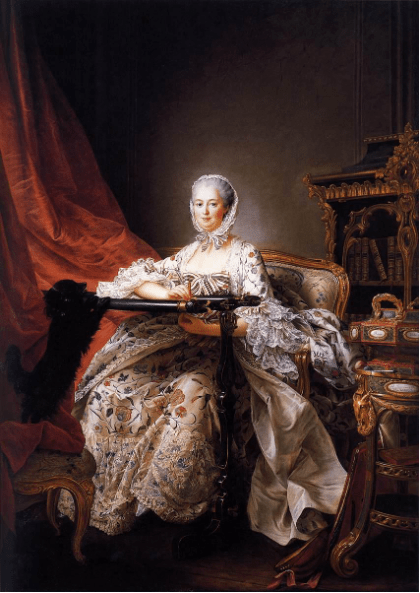
François-Hubert Drouais’ Madame de Pompadour at her Tambour Frame (1763-64) makes for an interesting contrast with Boucher’s portrait. In what was Pompadour’s final portrait, Drouais presents her in a more traditionally modest feminine light. She is clearly in middle-age and is shown occupied with embroidery, considered a virtuous pastime for an aristocratic woman. Moving to this form of presentation can be seen as a deliberate attempt to frame her as a conservative figure, making her less threatening to the public who were, by that point, extremely hostile towards her. Like Boucher’s portrait, there remains cultural signatures such as plentiful books on a lavishly decorated bookcase. Again, this highlights her wish to be seen as more than a temporary object of desire, as she was in her youth. She is positioned as a source of political and intellectual authority, showing her influence to be enduring, legitimate, and indispensable, even if this was not officially recognised by the French court.
Aside from Pompadour’s portraits, which made her the face of the Rococo artistic style, Sèvres porcelain showed her aesthetic tastes extend into objects of everyday luxury. The factory’s celebrated Rose Pompadour glaze immortalised her name in the creation of a new shade of the colour, demonstrating that her patronage shaped not only individual artworks but the visual identity of eighteenth-century France. At the time, the market for porcelain had been particularly saturated by Meissen porcelain. Pompadour changed this. Her influence was sizeable, from overseeing the factory’s relocation from Vincennes to Sévres, to advising on the type of products it put in front of consumers. Porcelain adopted the Rococo style, and pieces that included new colours such as Bleu Sévres and the aforementioned Rose Pompadour were introduced.
Pompadour used porcelain to cement her cultural relevance and position herself as an influential court patron. The porcelain was highly sought-after internationally, and so was strategically used as diplomatic gifts for royalty, with recipients including Empress Marie Theresea of Austria, and favourites of Louis XV. Pompadour’s large commissions were seen as patriotic, having a positive influence over the French economy. Owing to their desirability and expense, they further strengthened France’s position as the cultural capital of Europe, and Pompadour’s patronage of Sévres porcelain was something she continues to be lauded for.
https://www.metmuseum.org/art/collection/search/202193
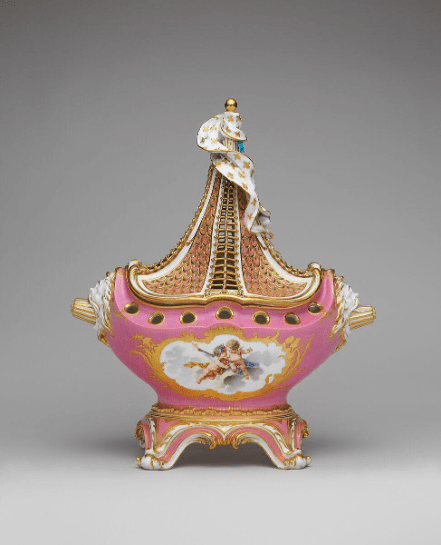
The Sévres pot-pourri vase (Pot-pourri á Vaisseau) perfectly demonstrates Pompadour’s use of decorative arts as a form of power. The vase itself is shaped in the form of a ship sailing under the royal fleur-de-lis; a few of them were purchased by Pompadour during the Seven Years’ War and put on display in her various homes, indicating her patriotism. Due to their intricate nature and limited number, the fact Pompadour owned so many showed any visitor that, at the very least, she commanded the wealth and cultural power to access such incredibly luxurious goods. In commissioning leading artists such as Charles-Nicolas Dodin to reproduce designs, Pompadour ensured that her aesthetic influence permeated everything, from court interiors to diplomatic gifts.
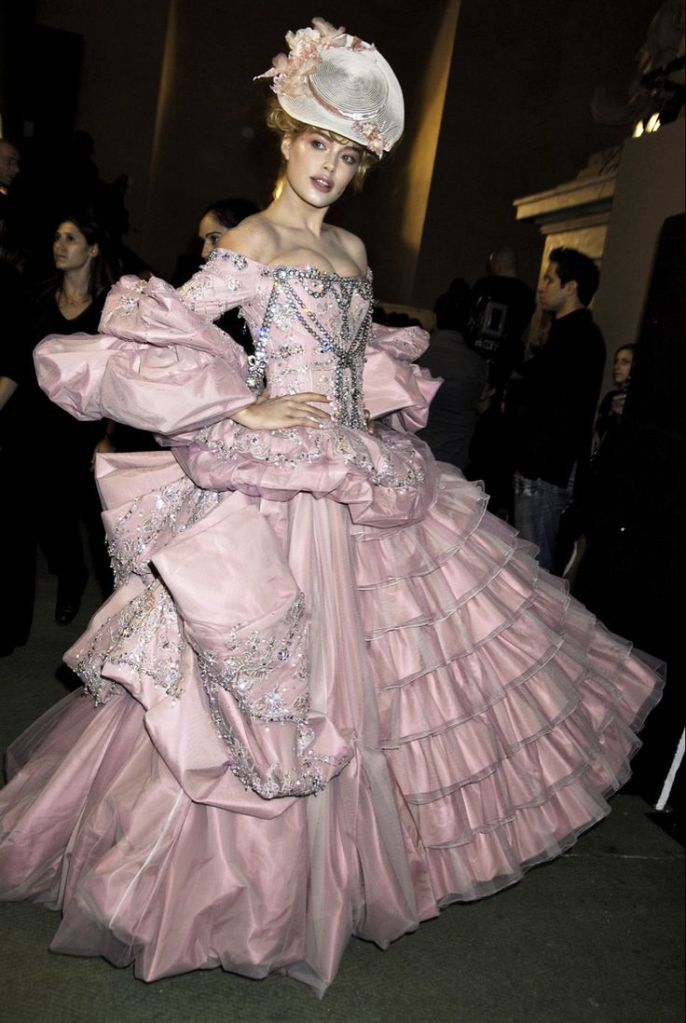
Madame de Pompadour has often been remembered as Louis XV’s mistress. This is to do her a disservice and to neglect her remarkable cultural influence. The marquise’s patronage of painters and porcelain manufacturers helped define the Rococo style, and her aesthetic influence can still be seen today, from Christian Dior’s Haute Couture Fall 2007 collection Le Bal des Artistes to Max Mara’s 2026 Spring/Summer collection Rococo Modern. If eighteenth-century France became synonymous with elegance, refinement and, indeed, the distinctive shade of Rose Pompadour, it was largely because of one woman who recognised that culture could become a form of political power in its own right.
Further Reading
Haughton International, Madame de Pompadour and the Porcelain Power of the Mistress (Youtube 15th October 2018). https://youtu.be/ApyBp-GvjyA?si=PZc5Ozsbn8RSFpVW [Accessed 10th March 2026]
National Gallery, François-Hubert Drouais, Madame de Pompadour at her Tambour Frame. https://www.nationalgallery.org.uk/paintings/francois-hubert-drouais-madame-de-pompadour-at-her-tambour-frame [Accessed 1st July 2026]
R. Hooper-Hamersley, The Hunt after Jeanne-Antoinette de Pompadour: Patronage, Politics, Art, and the French Enlightenment (New York: Rowman & Littlefield Publishers, 2011).
T. E. Kaiser, Madame de Pompadour and the Theaters of Power (French Historical Studies, 1996).


_edited_2.jpg)
