By Julia Ledesma
“On the breast of her gown, in fine red cloth… appeared the letter A.”
– Nathaniel Hawthorne, The Scarlet Letter
She had not been given the scarlet letter, the state-mandated brand of Adulteress. But a mark came to her all the same, on a night of whispering and rumour. And she took it, made it beautiful, made of the mark of shame a mark of authorship.
When Térézia Tallien (1773-1835) walked out of La Force prison in Paris in the summer of 1794, she had endured twenty-five days in solitary confinement. The “executioners drunk with blood” had hacked off her hair and stripped her of her boned stays and heavy silks, leaving her only a chemise. Her charge: improper influence over a revolutionary deputy.
Maximilien Robespierre, whose authority defined the Terror, a period of mass executions and denunciations that claimed thousands of lives between 1793 and 1794, sent a message to her locked cell: confess that Jean-Lambert Tallien, a powerful revolutionary deputy and her lover, had betrayed the Republic, and she would receive her freedom. Facing the scaffold, alone in the dark, she answered: “I am twenty years old, but I would rather die twenty times.”
Bartered at fourteen into a marriage for a tenuous claim to nobility, she refused another bargain. She smuggled a letter to Tallien. She did not beg. She dared him:
“The police chief has just left here, he announced that tomorrow I will go before the tribunal, which is to say to the scaffold. The dream I had last night was so different. Robespierre no longer existed and the prisons were opened. A courageous man might be able to make the dream come true, but thanks to your unworthy cowardice, no one will be left to enjoy such a good deed. Adieu.”
Two days later, Tallien denounced Robespierre on the floor of the Convention, helping bring the Terror to an end. She later wrote that “it was to some degree to this little hand of mine that the casting down of the guillotine was due.”
Térézia used her influence with Tallien repeatedly. She interceded for prisoners and helped some avoid arrest or escape. Robespierre had noted it himself earlier, reproaching Tallien for his liaison with a woman “who gets him to pardon many enemies of the Republic.”
She emerged from prison Notre Dame de Thermidor, widely regarded as the most beautiful woman in Europe. Paris watched. The women copied.
The art historian Anne Higonnet has done careful work recovering this world. In Liberty, Equality, Fashion (2024), she shows how the three women the era called its Graces—Tallien, Joséphine de Beauharnais, and Juliette Récamier—turned the marks of the Terror into a language of style. Within months of her release, Tallien appeared in the theatres and salons of Paris in slender, columnar gowns, her hair cropped close. Contemporary observers recalled her appearing at the Paris Opera in a sleeveless white silk tunic so light it seemed almost like she had dispensed with clothing. The diplomat Talleyrand remarked that one could hardly appear more “sumptuously unclothed.” The style soon crossed Europe and the Americas. She took what had been inflicted and made it chosen. This is grace.
The neoclassical ideal prized sprezzatura, studied nonchalance. Tallien’s sprezzatura was not performance but testimony. The chemise was not a costume choice; it was her prison clothes. She had been stripped to the classical ideal itself—the body unbound.
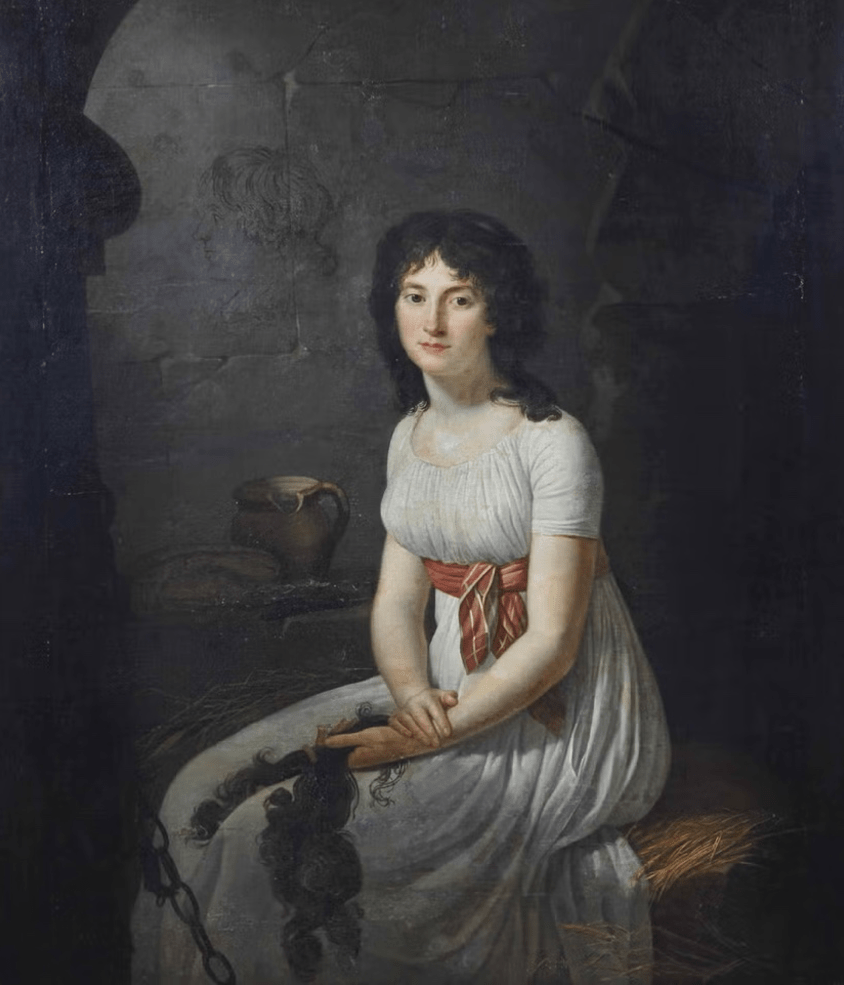
The Jean-Louis Laneuville portrait, exhibited at the Salon of 1796, was itself a political act. Convention demanded that a woman’s hand hold flowers, needlework, a child’s fingers—an insistence that she belonged to the home, the nursery, the domestic sphere. Tallien’s hand holds her severed hair. What should have signified femininity signifies instead near-execution.
She had already tried the direct approach—publishing an address to the National Convention in 1794 arguing that citoyenne, the female title of “citizen,” should signify real civic standing. As she noted, women were called citizens yet possessed none of the rights of citizenship. When argument failed, dress became her answer.
The Greeks had a word for what she was: kaloskagathos—beautiful and noble. The aristocracy had long claimed it as their birthright. Tallien, a Spanish commoner who emerged with nothing to her name, embodied it more fully. She put style in the service of eros—clothing an astonishing self-possession in radically new Parisian elegance. Eros is not simply desire. It is the pull toward the good made visible. Where Robespierre’s virtue demanded the erasure of the individual, eros made the individual radiant. Robespierre prosecuted such influence as a crime. He was not wrong about what it was. He was wrong about what it meant.
This is what beauty looks like when it becomes the only political speech available to you.
The Revolution had not changed women’s position: no vote, no legal standing, no civic participation. By 1793 they were excluded from citizenship. What remained was dress—left agentive precisely because Revolutionary officials had aimed their sartorial legislation at men.
Fashion, dismissed as trivial, became a weapon of the weak. Tallien and her circle dismantled aristocratic style’s architecture—the boning, the brocade, the towering coiffures.
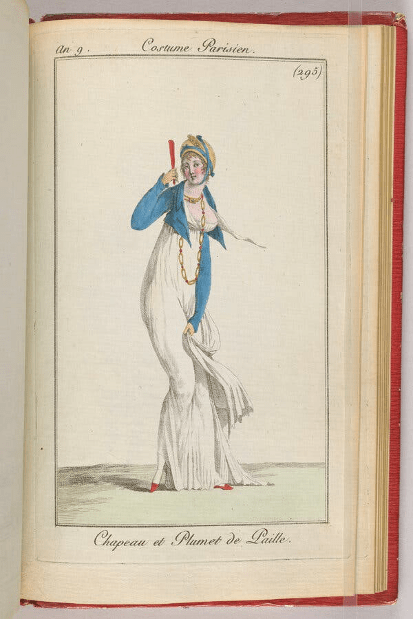
Photograph by Janny Chiu
Singular as she was, multiplicity made the statement.
The women who followed her—the Merveilleuses, the Marvelous Ones—wore red ribbons at the throat. Their scarlet marks of survival, worn exactly where the blade had fallen. Bare necks, exposed. White muslin, even in winter. Tallien’s portrait by Laneuville was pulled from the Salon within days; one reviewer recast her severed locks as the hair of the princesse de Lamballe, the aristocrat brutally murdered by the Paris mob during the Revolution. The critic didn’t dismiss her image—he confiscated it. Her most potent symbol of self-possession, the proof that she had survived, was reassigned as a relic of aristocratic martyrdom.
Visibility had been her weapon; soon it became her exposure. She bore eleven pregnancies and unapologetically raised nine surviving children by four fathers. If a woman dressed like Térézia Tallien, might she begin to live as she did?
In 1932, a New York Times reviewer assessing Sidney B. Whipple’s Scandalous Princess: The Exquisite Theresia Cabarrus arrived at this:
“Brains in the sense of a startling intellect she had none, but beauty beyond compare and a heart that beat warmly and generously for every creature in distress. And that she inspired distress in the heart of every man who saw her seems to be the consensus of opinion of historians.”
The woman who told Robespierre she would rather die twenty times was remembered instead for the distress she caused in men. Beauty was her speech, and history rarely forgives women who speak it.
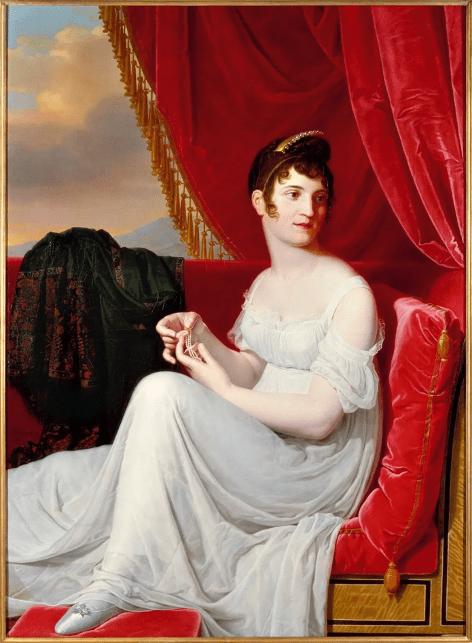
Brooklyn Museum, New York
Jean-Bernard Duvivier painted her in 1806, her hand—Higonnet notes—“absentmindedly toying with a triple-strand pearl bracelet,” in command of her own dress rather than commanded by it. If the chemise had been testimony, then here is the aftermath: a sprezzatura so complete it no longer requires a witness. Like the scarlet letter itself, the mark of shame has been fully transmuted into an emblem of grace. The weapon had not disappeared; it had been refined into an identity. The chemise outlasted the Terror. What is dismissed as decoration is often what endures, precisely because it is not policed. The powerful have always underestimated it. Tallien did not.
Further Reading
Feld, Rose C., ‘An Amazing Woman of the Time of the Directoire’, New York Times, 31 July 1932. [Review of Sidney B. Whipple, Scandalous Princess: The Exquisite Theresia Cabarrus]
Freund, Amy, ‘The Citoyenne Tallien: Women, Politics, and Portraiture during the French Revolution’, The Art Bulletin, 93.3 (2011), pp. 325–344.
Hawthorne, Nathaniel, The Scarlet Letter (Boston: Ticknor, Reed and Fields, 1850).
Higonnet, Anne, Liberty, Equality, Fashion: The Women Who Styled the French Revolution (New York: W. W. Norton, 2024).
Cage, E. Claire, ‘The Sartorial Self: Neoclassical Fashion and Gender Identity in France, 1797–1804’, Eighteenth-Century Studies, 42.2 (2009), pp. 193–215.
 Bluestocking Oxford