By Julia Ledesma
The trailer for You Can See Everything (2026) looked like a horror film. Disgraced Theranos founder Elizabeth Holmes had invited cameras into her life thirty-four days before imprisonment. Somehow, filmmakers Nathan Fielder and Lance Oppenheim had kept their documentary secret for years. Holmes describes learning to let others see her cry, her disputed baritone steady as a tear traces her cheek. Eerie in its on-cue accuracy. Surely this was a dramatisation? It wasn’t. Except, partly, it was.
We meet her in a rented beach house with her partner Billy Evans and their two children. Standing on the shore with her family, she texts Fielder: “Fyi you can totally see everything …” Sitting on a bed with him, she speaks of her awe at the ocean: “Come jump in with me.” The proposition is almost indecent.
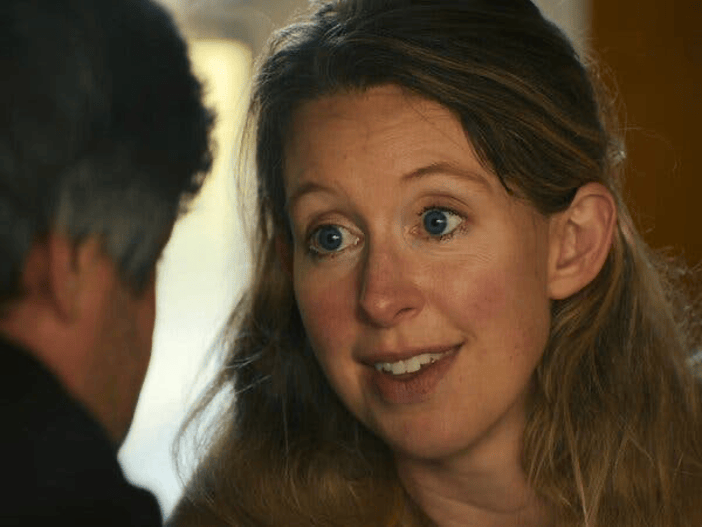
And so I studied the close-ups. I took that as the assignment. The camera brought me almost as uncomfortably close to Holmes as Fielder himself. The two seemed practiced at schooling the features that involuntarily give us away. I searched for a tell, trying to recall what I knew of microexpressions. Holmes holds Fielder’s gaze; he holds hers. Neither relents. Neither seems particularly eager to.
There is a peculiar delight in becoming the authority ourselves. Reality television has made a genre of it: the rich and famous grant us access, and we grant ourselves the right to judge. To peel back the layers, to see someone at the source, in her natural habitat. Or what passes for one when cameras arrive.
Simone de Beauvoir understood this appetite. In The Second Sex (1949), she describes the convenience of feminine “mystery”: a man makes his failure to understand a woman a property of hers. How flattering to his judgment. What if our fascination with Holmes tells us less about her mystery than about those determined to explain her?
Forbes once named her the world’s youngest “self-made female billionaire”. Female marked the exception; self-made obscured the machinery of credibility behind her. Her femininity did not explain her fraud. It shaped the stories we told about it.
A brief accounting. In 2004, Holmes dropped out of Stanford to pursue Theranos, the company she had founded at nineteen on the promise of blood tests from a finger prick. By 2014, the company was valued at $9 billion. Its board included former US secretaries of state Henry Kissinger and George Shultz, alongside retired Marine general James Mattis: men accustomed to matters of national importance, though not blood diagnostics. Her secret romantic partner, Sunny Balwani, nearly two decades her senior, became president and COO. In 2015, Wall Street Journal reporter John Carreyrou, aided by former employees Tyler Shultz—George’s grandson—and Erika Cheung, revealed that most tests ran on other companies’ machines. Convicted of defrauding investors in 2022, Holmes entered prison in 2023. She and Balwani were ordered to pay $452 million in restitution.
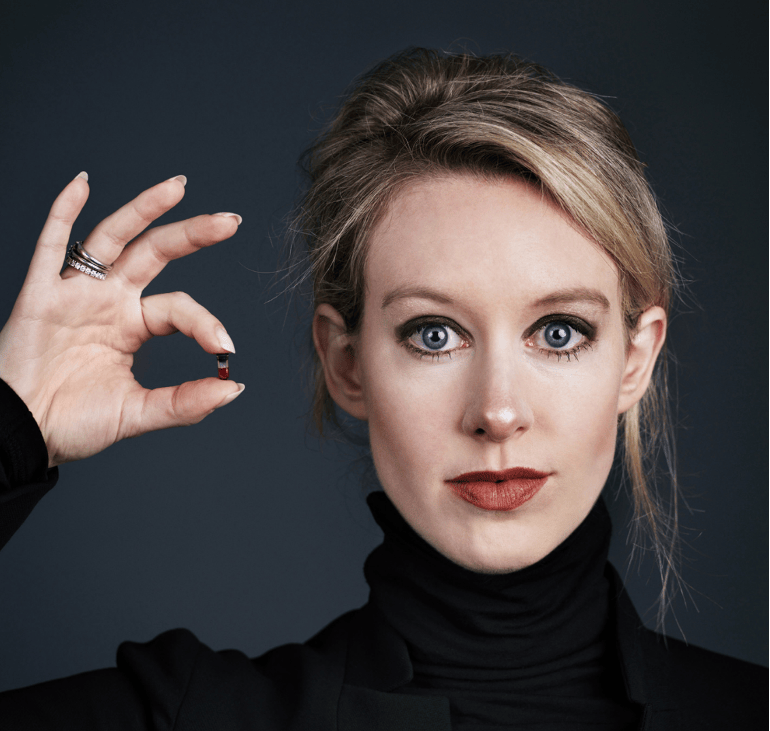
Authority has its stagecraft: the podium, the slides, the voice. We dress the part: the first item in the fake-it-till-you-make-it starter pack. Some might call it manifestation. Holmes wasn’t dressing to be desired. Was that what we expected of a woman seeking power? She was dressing to be believed.
The black turtleneck had already belonged to the existentialist, the artist, the intellectual. Steve Jobs adopted it as a personal uniform. So did Holmes.
The improbable baritone. Videos cited as evidence of its calculated change. Her immense blue eyes with their unblinking stare. Tyler Shultz described her voice as “hypnotic”. Carreyrou thought she was “playing a role”, that “part of it wasn’t genuine”.
Not genuine? What are the sincerities of Mark Zuckerberg? We called him a robot for his blank stare; Holmes’s becomes a theory of how she seduced powerful men. To explain her power over men, we reach for the language of enchantment. A spell is easier to believe than a choice. Or, less embarrassing.
Holmes understood the language of authority that powerful men already recognised. She was chameleonic in her ability to inhabit their expectations and adept at turning them to her advantage. They, in turn, lent her something no performance alone could supply: their credibility.

George Shultz helped recruit the company’s directors, friends among them. When his grandson Tyler raised concerns, George defended Holmes. Tyler later urged him to help those friends step down. But for George, to reconsider Holmes was to question his own judgement and that of the men who had taken his word. The fraud was hers; the credibility was theirs.
Why are we so fascinated by a woman’s power over men, and so much less curious about the power these men conferred upon one another?
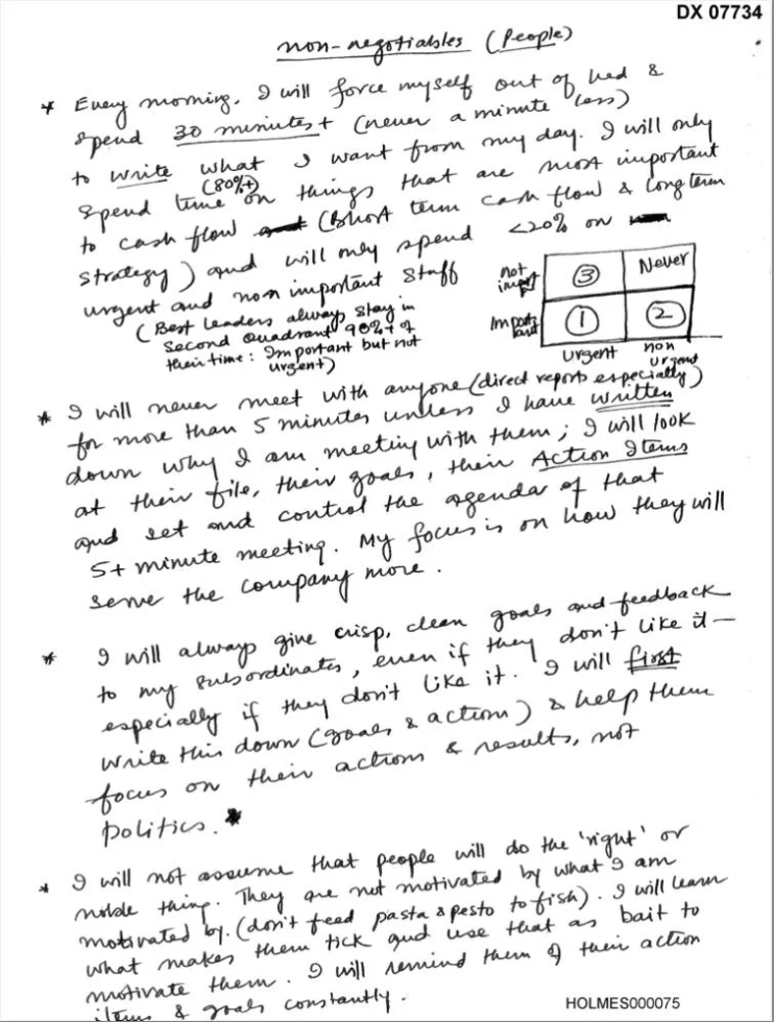
In 2021, Holmes testified that Balwani had abused and controlled her; he denied the allegations. She produced handwritten instructions she attributed to him and said he told her to kill the person she was and become a “new Elizabeth”. He considered her too feminine, she said, and wanted her to behave more like a man in business.
Evans, her current partner, says he holds power of attorney. He posts online in her name and has explored making an AI likeness of her publicly available. When Fielder raises the prospect of sexual deepfakes, Evans treats them as inevitable.
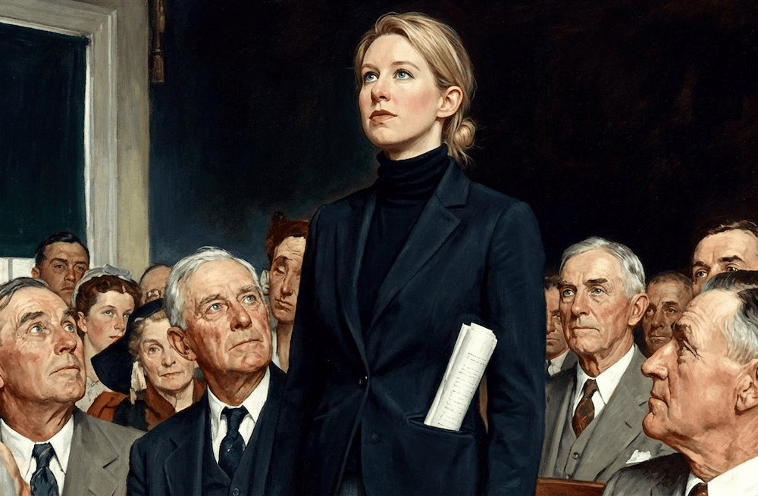
Yet Holmes is not merely someone being spoken for. “The world believes a reality about me that isn’t true,” she tells Fielder. Holmes approached A24. She and Evans invited the crew in under the promise of “radical transparency”, hoping to correct that account. But the director’s cut is what the rest of us get.
We see Holmes breastfeeding, crying, caring for her children. In the boardroom, men supplied her credibility. In the living room, are women expected to supply her sympathy? Midway through, another woman states, “No woman wants to see a woman being controlled by that kind of guy.” Holmes later finds it pretty fucked up that one woman would perpetuate what she considers lies about another. The same appeal, opposing demands: concern on one side, loyalty on the other. As a woman, which am I supposed to offer?
The next morning, listening to the New York Times podcast Hard Fork, I heard another woman preface her observations with her sex. Caitlin Roper, who had interviewed Holmes for Wired before the fall, spoke of “watching this as a woman” and trying to toggle between questions: “Is this real? Do they think it’s real? Do real people talk like this to each other?” Then, considering Holmes’s dual romantic and business partnerships: “Why is she picking these guys?”
A man might have asked every one of Roper’s questions without announcing that he was watching as a man. Perhaps that is what it means to occupy the default.
Holmes’s assurances were believed when they needed verification; now that her actions are documented, we still search for someone who can explain the woman herself. For all our detective work, we reached the same conclusion, which was not a conclusion at all: What on earth did I just watch? How readily our bewilderment at the film becomes further evidence of the enigma of Elizabeth Holmes. Even Tyler Shultz, before he blew the whistle, imagined there must be “some locked door somewhere where the technology really is.” The investors thought they saw something. So did the board. So did the journalists who initially celebrated her. Now we come looking for something ourselves.
Theranos’s directors had a more ordinary responsibility: to establish whether her blood tests worked. We needn’t determine whether her tears are sincere to examine what her company did. Mystery becomes convenient where scrutiny might have sufficed. A woman can be wronged and do wrong.
A costume is not competence. A famous name is not due diligence. Access is not knowledge. We have a conviction. Throughout the film, Holmes maintains her innocence. “I know I didn’t commit any crime.” “I’m not guilty.” “I’ve never tried to deceive anyone.” What we still seem to want is a conversion: not merely an admission of wrongdoing, but a change in the story by which she understands her actions.
Perhaps she still sees herself as a visionary working for humanity’s good. In the hero’s narrative, the hero may not be the only one making sacrifices. She need not relinquish her belief that the original mission was good to accept that her actions were wrong. What she would have to relinquish is the belief that the goodness of her intentions justified those actions.
We know what Holmes did. What is it, exactly, we’re still trying to uncover?
Further Reading
Simone de Beauvoir, The Second Sex, trans. Constance Borde and Sheila Malovany-Chevallier (Vintage, 2011; first published 1949)
John Carreyrou, Bad Blood: Secrets and Lies in a Silicon Valley Startup (Alfred A. Knopf, 2018)
Merve Emre, ‘The Female Sociopath’, Digg, May 2014 https://digg.com/2014/the-female-sociopath
Nathan Fielder and Lance Oppenheim (dirs), You Can See Everything (A24, 2026) https://a24films.com/films/you-can-see-everything
Max Read (host), ‘Why No One Can Look Away From Elizabeth Holmes’, Hard Fork, The New York Times, 16 October 2026 https://www.nytimes.com/2026/10/16/podcasts/hardfork-elizabeth-holmes.html
Tyler Shultz, ‘Inside Theranos with ex-Employee Tyler Shultz’, interview with Carolynn Levy and Jessica Livingston, The Social Radars, Y Combinator, YouTube, 11 November 2026 (originally released as a two-part podcast, 27 November and 4 December 2024) https://www.youtube.com/watch?v=iXWSYlAX5Lg

