By Sara Álvarez Carpintero
As the daughter of Spanish rulers Alfonso VI of León and Constance of Burgundy, Urraca was born around 1079, at a time when her father’s monarchy was undergoing a period of expansion and consolidation. Her status as the king’s legitimate daughter allowed her to receive an education appropriate to her rank and to participate from an early age in the political strategies of the dynasty. However, her position as a woman in a society deeply shaped by power would condition both her access to and exercise of political authority.
Her first marriage to Raymond of Burgundy, who died in 1107, was also of great political importance, as their union produced Alfonso Raimúndez, the future Alfonso VII. A year later, in 1108, her half-brother Sancho Alfónsez, heir to the throne, died at the Battle of Uclés. Following the death of her father, Alfonso VI, in 1109, Urraca became the legitimate heir to the thrones of León and Castile and, consequently, one of the first women to exercise royal power in her own right in medieval Europe.
Her accession to the throne was far from straightforward, as it was marked by numerous political conflicts, including threats and clashes with the Almoravids, a North African Muslim dynasty that expanded into the Iberian Peninsula during the late eleventh and early twelfth centuries, as well as family disputes and difficulties in exercising her authority in a society where political and military power was largely held by men.
In this context, and with the aim of strengthening her position and ensuring the stability of the kingdom, her second marriage to Alfonso I of Aragon, known as “the Battler,” was arranged. The union was intended to strengthen the power of both territories and provide greater political stability, but significant disagreements soon arose between the two monarchs. Differences over the exercise of power and their respective rights over the territories of the Crown meant that, rather than resolving Urraca’s difficulties, the marriage generated new tensions and conflicts that further complicated her rule. Added to this were the resistance of part of the nobility and other groups who questioned her ability to exercise power simply because she was a woman.
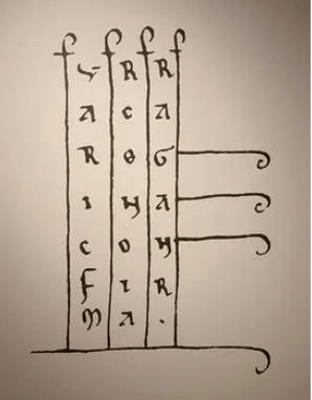
Urraca therefore not only had to exercise power, but construct an image that would make her authority as queen recognizable to those who sought to limit her ability to govern. In the Middle Ages, a monarch’s authority depended not only on territorial control or command of armies; it was also essential to communicate and reinforce a particular image of power. Royal documents constitute one of the main sources through which we can approach this question. For this purpose, Urraca appears using formulas and titles intended to express her authority. Among them, the expression Totius Hispaniae Regina et Imperatrix, meaning “Queen and Empress of All Hispania,” stands out. The use of this title is significant because it presents Urraca’s authority as extending beyond a single kingdom, associating her sovereignty with the broader territory of Hispania. By describing herself as both Regina and Imperatrix, Urraca projected an image of elevated political authority and asserted her position as a sovereign with ambitions that transcended the limits of her own kingdom.
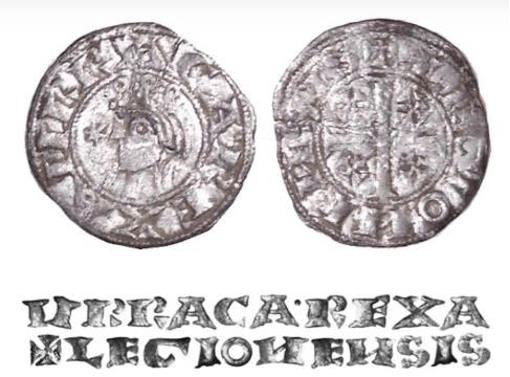
Queen Urraca’s interest in the representation of her power is reflected in the extensive numismatic production during her reign, which began in July 1109 and lasted until March 1126, during which the issuing of coinage played a fundamental role. This production can be divided into four main categories: marital coinage; co-reign coinage; concessionary coinage; and, finally, royal coinage. To study Urraca’s representation, the royal coins are particularly important for understanding Urraca’s iconographic representation, as they were issued during her reign and display different forms of representing the queen, each charged with symbolic meaning.
The way in which she herself inscribed her name on many of these coins is also particularly significant, using formulas such as VRRACA RE or VRRACA REXA, as feminine Latinisations of the term Rex, which had already been used by previous sovereigns. This once again, demonstrates the power exercised by a woman who performed functions traditionally associated with male authority. Within this numismatic corpus, Queen Urraca’s bust generally appears in profile, adorned with a veil and a crown, while the circumference of the coin itself is used as a halo, a highly distinctive feature. This is not merely an aesthetic matter: every image, every title, and every document formed part of a strategy of legitimisation.
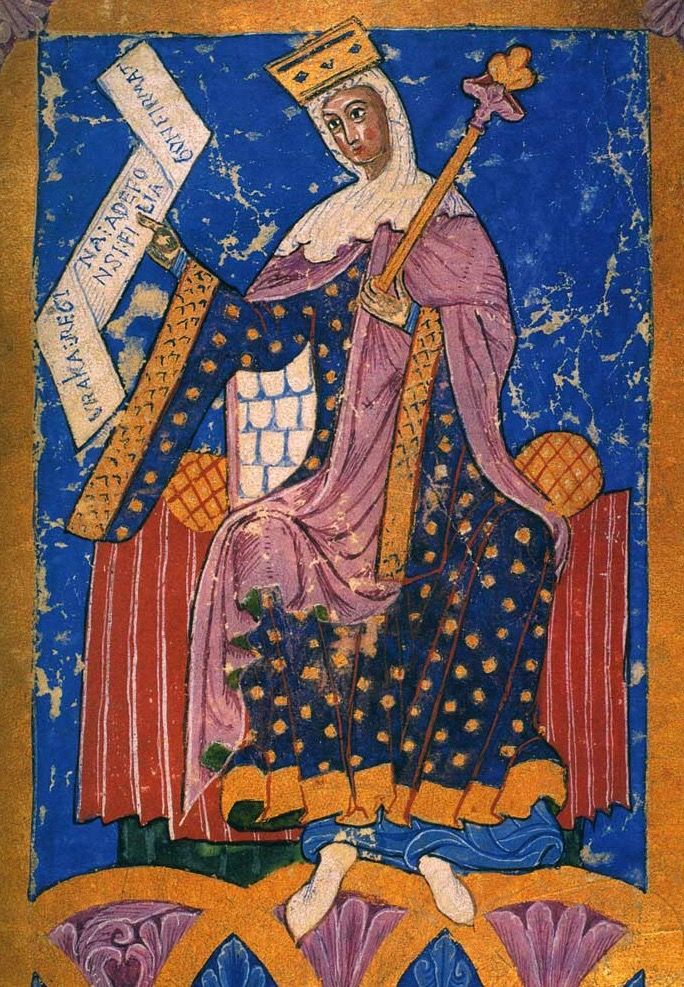
The properties and donations granted to the Cathedral of Santiago de Compostela contributed to the inclusion of Queen Urraca I’s effigy in the prestigious Tumbo A, a cartulary produced a decade after the queen’s death. It is the most famous representation of the sovereign, portraying her as a figure of high renown alongside the other Spanish rulers.
The sovereign appears enthroned and adorned with a golden crown with a crenellated-trapezoidal profile, resting over her veil and reflecting her status as a married or widowed woman. She wears a long, colourful animal-skin tunic, a garment commonly reserved for kings. A purple mantle is draped over her shoulders, a colour that evokes the imperial tradition and the royal majesty of her figure. At the same time, the extensive use of lapis lazuli blue in the background and tunic, combined with gold and purple pigments, highlights the sacredness and richness of the illumination.
Her authority is further conveyed through symbols such as the famous Virga Virtutem, or rod of authority, which she holds in her left hand. In her right hand, by contrast, she holds an unfurled manuscript bearing the text VRRACA REGI[NA] / [ALDEF]ONSI FILIA / CONFIRMAT (“Queen Urraca, daughter of King Alfonso, confirms”). This element functions as a symbol of the queen’s legislative and diplomatic authority, validating the donations and privileges granted to the Church of Compostela.
Urraca’s death in 1126 brought an end to a turbulent reign, but not to her historical significance. Her son, Alfonso VII, inherited the throne and continued the dynasty. For centuries, the memory of his mother remained linked to a particularly complex period in the history of the Iberian Peninsula, and her figure was interpreted in very different ways.
Today, the study of Urraca allows us to approach a fundamental question: how was it possible for a woman to exercise and demonstrate authority in medieval society? Her reign is a testament to the fact that women were not passive figures within medieval political structures. Although they had to navigate a system deeply shaped by male power relations, some women attained positions of great importance and developed their own mechanisms to defend their legitimacy. Urraca I of León was one of them.
The story of her life was shaped by wars, marriages, family conflicts, and struggles for power, yet another narrative exists in the documents, coins, and representations that allow us to reconstruct the image she sought to project as a sovereign. More than nine hundred years after her death, these testimonies continue to raise questions. And perhaps this is precisely where Urraca’s interest lies: far from being a secondary figure of the Middle Ages, the documentary traces she left behind allows us to look closely at how a woman claimed the exercise of power for herself during one of the most complex periods in the history of León.
Further Reading
Boto Varela, G., & Moráis Morán, J. A. (Coords.). (2026). Reina ella. Urraca I de León (1109–1126): Catálogo de exposición Museo de León (6 marzo–7 junio 2026). Ayuntamiento de León. https://dialnet.unirioja.es/servlet/libro?codigo=1027466
Mozo Monroy, M. (2026). Cara y cruz. Monedas de Doña Urraca (1109–1126). En G. Boto Varela & J. A. Moráis Morán (Coords.), Reina ella. Urraca I de León (1109–1126): Catálogo de exposición Museo de León (6 marzo – 7 junio 2026) (pp. 173–188). https://dialnet.unirioja.es/servlet/articulo?codigo=10743077
Mozo Monroy, M. (s. f.). Memorial de moneda medieval. https://manuelmozo.com/
Roma Valdés, A. (2016). Notas sobre las acuñaciones medievales leonesas: primeros escritos conocidos y las emisiones de Doña Urraca. Revista Numismática OMNI, 10, 56–73. https://dialnet.unirioja.es/servlet/articulo?codigo=5663320

