By Maisie Corkhill
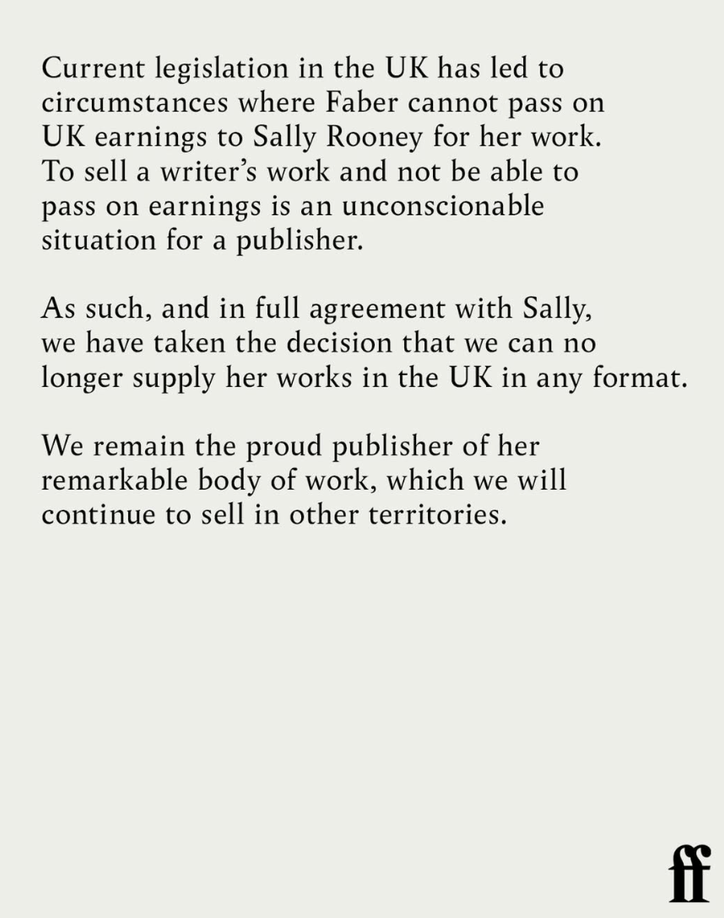
What does it mean when a highly popular author of mainstream books is pulled from sale? Usually, the removal of books signals something significant: state repression, religious disapproval, legal cases. In the weeks since Faber & Faber’s announcement that it would be pulling Sally Rooney’s books from the UK market due to UK legislation, some news outlets and political groups have reported this as a case of ‘direct or indirect’ censure. Rooney’s publishing house have been put in an ‘unconscionable’ position, as they put it, of not being able to pass UK earnings on to their author. If they pay Rooney her earnings from the UK, they may be criminally liable under the Terrorism Act 2000, which was used to proscribe the group Palestine Action on 5th July 2025. After this date it became ‘illegal to be a member of, or to invite support for, Palestine Action’ (UK Parliament). Rooney has already breached this legislation: not, in her Guardian opinion article anticipating the proscription, which she concluded, ‘I admire and support Palestine Action wholeheartedly — and I will continue to, whether that becomes a terrorist offence or not’. Rooney became liable when she published a piece in The Irish Times, pledging to donate earnings from her books, including royalties, and residual payments from the BBC adaptations of her novels to ‘support Palestine Action and direct action against genocide’.
Rooney’s novels are not overtly political. They are concerned with the messy entanglements of love, intimacy and friendship between young people in contemporary Ireland. Rooney describes herself as a Marxist, and tensions of class, property, and capitalism are all there in her books, just lingering beneath the surface of her primary subject: relationships. She has long been outspoken on Palestine. In 2014, she protested in Dublin against Israel’s illegal military operations in Gaza. In an interview with activist Samir Eskanda, Rooney said ‘that moment of horror and outrage was a formative experience for me, as a person and as a writer’. That outrage found its way into her fiction, as she included a scene set at the same protests in Normal People (2018):
“They went to a protest against the war in Gaza the other week with Connell and Niall. There were thousands of people there, carrying signs and megaphones and banners. Marianne wanted her life to mean something then, she wanted to stop all violence committed by the strong against the weak…”
The difference in Rooney’s political position now is that she has moved from vocal support into direct political action by pledging money to a proscribed group. And while we cannot know that either Rooney or Faber & Faber would have actually been charged under the UK legislation – because the UK Government would then have had to decide whether to explicitly practice artistic censure – Rooney’s direct action has brought the legislation under scrutiny. It has become a major news story, a site of public outcry and condemnation. Rooney’s position has also received heated criticism, particularly from the right-leaning press. Hostile articles have been published, several from The Spectator, which follow these general lines: Rooney has manufactured a situation where she is self-censoring to prove a point, and more broadly to achieve the political action that is otherwise lacking in her art.
It seems that when an author’s fiction is not explicitly political, their decision to take a political stance provokes some outrage. This is an oddly one-dimensional way of thinking, a kind of logical fallacy in which art becomes synonymous with its creator, and the writer’s work is required to serve as a complete and unambiguous expression of their politics. The perceived discrepancy between Rooney’s art and her politics has become a clear target. In one of the more measured critiques published since Faber’s announcement, Sam Leith calls it ‘simply absurd’ that Rooney’s support for Palestine Action ‘should deprive British readers of her novels about angsty teenagers getting it on in Dublin’. Leith seems particularly pleased with his ‘angsty teenagers’ phrase, using it twice in the article, despite the fact that the majority of Rooney’s characters are in their twenties or thirties. Even as writers such as Leith concede that the legislation Rooney faces is flawed, they mock the triviality of her artistic work. As if it were not these novels – with their mainstream appeal – that explore the universal experience of love, loss, and the spaces inbetween, that made us care about what Sally Rooney had to say in the first place.

In 2023 The Guardian published a conversation between Rooney and British-Palestinian author Isabella Hammad, who had been corresponding over email for several weeks about the Israel-Palestine conflict. The two writers discuss the relationship between artistic work and political resistance, and the role artists and intellectuals might play at a time like this. Hammad honours the difficulty: ‘violence can make art-making seem quite futile and feeble, something easily crushed’. It is easy to feel useless, she writes to Rooney, ‘and from there it’s a short leap to despair. But I don’t believe we can afford to despair, nor do I think despair is ethical’. It is difficult not to despair when the atrocities we witness continue to evade language. Rooney describes the footage from Gaza, live-streamed to our phones, as so inconceivable it almost has a fictionality to it. ‘How is it possible to describe such a scene?’, she writes, ‘as if it’s happening in a film or a novel; as if I’m trying to tell you about something I’ve seen in an episode of a television show. But this is our world, the world in which soil is shovelled over the unmarked bodies of the dead.’
The exchange between these two writers, which is itself a work of political art, answers its own question. We want to hear from writers of fiction, artists, speaking out on political issues because they find language for what seems incomprehensible. They approach issues with both political nuance and artistic empathy. After all, the humanities train us not only to think critically, but to extend grace to the other even as the prevailing discourse seeks to dehumanise them. Hammad writes in the final message of the exchange: ‘talking and thinking as clearly as we can, even as we understandably do not feel cool-headed, is so important, it is our responsibility, when the politicians are telling the public that this is too complicated to understand. They are lying.’
Formally, the email exchange between Rooney and Hammad is reminiscent of another exchange, between two of Rooney’s protagonists in Beautiful World, Where Are You? (2021). This novel marked a turning point in the public scrutiny of Rooney’s politics. That year, she refused to sell the Hebrew translation rights to the Israeli publisher, Modan, having become aware of its ties to the Israeli military. In line with the Palestinian-led Boycott, Divestment and Sanctions (BDS) movement, which seeks to withdraw ‘ideological, commercial and material support from Israel’s apartheid regime’, Rooney rejected the deal. This decision prompted accusations of antisemitism, and two of Israel’s largest book chains pulled her work from the shelves. Given the close ties between Israeli state and cultural institutions, this comes much closer to an actual state-sanctioned book ban than the current case in the UK. From Rooney’s side, it was never a question of withholding her work from Israelis: this year she announced that she was pleased her novel Intermezzo (2024) would be translated by a BDS compliant Israeli publisher (November Books).
Rooney’s style of political writing and her fiction are not far removed. Her emails to Hammad retain the spare, unadorned prose of her novels and similar moments of brutal candour. In Beautiful World, Where Are You, about half of the narrative is taken up by emails between Alice (a successful author and apparent stand-in for Rooney) and her best friend Eileen. They discuss the state of the world generally, touching on the exploitation of the third world for Western consumerism and whether meaningful political action is still possible. The book does not mention Palestine, but it asks a question that has become more pressing in the years since its publication: what is the role of fiction in the face of historical atrocity?
Alice argues that the contemporary Euro-American novel depends on suppressing the lived realities of most of humanity: asking, how can we care whether fictional protagonists break up or stay together when their lives unfold against a backdrop of increasingly brutal global exploitation? The novel works, she argues, ‘by suppressing the truth of the world — packing it tightly down underneath the glittering surface of the text’. Eileen challenges her that despite the veritable hellscape that surrounds us, it is the human condition to want to return again and again to our relationships. It may seem ‘vulgar, decadent, even epistemologically violent’, she writes, to invest in ‘the trivialities of sex and friendship when human civilisation is facing collapse. But at the same time, that is what I do every day’. The two positions are not mutually exclusive, we realise as Rooney’s book unfolds. You can be horrified at the state of the world and still care about the intimate lives of fictional characters.
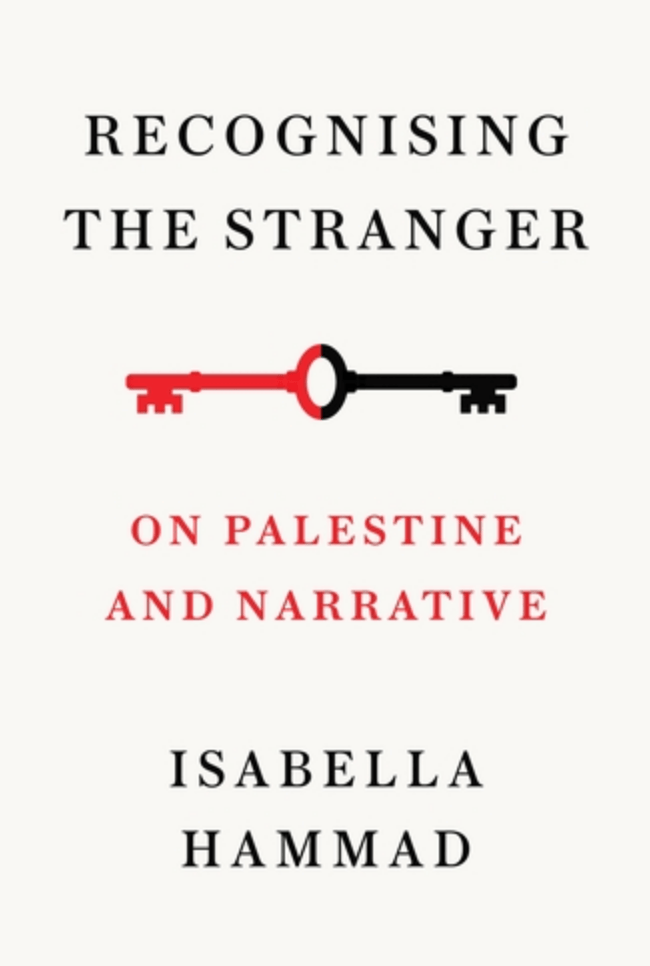
The tension Rooney presents here in her third and most politically experimental novel finds a parallel in Isabella Hammad’s comments on narrative in her Edward W. Said Memorial Lecture, Recognising the Stranger (published 2024). Hammad spoke about how narrative shapes our understanding of history: how we identify turning points, moments of recognition (anagnorisis), and that we often conceive the true meaning of events only in retrospect. Drawing on the legacy of Said, Hammad examines the relationship between the European literary tradition and imperial power, while defending the possibility, in the novel, of a ‘humanism that can evolve and expand beyond its exclusionary origins’. Like Alice, Hammad is troubled by what novels can actually do in the world. She describes the novelist as having a ‘split consciousness’. On the one hand, novels are commodities, produced and marketed for entertainment: at the same time, they play a role in what Hammad calls ‘our spiritual lives’. They offer the opportunity for concentrated attention away from our screens and allow us to think deeply about the lives of others.
Rooney is acutely aware of the line between art and commerce in her fiction. She also speaks (through Alice) on the unwanted fame of the author who is catapulted to the position of public figure through their work. This, of course, is what happened to Rooney herself. Now she is criticised for writing novels that are not ‘political enough’ to earn her the right to make political statements. Hammad offers a different way of thinking about the relationship between fiction and its consequences. Drawing on Sylvia Wynter, she writes that the novel is a revolutionary form because ‘it is in essence a question mark’. Perhaps, Hammad suggests, ‘a writer doesn’t have to have a clear sense of what her text will do in the world’.
Rooney, however, is in a position to see what her novels have done in the world. They have given her a platform from which to speak politically, and she is using it. Authors often write on what they know, what falls within the scope of their own experience. Rooney writes her novels (so far) on the social dynamics of young people in Ireland. Isabella Hammad, with her Palestinian ancestry, writes about historic and contemporary issues in Palestine. Her first novel, The Parisian (2019) follows the life of her great-grandfather, Midhat Kamal, and Palestinian experience before the foundation of Israel. Her second, Enter Ghost (2024) follows a production of Hamlet in the occupied West Bank. It felt like one of the most important books I had ever read. But the problem here is that people reading Hammad’s books, exceptional as those books are, have most likely already made up their minds about Israel-Palestine. Hammad is an equally talented and acclaimed writer, but she does not have Rooney’s fame.
This brings us to the contested ground of the mainstream, of popular appeal, and the power it holds. In The Gaza Tribunal, to which Rooney contributed the Afterward, Jeremy Corbyn writes ‘for many, the recent horrors in Gaza have been the first time they have even heard of Palestine, let alone demonstrated for its freedom’. The news about Rooney’s censure – whether censure or not – may offer a moment of recognition to those who read her books but had not considered where they stand on Palestine. Rooney is wise enough to know that the decisions surrounding her authorship are political. She said in a recent interview: ‘whereas once I worried that the mainstream popularity of my work was in itself politically limiting, now I can feel purely proud and happy that my books continue to be popular among a mass readership’. Personally, I do not know how anyone could remain ambivalent about what we have witnessed in Gaza. But that is the all-important, contested ground: normal people whose opinions may only now be swayed because they want to find out why they can no longer buy Sally Rooney’s books.
Further Reading
Sally Rooney, Beautiful World, Where Are You? (London: Faber & Faber, 2021)
Isabella Hammad, Recognising the Stranger: On Palestine and Narrative (London: Penguin, 2024)
Corbyn, Gordon & Hammouri, with an afterward by Sally Rooney, The Gaza Tribunal: Britain’s Complicity in Genocide (London: Pluto Press, 2026)
UK Parliament, Palestine Action: Proscription, https://hansard.parliament.uk/commons/2025-06-23/debates/25062337000014/PalestineActionProscription
BDS: ‘Boycott, Divestment, Sanctions (BDS) is a Palestinian-led movement for freedom, justice and equality. BDS upholds the simple principle that Palestinians are entitled to the same rights as the rest of humanity.’ https://bdsmovement.net/what-bds
Sally Rooney and Isabella Hammad, ‘’The bombs are still falling. My heart breaks every day’: novelists Sally Rooney and Isabella Hammad on the Israel-Palestine conflict.’ The Guardian, 17 Dec 2023. https://www.theguardian.com/books/2023/dec/17/israel-palestine-conflict-sally-rooney-isabella-hammad
Sally Rooney, ‘Israel kills innocent Palestinians. Activists spray-paint a plane. Guess which the UK government calls terrorism.’ The Guardian, 22 Jun 2025. https://www.theguardian.com/commentisfree/2025/jun/22/israel-palestine-action-uk-government-terrorism-sally-rooney
Sally Rooney and Samir Eskan, “Sally Rooney on a new Hebrew translation of Intermezzo: ‘The Israeli culture sector is complicit in apartheid’”, The Guardian, 19 May 2026. https://www.theguardian.com/world/ng-interactive/2026/may/19/sally-rooney-new-hebrew-translation-intermezzo
Sam Leith, ‘The utter absurdity of the Sally Rooney Affair’, The Spectator, 19 October 2026. https://spectator.com/article/the-utter-absurdity-of-the-sally-rooney-affair/

