By Eleanor Davies
Beneath a blog review of Elizabeth Strout’s most recent novel, The Things We Never Say (2026), lies a comment from an anonymous account: ‘Loved the book until the author brought in present day TDS undertones. Stopped reading it and tossed it. Shameful’.
TDS, in this context, stands for ‘Trump Derangement Syndrome’. It is a term used by Trump supporters to describe what they regard as an irrational and disproportionate hostility towards the president. In this respect, the anonymous comment is neither novel nor unexpected. The assumption contained within it, however – that politics has somehow entered the book from elsewhere, interrupting an otherwise enjoyable work of fiction – is striking. There is something wonderfully revealing about the idea that a novel can be enjoyed until the real world intrudes.
Yet what if, in The Things We Never Say, the real world is not an intrusion at all? Strout’s novel takes place in Massachusetts in the run up to the 2024 presidential election, and the political atmosphere of contemporary America is hard to keep at the edges. Ukraine and Gaza enter the conversations of its characters, the pandemic remains a recent memory, and the prospect of another Trump presidency casts its particular shadow over their lives. But this is not, in any conventional sense, a political novel; Strout seems less interested in using fiction to make an argument than asking what happens to an ordinary person when the history around him becomes impossible to ignore.
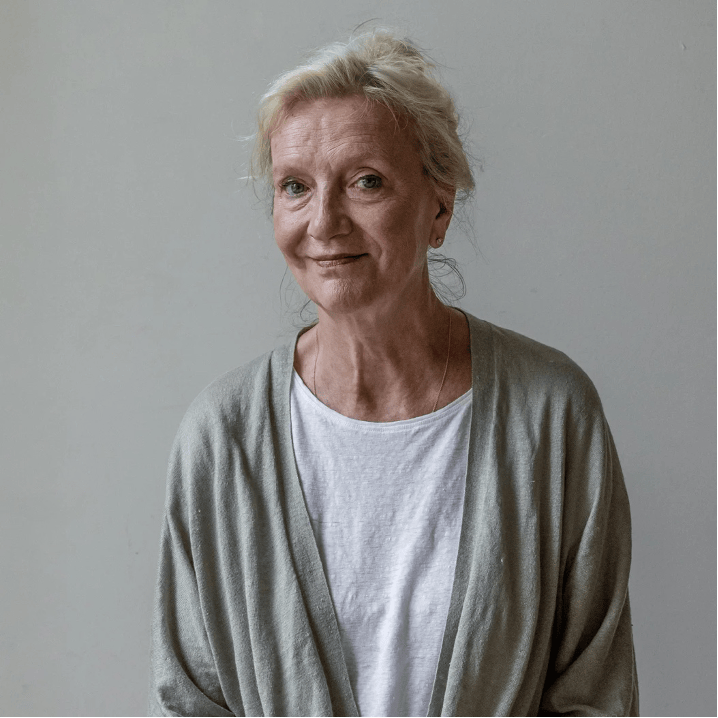
‘I didn’t want it to be a political story,’ Strout has claimed in a recent interview. ‘It’s a personal story about the interior life of this man – I’m always interested in people’s interior lives and how they come banging up against the external world.’
The man in question is Artie Dam, a 57-year-old history teacher whom Strout describes as ‘supposedly quite ordinary’. There is, however, something quietly significant about making a history teacher the centre of a novel concerned with the present. Artie spends his working life explaining how the decisions of individuals and governments acquire consequences far beyond the moment in which they are made. Meanwhile, he is living through a period in which the distinction between history and the present seems increasingly unstable. When he teaches his students about Hitler and the concentration camps, he tells them that ‘the leader of any country is tremendously important’; their decisions can affect ‘very often the entire world’.
The irony is that Artie’s attempts to understand history do not make him better equipped to understand his own moment. If anything, they make him more conscious of its terrifying contingency. Strout is interested in precisely this collision between what is private and what is historical, and it is here that the feminist formulation that ‘the personal is political’ acquires a particular resonance. Rather than turning Artie into a political emblem, Strout demonstrates that there is no private life entirely untouched by the public world. The question is what history feels like when it arrives, not as an abstraction, but in the mind of a husband, a teacher, or a friend.
Strout’s prose is ideally suited to this kind of inquiry because it so rarely announces itself as argument. She has described her style as that of an ‘embroiderer’ – she writes elliptically by stitching distinct moments together, leaving space around what is said and allowing meaning to accumulate in what remains unspoken. Her simplicity is therefore somewhat deceptive; although there may be little discernible ornament on the surface, beneath her writing there is considerable pressure.
The epigraph to The Things We Never Say, from Carl Jung, provides a kind of key: ‘Loneliness does not come from having no people about one, but from being unable to communicate the things that seem important to oneself, or from holding certain views which others find inadmissible’. It is a quotation particularly suited to a novel about contemporary political division. Strout understands that convictions are often most powerful before they become arguments, that they can exist as private certainties or half-formed fears. Her characters are continually trying, and failing, to cross this distance between their inner lives and those of others. ‘So blind we humans are,’ Strout writes, ‘[t]o each other and to ourselves, moving through life as though through shadows, putting out a hand in the dark and thinking we have touched someone’.
The politics of the novel reside partly in that blindness. They are present not only in what people say to one another, but in what they cannot say. In Strout’s fiction, silence is often the place where contradiction, shame, love, and political conviction coexist before they can be made intelligible.
This is perhaps why the election itself is rendered with such starting simplicity: ‘The election came and went. Half of the country was stunned, the other half jubilant.’ The sentence is almost deliberately flat, as though an event of enormous national consequence could be registered only through the shock it leaves behind. What matters to Strout is not the machinery of the election, but its effect upon the way Artie sees the people immediately around him. Looking at his students soon afterwards, he finds that he sees them differently: ‘he could have wept with a simple unadulterated love for them. They seemed innocent in a way that almost floored him.’ The political event has become, almost imperceptibly, an alteration in perception.
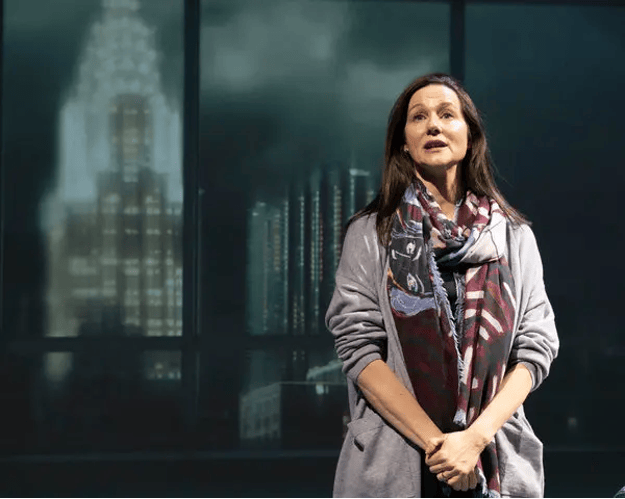
Strout’s concerns, nevertheless, remain quite clear. The novel is deeply troubled by authoritarianism and the fragility of American democracy; it is attentive to antisemitism and to the suffering caused by war; at one point Artie bleakly observes that America is ‘committing suicide’. Yet what is more interesting is Strout’s refusal to simplify the characters who inhabit a moral certainty. Artie discovers, for example, that a friend whom he finds unusually compassionate is a Trump supporter. Elsewhere, he chides his students: ‘Do not ever feel that you are superior to someone else. […] No one is superior to anyone else in this world.’
The statement might initially sound like a straightforward piece of humanist wisdom, but in Strout’s hands it becomes something more demanding. Her characters are permitted to remain contradictory, compromised, and difficult to understand. Rather than asking us to agree with everyone she writes about, she asks us to grant them the privilege of being human. Perhaps it is this refusal to simplify the individual that has always made room in her fiction for the wider world.
In this sense, The Things We Never Say is not quite a new departure for Strout. In Lucy by the Sea (2022), the killing of George Floyd and the storming of the Capitol enter a novel ostensibly concerned with the pandemic. Tell Me Everything (2024) contains an image of America as ‘a huge tractor rumbling down the highway and the wheels, one by one, falling off’. Given the publication of Strout’s novels so soon after the events they comment on, her writing might even be considered a form of journalistic reporting embedded in fiction. Indeed, as the fictional novelist Sarah Payne puts it in My Name is Lucy Barton (2016), a writer’s job is ‘to report on the human condition, to tell us who we are and what we think and what we do’.
There is, appropriately, a moment in The Things We Never Say when politics and art appear to subtly meet. During a conversation about Shakespeare, Artie has the realisation that ‘he had slipped the ties of this world’. It is an image that calls to mind the opening of John Gillespie Magee Jr.’s ‘High Flight’, the World War II sonnet that Ronald Reagan famously invoked when addressing the nation after the Challenger disaster, the 1986 tragedy when a space shuttle broke apart 73 seconds after liftoff, killing all seven crew members:
Oh! I have slipped the surly bonds of Earth
And danced the skies on laughter-silvered wings
The echo may be coincidental, but it is nevertheless intriguing, calling to mind a historical moment in which political language turned to literature for a vocabulary adequate to collective grief. Art can be shaped by politics, certainly, but politics itself has always depended upon stories, metaphors, and inherited forms of expression to give public feeling a shape.
Perhaps this is the reason that the anonymous ‘TDS’ comment is so revealing. The reader who abandoned the novel believed that politics had spoiled something that was, until that point, private and pleasurable. Strout’s achievement, however, is to show why such a division cannot hold. Artie cannot leave the history he teaches at the classroom door, just as he cannot keep the anxieties of his country from entering his marriage, his friendships, or his understanding of his students.
The reader was right about one thing: The Things We Never Say is political. The external world finds its way into interior life because there is, ultimately, nowhere else for it to go. Yet perhaps the most revealing irony is that the novel’s politics lie precisely in its refusal to stop seeing humans as humans. Strout does not tell us that political differences do not matter, but instead asks what it means to live with them. For Strout, politics is not something that enters the personal; it is what the personal has been carrying all along.
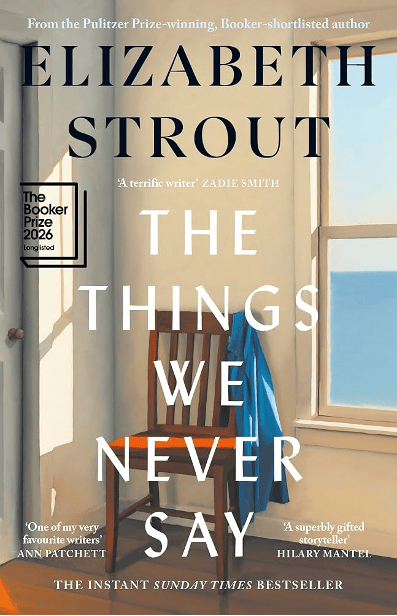
The Things We Never Say by Elizabeth Strout (Random House, £18.99) is currently longlisted for the 2026 Booker Prize
Further Reading
Hanisch, Carol, ‘The Personal is Political’ (1969)
John Gillespie Magee Jr., ‘High Flight’ (1941)
Strout, Elizabeth, The Things We Never Say (2026)
Strout, Elizabeth, My Name is Lucy Barton (2016)
Times Radio, ‘Elizabeth Strout Reveals The Creative Intuition Behind Novel “The Things We Never Say”’ https://www.youtube.com/watch?v=ieQE-KGg0Lc

