By Emily Sceeny
Sound of Falling (2025) is director Mascha Schilinski’s second feature film, one I had initially assumed to be a 149-minute historical drama, only to find an impressionistic and singular experimental depiction of girlhood that has continued to haunt me five months after viewing. In its most basic terms, the film is a non-linear story of four generations of girls, separated by time but inextricably connected by the same farmhouse in northern Germany. This becomes the site that shapes their adolescence, a place fraught with abuse, death, and existential dread. Though spanning from the beginning of the twentieth century to the present day, the film portrays how the girls’ experiences echo one another across generations, suggesting that trauma is not an individual experience but a collective one. Each generation inherits the suffering that precedes it, as trauma transcends the physical and temporal to become a residual mark upon the body, mind, and place.
Meditations on death and freedom in the film evoke comparisons to Sofia Coppola’s The Virgin Suicides, but instead of hazy dream sequences in sun-drenched fields, the fantasies of Alma, Erika, Angelika, and Lenka are underpinned by darkness and violence. In the opening shot of the film, the camera follows Erika in the 1940s as she hobbles on crutches with one leg, while being berated by her father. Yet this is all a game: there is no more struggle as she unties her leg and walks away. Her morbid fascination with suffering continues when she spies on her amputee uncle (the clear inspiration for her game) as he sleeps, tasting his sweat with her finger. Moments later, she hurries outside and is slapped by her father. This bizarre opening sequence perfectly encapsulates the film’s tone – confined, perverse and uncomfortable. Erika, and the rest of the girls at the farmhouse, take a strange interest in the suffering that surrounds them, with this deceptive game being just one instance of visual trickery in the film. The girls’ penetrative curiosity becomes a form of youthful resilience, while their games and performances act as forms of defiance. Reality, imagination, and memory are constantly blurred as their fixation on pain and death represents a form of escapism, a fleeting way to release themselves from male oppression and violence.
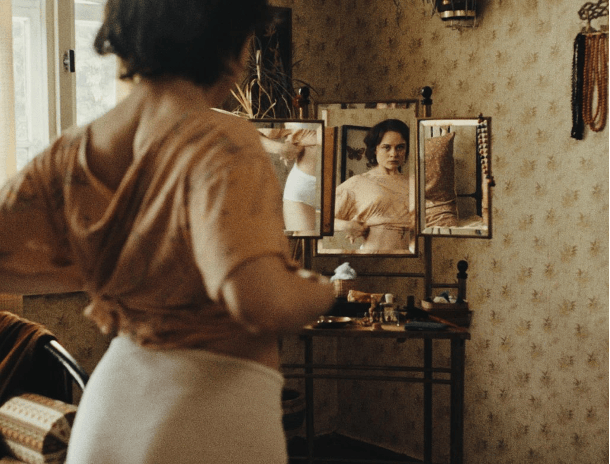
Female sexuality is the most tightly constrained freedom, as the experiences of each generation are repeatedly tainted by the lustful gazes of predatory men. Angelika, living in the farmhouse during the Cold War, is the most explicit victim. She is provocative and openly inquisitive about her changing body, yet her displays of sexuality cannot be separated from the disturbing allusions to her incestuous relationship with her uncle. From their first interaction, his lingering hand on her thigh, it is clear that her youth is being exploited; in one scene, their unsettling proximity is obscured by low lighting as Angelika’s challenging glance is met with her uncle’s salacious stare.
Decades later, twelve-year-old Lenka, the most recent inhabitant of the house, experiences the same invasive looks as she plays in water with younger children: she is ashamed to have noticed a family friend leering at her topless pubescent body. However, Lenka and the other girls repeatedly watch back in an uneasy exchange of looks between the camera and the audience. Angelika even admits this in voiceover as “It was actually me who was secretly watching them look at me”: she is both the object and spectator of the gaze. By breaking the fourth wall, Schilinski grants them a chance to reclaim autonomy; their knowing expressions seem to ask us what we will do after witnessing this cycle of abuse, implicating us in its history.
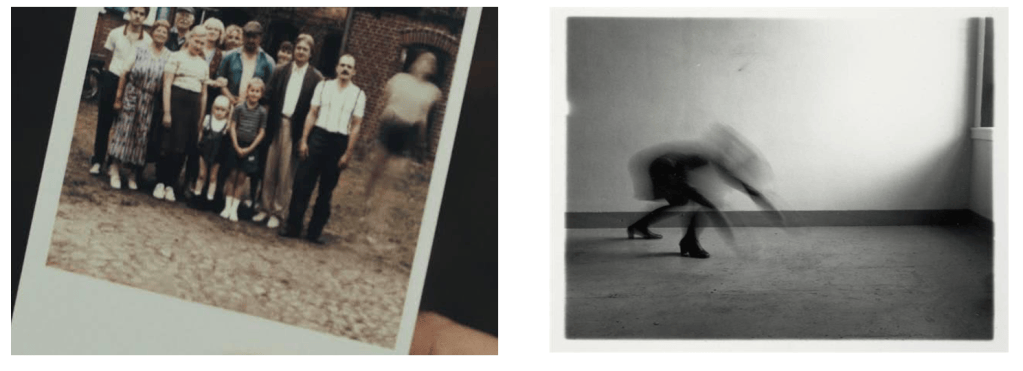
Beyond their experiences, these characters are bound together by the visual language of cinematographer Fabian Gamper. He shoots each time period with the same grainy texture, which is at once nostalgic and soiled by a grimy gauze which must be scratched away to uncover the secrets of the past. Gamper has cited Victorian post-mortem photography as one of his influences because it obscures the boundary between the living and the dead.
This influence is most explicit in scenes of after-death photography in which dead daughters are posed alongside living members of the family to appear as though they were still alive. As another form of visual deception, the families attempt to resist the irrevocability of death by altering their memories of the dead with the illusion that they remain with the living. This obscuration is central to the unique look of the film: even though it is not a conventional ghost story, characters sometimes appear as spectres, disassociated from their surroundings. Schilinski and Gamper also drew inspiration from the photography of Francesca Woodman since they “couldn’t find inspiration from cinema itself”. Her blurry self-portraits convey a sense of ephemerality, and Woodman’s own death, dying aged twenty-two by jumping from a window, bears an unsettling resemblance to the imagined and realised suicides in the film. As a result, the film looks like a memory, with extraordinary moments where the camera cranes and drifts through the farmhouse as if from the perspective of a ghost observing the present.
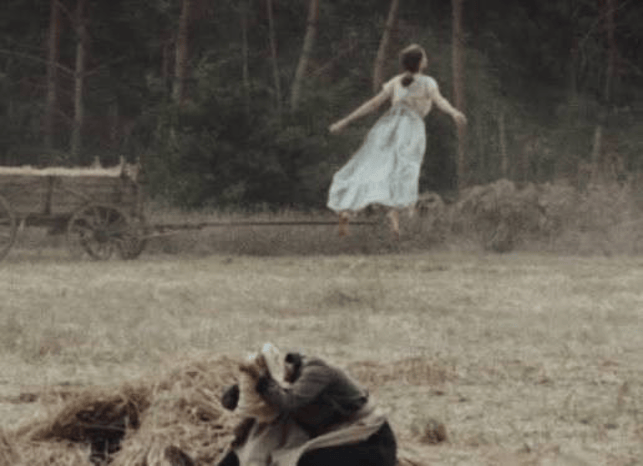
So, what is ‘the sound of falling’? Gamper’s ghostly visuals are accompanied by a richly textured sound design, isolating the trilling of bugs, ambient tremors and creaking doors. The only use of music in the film is Anna van Hausswolff’s haunting country ballad (any fans of Killing Eve may recognise it from the finale) cued during brief moments of freedom. “I’m scared to fall, I’m scared of death”, she sings, a shared lament that thematically resonates with each girl. Beneath this melancholy melody is the far more unnerving Lynchian rumble of static that permeates even the most quotidian of scenes, filling them with dread. Just as we expect something horrifying to unfold in the next frame, it cuts away. When tragedy does strike, we do not hear bodies hit the ground or screams of pain, only a nauseating wave of white noise. Sound becomes another medium through which memory and the women communicate with one another as each generation hears the fall that came before.
Mascha Schilinski’s tale of girlhood is a relentlessly bleak one, depicting the senseless cruelty of societal systems whose patterns are repeated throughout history, yet these girls are never simply victims. Across four timelines, Schilinski weaves an intricate web of developed female characters, each of whom is distinctly complex; her depiction of generational development and emotional inheritance reminded me of D.H. Lawrence’s The Rainbow (1915), another work in which the experiences of the past resound from one generation to the next. Sound of Falling is a film to be felt rather than understood: a deeply evocative contemplation of human nature and suffering through the lens of female adolescence. It is impossible to come away from the film without bearing the weight of the history we have just witnessed.
Further Reading
Sound of Falling, dir. Mascha Schilinski (Mubi, 2025)
Bankston, Douglas, Sound of Falling: Custom Optics Capture Fractured Memories. 5 March 2026. https://theasc.com/article/sound-of-falling-cinematography/
Grey, Carmen. 2026. Mascha Schilinski on Sound of Falling. 4 March 2026. https://www.bfi.org.uk/sight-and-sound/interviews/we-wanted-give-characters-chance-gaze-b ack-mascha-schilinski-sound-falling
Tate Modern, Finding Francesca. https://www.tate.org.uk/art/artists/francesca-woodman-10512/finding-francesca

