By Julia Ledesma
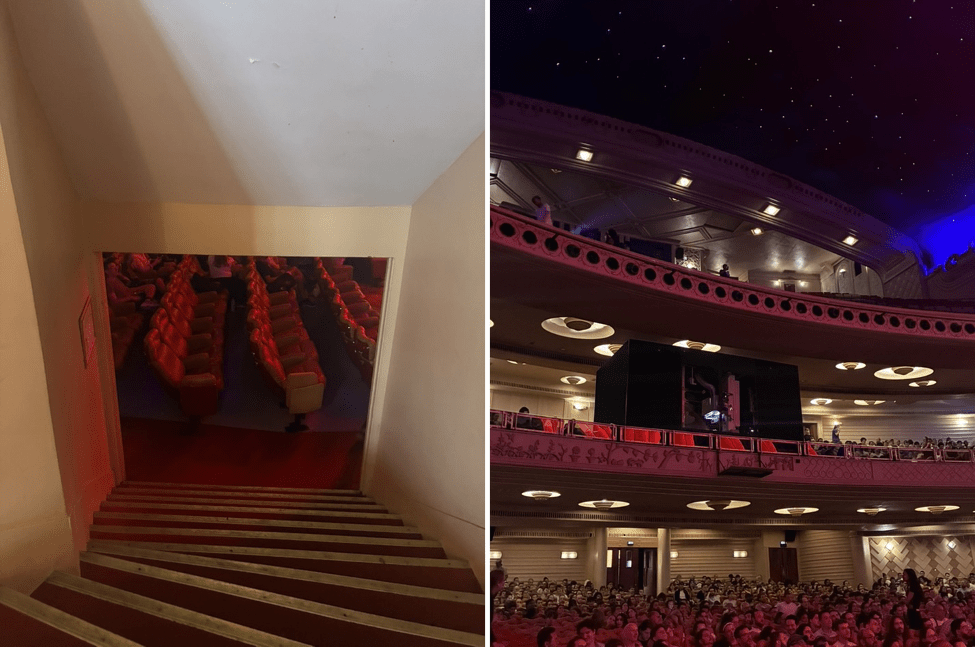
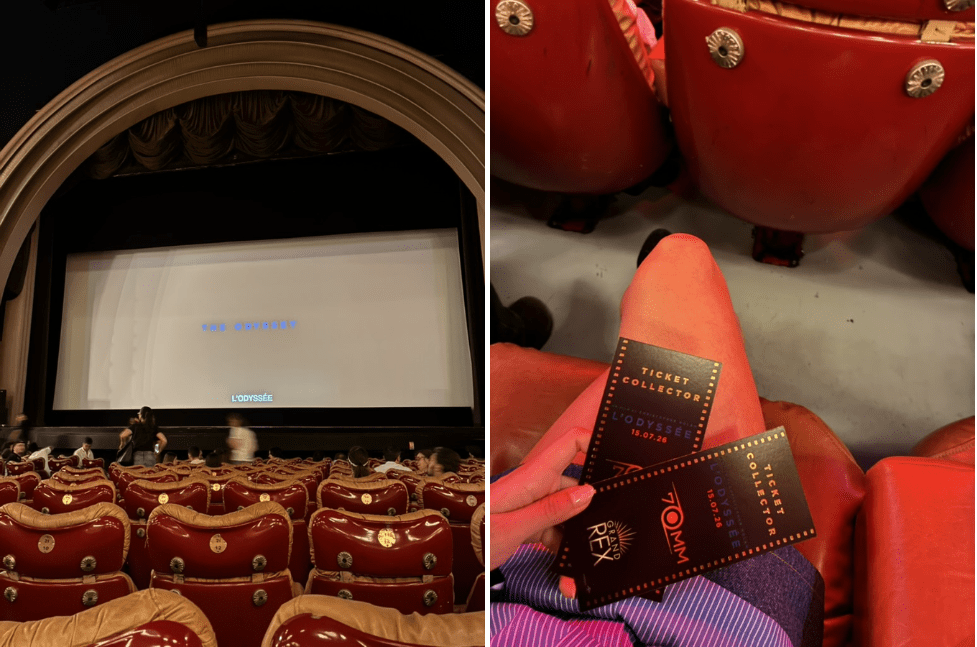
Led through a side door and down a flight of stairs in Paris’s 2nd arrondissement, I emptied into the Grand Rex’s Grande Salle: a dimly lit, wine-dark sea of velvet chairs. A VIP ticket meant favourable seats and champagne; the bar of Alain Ducasse chocolate was already in my purse. Christopher Nolan shot his epic, The Odyssey (2026), on celluloid, and the Rex built a temporary 70mm booth amid the mezzanine to project it. Like winding a watch, there is romance in hearing a projector whirr—the mechanics of care and craft interlocking. Under its steady hum and the starry Art Deco arch, I sat, ready to be entertained by the narrative from which all Western stories flow.
The poem begins by asking a goddess to speak so that a man may have a story. Emily Wilson’s first line in her 2017 translation—”Tell me about a complicated man”—follows Homer’s Greek in placing man first and Muse second. But she is there. The invocation ends with a command: Find the beginning.
Nolan’s film begins instead with an epigraph: “A time of apparent magic.” Before a face appears, the divine is already under suspicion. Then Travis Scott, credited only as Bard, rhythmically strikes a wooden staff. “A face. A fleet. A war. A man. A thought. A trick.” A carved horse’s head tops the staff. The trick already in hand. The beat gestures towards dactylic hexameter, the poem’s own metre. The story is underway without the Muse. The women who follow do speak, often with contemporary force. Yet as the film complicates its man, it narrows Homer’s complicated women.
When the film reaches Odysseus’s wanderings, we find him lotus-hazed on Calypso’s island, reconstructing himself from memory. Homer also lets Odysseus narrate these adventures, but aloud, before the assembled Phaeacian court. Nolan removes that witnessing court and turns storytelling into private recovery, administered by Calypso. In Homer, Odysseus drags his lotus-eating men back to the ships; Nolan makes Odysseus himself the lotus-eater. Numbness is not neutral. In shutting out the pain of war, he also shuts away the memories he must recover before he can return.
Calypso wonders whether remembering might destroy his happiness; he answers that, if so, it was never real. Feeding him the lotus or begging him not to eat it, she is the one managing him. After the flashback, as she gives him up, she tells him he was happy. He hands the verdict back—you were—and she settles the account in the plural: we were, for years.
In the audience, I felt the urge to protect lotus-eating Odysseus. “Do not, like your men, be so fooled! You are not happy.” But in resisting Calypso’s verdict, I had merely supplied another. The film had recruited me into its own economy, making me one more voice testifying to the hero’s interior. Calypso is the only witness to years he cannot count and the person with the greatest stake in what they meant. She may be restoring a truth he cannot face or pressing her version of the past. The film gives us no relationship against which to test either possibility.
Homer gives us what can be witnessed on Calypso’s sumptuous shore: Odysseus’s grief, sex, the lovers holding one another, departure, landfall. What it never gives us is a verdict on those seven years. It never says Odysseus was happy with Calypso. It shows us instead a man weeping on the shore by day and lying beside her unwillingly at night; after Calypso agrees to release him, the two take “the pleasure of their love, held close together.” Grief and pleasure, attachment and coercion remain together, unresolved.
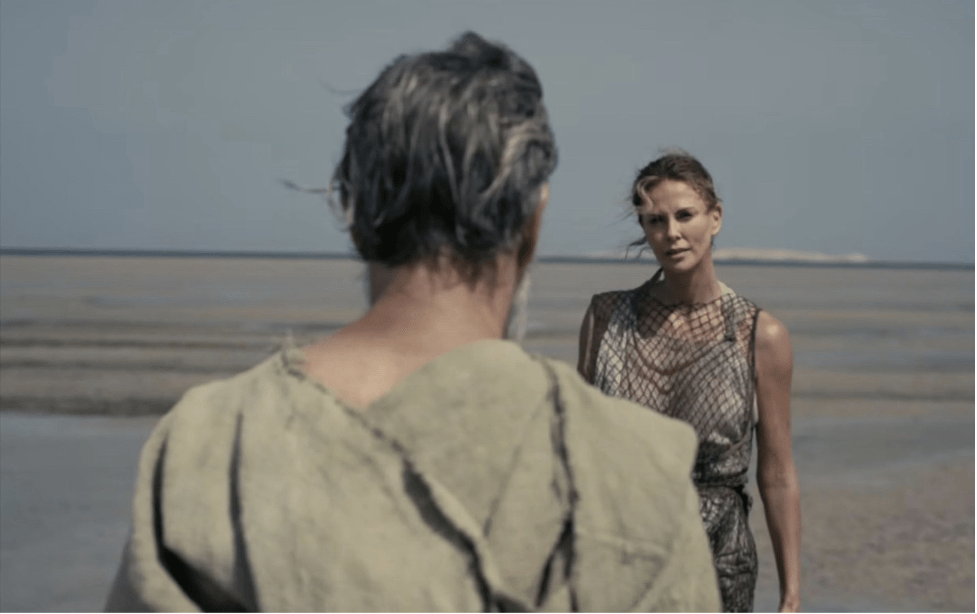
Seen as translation—Homer carried through Nolan—the film reveals a sensibility drawn to psychological explanation: Nolan inverts Homer’s terms. In Homer she keeps him and he cannot leave; in Nolan she lets him go, and what holds him is inside his own head—the lotus, the forgetting, a memory whose timing she controls. The film keeps the grief and landfall but removes the relationship’s bodily life—no sex, no embrace. “How do you know?” Calypso asks. “I don’t know. I feel,” Odysseus answers. Yet when she tells him he was happy, we have not been permitted to feel what she means.
The absence is stranger amid an onslaught of sensation that implicates us bodily in almost everything else: the drag of an oar through water, the confinement inside the wooden horse, fire, thunder, hooves, breath. Nolan gives epic scale a physical presence, reminding us that cinema is not watched but undergone. Göransson scores it without an orchestra, using the aulos and lyre alongside bronze percussion, as the film clangs, rows, neighs and screams. Violence is embodied; desire is interpreted. Odysseus never looks at Calypso with desire, and the film never makes hers palpable. His sexual relationship with Circe disappears too.
With it goes the poem’s erotic triangulation. Homer makes the audience know what Penelope does not. We watch the husband she waits for inhabit other women’s beds, though the poem complicates his consent and the goddesses’ power over him. To watch Calypso or Circe desire him is to remember Penelope; to watch the suitors desire Penelope is to remember Odysseus. Nolan removes the bodily relationships abroad and any real ambiguity in Penelope’s relation to the suitors. They still threaten Odysseus’s household and succession, but never his place in Penelope’s desire. Calypso, meanwhile, is permitted to interpret his feelings after the film has ceased to represent her desire.
Homer’s Calypso protests Zeus’s order to release Odysseus, calling the injustice by its name: a sexual double standard in which male gods take mortal lovers freely and object only when a goddess does. The same economy governs mortals. Odysseus’s years in goddesses’ beds cost his reputation nothing, while Penelope’s virtue is constituted entirely by abstention. Nearly three thousand years ago, a female voice critiques desire from inside the poem. Calypso then concedes—not that Zeus is right, but that he cannot be resisted. The care with which she equips Odysseus for departure coexists with the compulsion under which she releases him.
Nolan purifies the scene of that coercion, giving Calypso the choice Homer withholds. Her release becomes an act of love—perhaps the ultimate act of power: willingly surrendering what one most wants. The choice is morally beautiful; its terms are also familiar. Her love becomes legible through relinquishment and emotional care: she prepares him to return to another woman. Her political grievance disappears into his recovery. There is no order, so no protest.
The bard’s opening nagged me for another reason. In Book One, his song brings Penelope downstairs: she asks for a happier one because she cannot bear the grief, and Telemachus sends her back upstairs. Speech, he tells her, will be the business of men. In her essay collection Women & Power: A Manifesto (2017), Mary Beard calls this the first recorded instance of a man telling a woman to “shut up.” The word Telemachus uses, muthos, means not chatter but authoritative public utterance. Penelope enters Western literature as a critic and is promptly told to leave the room.
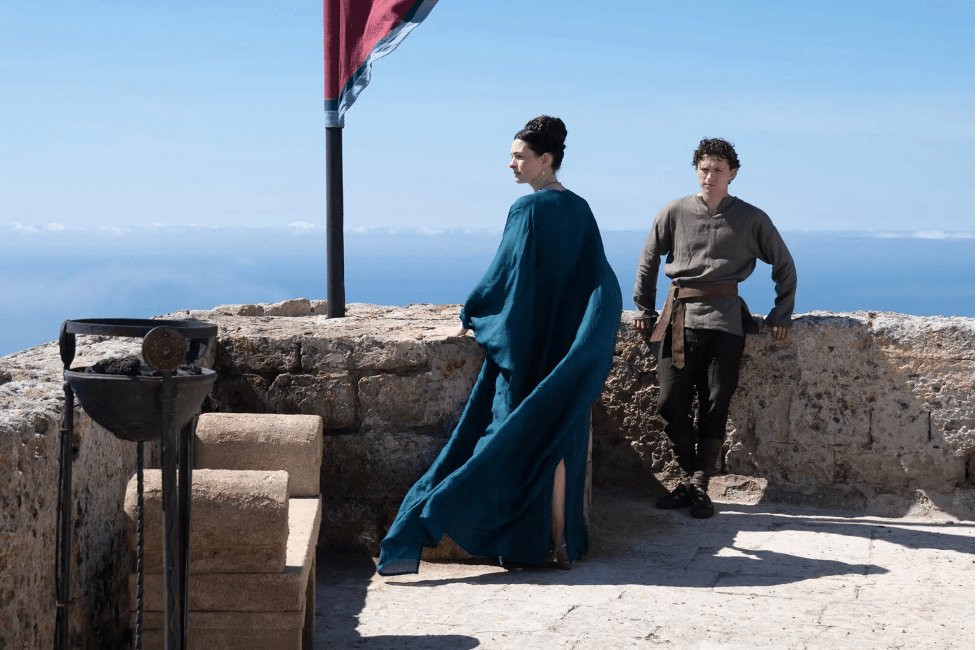
The film reverses the scene: Penelope tells the bard to stop, and he stops. The Phaeacians disappear, taking Nausicaa’s independent scenes and Queen Arete’s authority with them. Bright-eyed Athena, who sets whole books in motion, becomes Odysseus’s mournful conscience. Penelope is liberated, raising her voice to tell Telemachus he is still a child, unready to take his father’s place.
Wilson calls Nolan’s Calypso “an unpaid therapist.” The phrase names the film’s redistribution of agency: Calypso ceases to inhabit an erotic life of her own and becomes an interpreter of Odysseus’s interior life. Narrative agency is not forcefulness but the capacity to desire, judge, and act from purposes not wholly organised around the hero. Calypso can become more decisive and less independent; Circe more forceful and less desiring; Penelope more assertive and less ambivalent. A woman may gain lines and lose narrative authority.
The women of Homer’s Odyssey do not simply surround the hero; they narrate, desire, protest, resist, test, and finally bear witness to him. Glory—kleos—is what others say about you. It requires voices that are not yours, singing. A refrain runs through the poem: tell me truly.
This is a story of liars, disguises, tests, and competing narrators, forever asking what is real and which teller to trust. Its most exacting auditor is Penelope, who interrogates a disguised Odysseus detail by detail.
Nolan’s own climax turns on surrender. Odysseus cannot navigate his way home or outthink the sea, and reaches Ithaca only by releasing the raft and giving himself to the water. The film stages surrender dramatically. Interpretively, it retains control.
The writer-director has since explained that he wanted a phrase that would help the audience understand the terms of the story, and that “apparent” acknowledges that a realistic telling must, to some extent, explain why there is magic. His is a personal reading, shaped by what he takes a modern audience to require. The film does not distrust sensation. Its onslaught depends upon it. Yet it rarely leaves experience uninterpreted. The title card qualifies the gods before a face appears; Calypso and Athena are recast as interpreters of Odysseus’s inner life. The qualified gods, the interpreted interior—both accommodate us: our scepticism about gods, our appetite for psychological explanation. The question is not whether Nolan may resolve the poem’s ambiguities, but what those resolutions require of the women he enlists to deliver them.
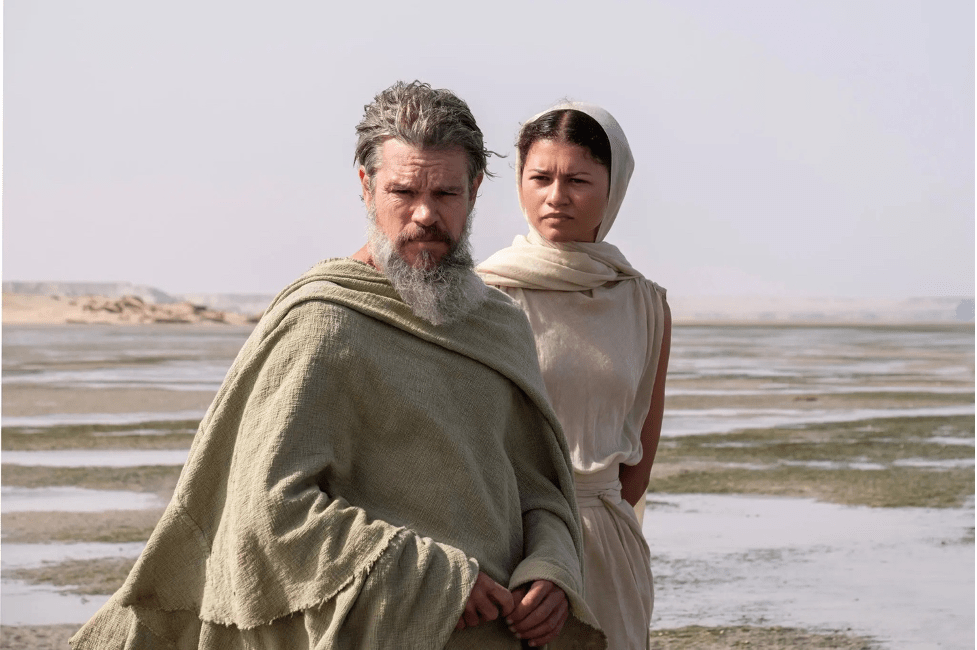
On Ithaca, as in Homer, Penelope and Telemachus exist beyond Odysseus’s telling. Disguised, standing on his own island, Odysseus tells Penelope he is not yet home. He will not be until their reunion. Here the film understands Homer’s deepest logic: arrival is not yet nostos. A man may tell the story of his return, but he cannot confer homecoming upon himself. The film finally needs the female independence it has repeatedly narrowed.
I barely stirred from the seat. The chocolate remained unopened; the champagne was sipped evenly, which is remarkable for a glass held through a three-hour film. The Odyssey itself was the indulgence. It made me feel, then want to argue.
We tend to call an adaptation original when it makes an old story new. Yet the word’s earliest meanings point not to novelty but to origin: what came first, and the source from which another work derives. Wilson’s translation models a harder kind of originality: she returns to the Greek and lets it challenge the assumptions of the present. Her rendering of the invocation ends: “Now goddess, child of Zeus, tell the old story for our modern times. Find the beginning.” The Muse is asked not merely to repeat the story but to find where it begins.
Nolan tells it in dazzling new ways. Near the end, the bard returns to his beat and finally asks the Muse: “Sing, Muse, of a man. A thought. A trick.” The invocation arrives as an epilogue, reopening the story as the sceptre passes to the next teller. It asks for the man.
To call the film a translation is not to demand fidelity; it is to keep the source and its interpretation in relation. As Homer passes through Nolan, what is amplified, resolved or lost in that passage becomes part of the film’s meaning. Some women disappear; those who remain are bent towards Odysseus—their desires muted, their grievances removed, their perspectives redirected towards his recovery and return. The film returns Odysseus to Ithaca. It does not find the beginning.
Further Reading
Beard, Mary, Women & Power: A Manifesto (London: Profile Books, 2017).
Grow, Kory, ‘How Ludwig Göransson Found Ancient Greek Instruments for The Odyssey’, Rolling Stone Australia, 12 June 2026 https://au.rollingstone.com/movies/movie-news/the-odyssey-ludwig-goransson-score-96679/
Homer, The Odyssey, trans. by Emily Wilson (New York: W. W. Norton, 2017).
The Odyssey, dir. by Christopher Nolan (Universal Pictures, 2026).
Pearce, Leonard, ‘Christopher Nolan and Park Chan-wook Discuss The Odyssey, Magic, and Filmmaking Techniques’, The Film Stage, 10 August 2026 https://thefilmstage.com/christopher-nolan-and-park-chan-wook-discuss-the-odyssey-magic-and-filmmaking-techniques/
Wilson, Emily, ‘An Uncomplicated Man’, London Review of Books, 48.14 (2026) https://www.lrb.co.uk/the-paper/v48/n14/emily-wilson/an-uncomplicated-man Wilson, Emily, and Sarah Ruhl, ‘The Odyssey Onscreen’, The 92nd Street Y, New York, YouTube, 20 July 2026 https://www.youtube.com/watch?v=HmnR2mYM6oc

