By Raluca David
Sometimes a small woman can be a real presence. So was Professor Anne Campbell. Whenever this inconspicuous woman with a short white bob entered the amphitheatre of the Psychology Department at the University of Durham, where she taught me in the early 2010s, the room became silent. Her figure was a metaphor for her work. During her diverse and adventurous career, Anne Campbell’s single-handedly revolutionised the way evolutionary psychology thinks about womanhood.
Few Professors had such an aura. Partly, it came from the way she introduced herself as the woman who, in the 1980s at the start of her career, had spent two years with girls’ gangs in New York City in order to study female aggression. These gangs were on the police radar, they were the real thing. Anne tape-recorded ‘girls’ members, aged between fifteen and thirty, with their consent. From recordings of the girls talking to each other, Anne was able to gauge what sort of fights they were involved in—with the caveat that reports would be inflated by bragging. Nonetheless, the tapes revealed something unexpected: girls’ fights differed substantially from men’s, but not in the stereotyped way. It wasn’t that they fought ‘like girls’, with biting and scratching and without weapons. The girls took pride in punching and hitting, and many if not most fights involved weapons, just like men’s did.
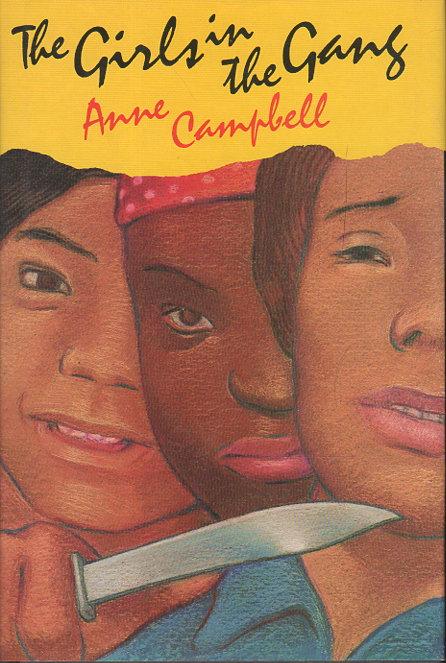
https://www.abebooks.co.uk/GIRLS-GANG-Campbell-Anne-Basil-Blackwell/11381238422/bd
Instead, what differed between men’s gangs and women’s gangs were the reasons to fight: while male gangs fought ‘for the gang’, for dominance over other gangs, girls’ fights were individual. The principle was, ‘No one says that and gets away with it’. They fought for their personal integrity, for ‘face’, for their lovers and children. Their disputes were often of domestic or romantic nature. And they fought men. Not only for men, but also with men. Herein lay the key that unlocked the rest of Anne Campbell’s work in evolutionary psychology.
It is a peculiar thing, to discuss the merits of the evolutionary psychology of women in a feminist context. Historically, feminism and evolutionary psychology have been pitted against each other, for good reason. Evolutionary psychology implies a determinism. It argues that our behaviours are biologically coded in our minds by tens of thousands of years of human evolution in the ‘Environment of Evolutionary Adaptiveness’, one in which human societies of hunter-gatherers lived. In popular culture, this conjures images of the male hunter – hero, strategist, risk-taker, social leader – and the stay-at-camp females looking after the children. It is an easy slip of logic to say that if this were indeed the case then, something similar ought to happen now. This discourse has been gaining quite some track in recent years with phenomena such as the ‘trad wife’ movement, which argues that women’s natural role is in the home, while men should be providers.
Yet whether this is in any way ‘natural’ is far from established: first, it requires evidence that things were like this tens of thousands of years ago, evidence which is impossible to acquire, since behaviour does not leave behind fossils. In absence of archaeological evidence, it needs proof that this division of labour is universal across the human species.
Early evolutionary theorists did portray behavioural differences between women and men as similar to the above-mentioned case, if not as reductive. Much of their theories rested on one central factor: how the two sexes differed in their risk-taking behaviour. Men were seen as aggressive explorers, women as sheltered and in need of protection. Yet, until Anne Campbell, no scientist had ventured in contemporary human societies to gather real data on female aggression.
In 1979, an evolutionary theorist called Alexander wrote that ‘the entire life history strategy of males is a higher-risk, higher stakes adventure than that of females’. Throughout the 80s and 90s, evolutionary scientists such as Daly and Wilson saw women as relatively passive minds. According to them, women chose their mates based on how likely they were to provide good genes, shelter and resources for the offspring. Other than that, women had little to fight for. In this view, it was the males who fought for partners. Since males could produce practically limitless sperm for decades, the access to ‘partners they can inseminate’ (Campbell’s words) who would carry their offspring was the limiting factor to their reproductive success. The more females they could secure, the more children they could produce, thus the onus of competition fell on males.
According to Daly and Wilson, increased rates of male aggression found in societies all across the world, differentiating boys as young as two years of age from girls, reflected men’s tendencies to form hierarchies and seek dominance. In this evolutionary model, female aggression was considered a gender-incongruent aberration to be explained away by irrationality. Seeing women’s aggression as irrational was a trend that influenced popular culture so strongly, that Campbell’s girls of the 80s in New York exculpated their violence as a loss of self-control.

https://www.facebook.com/groups/1176686300033650/posts/1578629233172686/
Campbell saw the girls’ aggression differently, and for the first time, she brought evolutionary psychology to a point where it meets feminism by adopting a unique approach to data gathering. Anne then spent decades corroborating this with further research: questionnaires across cultures, experiments measuring women’s and men’s willingness to engage in direct aggression in game-like computer tasks, observational studies. All of these showed, over and over, that women fought hard, albeit often in less physically violent ways than men did, instead employing subtler, indirect aggression. There was good reason for women to engage in less physically risky aggression. Even in modern societies, an infant was half as likely to survive if their mother died. A child’s survival up to the age of five was strictly related to a mother’s presence, and this correlation remained for later childhood too. For a mother’s genes to survive, she had to stay alive for as long as possible.
Nevertheless, Campbell argued that women very much had reasons to compete with each other, both for securing a good-quality mate, and particularly for keeping him, and fortifying their scarce resources. Female aggression was, evolutionarily speaking, justified and essential.
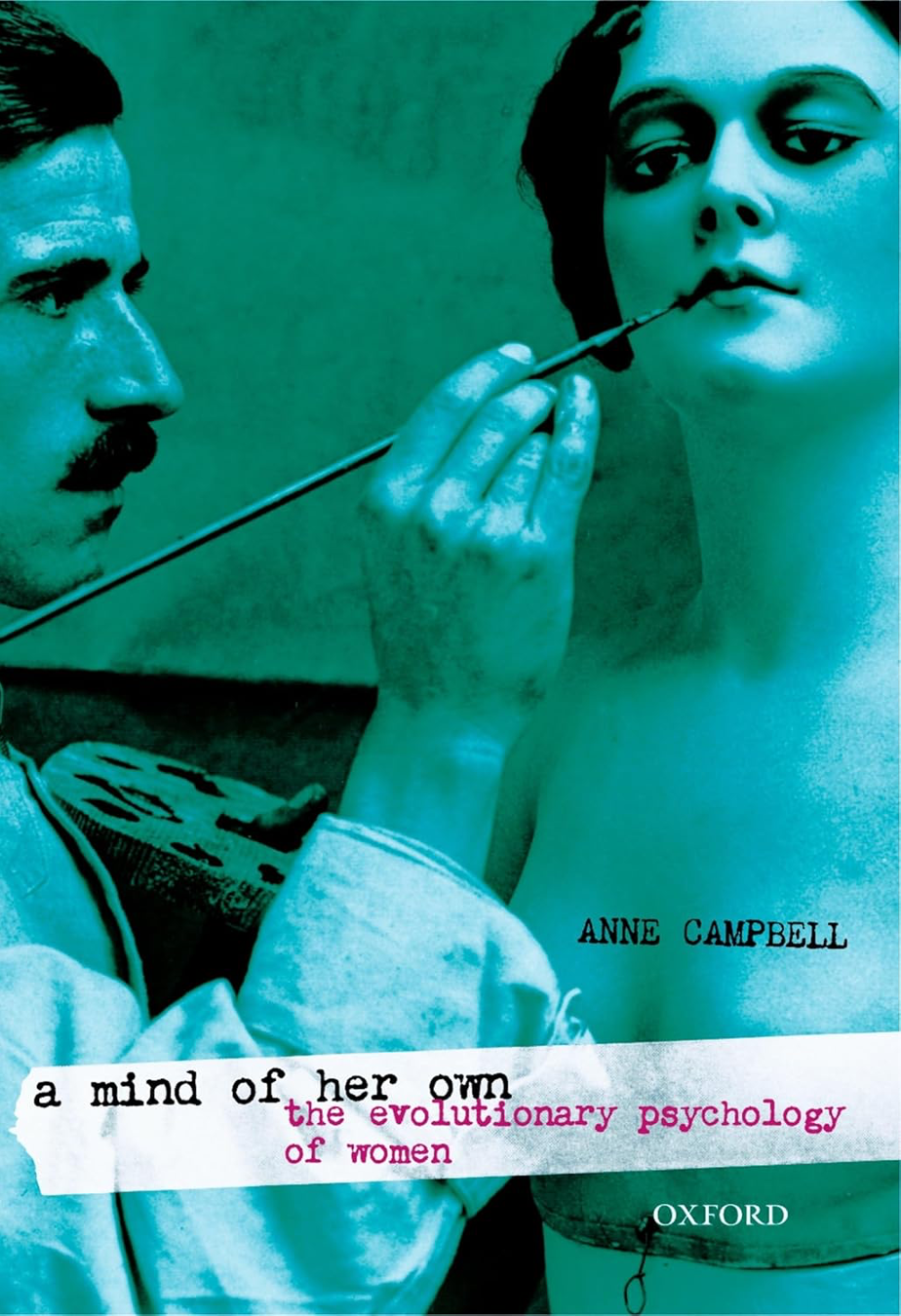
https://global.oup.com/academic/product/a-mind-of-her-own-9780199609543
Women had minds of their own, and they fought for their own interests. Crucially, this wasn’t just about ‘cat fights’ – a term that diminishes the stakes of female conflict. Women used aggression against men too. Moreover, they were willing to be aggressive towards their sexual partner. This latter point was particularly fascinating and counter-intuitive. It can be interpreted, on the one hand, as the woman’s struggle to secure her partner’s resources and investment for their children. On the other hand, the struggle can equally be about ‘inclusive fitness’, an evolutionary term that reflects a woman’s social status, essentially. In this view, a woman free to pursue her hierarchical position in society can improve the survival and success of her extended family, thus maximising her genes’ survival beyond her offspring. A woman liberated to seek kinship in others, especially in other women, similarly maximises her inclusive fitness through building a support network for her children, her relatives and her wider community.
Female minds were considered, for a long time, a sort of by-product of evolution, rather than being shaped by their own evolutionary ‘desires’. Anne Campbell changed the conversation. She shed light on how women had evolutionary problems to solve, and had just as much power of decision-making as men did: through competitiveness, through kinship, through social status of their own. Anne Campbell did her scientific duty. Now it remains for the rest of us to shed light on her work if our cultural understanding of women’s nature is to catch up with scientific research.
Further Reading
Campbell, A. (1984). Girls’ Talk: The Social Representation of Aggression by Female Gang Members. Criminal Justice and Behavior, 11(2), 139–156. https://doi.org/10.1177/0093854884011002001
Campbell, A. (1991). The girls in the gang (2nd ed.). Basil Blackwell.
Campbell, A. (1999). Staying alive: Evolution, culture, and women’s intrasexual aggression. The Behavioral and Brain Sciences, 22(2), 203–214. https://doi.org/10.1017/S0140525X99001818
Campbell, A. (2014). A mind of her own : the evolutionary psychology of women (2nd ed.). Oxford University Press.

