By Jemima Gravatt
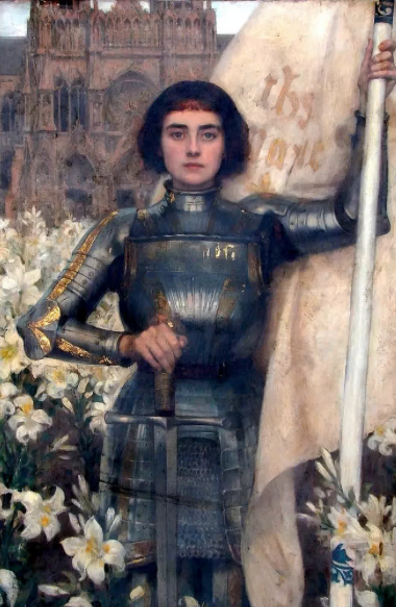
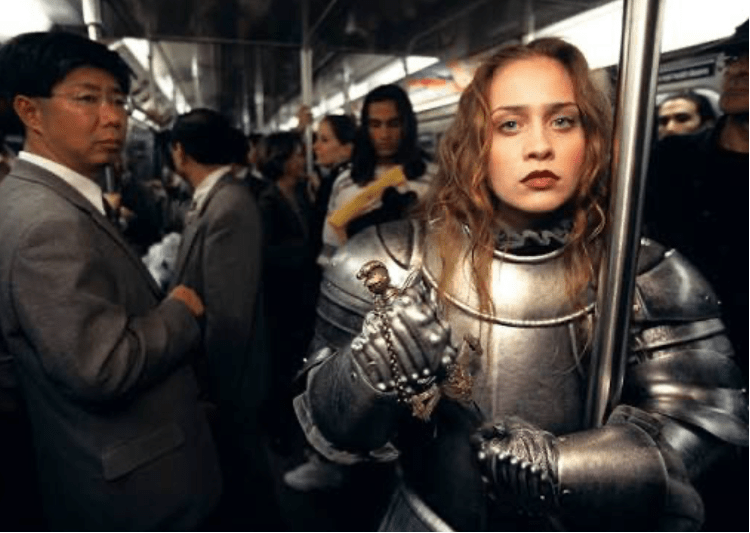
From pre-Raphaelite paintings to Fiona Apple’s subway music video and more recently, the Chappell Roan’s 2024 MTV video music award performance, Joan of Arc persists in the cultural zeitgeist as a Romantic figure of female strength. However, today and historically, Joan of Arc also features in conservative areas of France as a figurehead of national identity and the far right. Getting to the bottom of who this woman was might help elucidate where her image fits best – in feminist or far-right discourses and iconography. Why is it that she can be used for seemingly opposite aims but with equal strength and fervour, and is her sex the reason for the discrepant projections placed onto her?
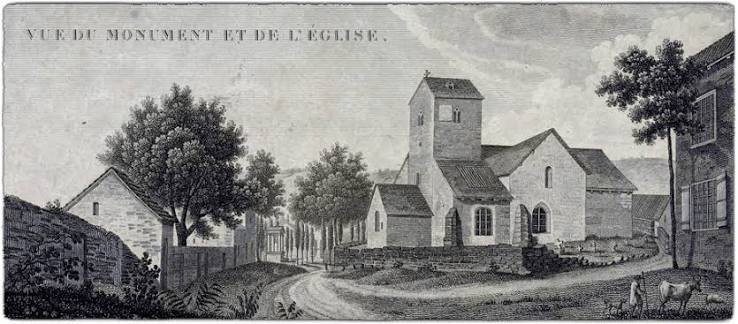
Joan of Arc (1412 – 1431) began her life as a pious teenager living in Domrémy, a small village in northeastern France. She started having mystical visions from the age of just thirteen and gradually had more specific visions about St Michael and St Catherine. It was when she was just seventeen that her visions showed her that saints had designated her the saviour of France against the English. France had been losing the very long and arduous Hundred Years’ War and the end was far from sight.
https://www.womensvoicesnow.org/joan-of-arc
Now, was it a national crisis and luck that led the French king Charles VII to accept the young girl as council into his lost court? Not exactly. In fact, her zealousness was so ardent that news of her visions and proclamations travelled widely and were even confirmed by high-ranking theologians in Poitiers. Each male gatekeeper confirmed her candour and seriousness until Joan, at just seventeen, was sat in front of the King directing him in his battles, turning the tide of national events.
There is some much-needed context around her life. Joan was not an educated woman who had other avenues of mental exploration. In fact, she was entirely homeschooled by her mother, solely in a religious context. Furthermore, the war would have been an affronting and very real part of life in her village. She would have grown up seeing battles and invasions and hearing about the constant instability affecting everyone she knew, and her family in particular.
https://www.jeanne-darc.info/location/domremy/
It is reported that Joan had exceptional strategic skills, later visible on the battlefield, and immense verbal dexterity as well as emotional intelligence. She had turned down an arranged marriage orchestrated by her father and led a life estranged from him. When it came to leaving her village, she lied to her father and told him she was helping to deliver a baby in a nearby village. This is not the image of a woman living for her country with patriarchal support, this is a woman outmanoeuvring the stringent restrictions on her own expansion. These facts show what a bright woman Joan was.
We can see both how feminists may thrill at the turning down of a marriage proposal by a local man, or how this could all be reinterpreted as a totally sacrificial act of her devotion to France as a whole. If Joan was a highly intelligent woman, can we say that she was simply looking for a way to expand beyond her station? Likely bored from working in the fields, can we say that her tool for expansion was her religious education, and that the problem her eager mind found was in front of her eyes, in the form of the battlefield with the English?
Upon leaving her village, Joan of Arc’s skill and rigour – serving as both a strategist and a symbol for the fighters to keep going, created immense change in the French army’s morale. Her perseverance led to the lifting of the siege of Orleans in 1429 and eventually enabled the coronation of Charles VII via the success in the Battle of Patay. Images proliferate in art and media today of her with her boyish cropped hairstyle and armour. Heroines of the past adorning such male fashions whilst still being perceived as feminine are rare; unseen even. Her beauty leads to endless Romantic fascination over and above that which the likes of other female warriors like Boudicca receive.
https://www.tumblr.com/365daysoflesbians/174405676674/may-30-joan-of-arc-1412-1431
There is weight to retrospective speculation that Joan of Arc may not have been straight. Her desire to leave her provincial life, her turning down of the marriage proposal, as well as the obvious masculine appearance all suggest that possibility. Nevertheless, in her trial at the end of her life, no behaviour of hers was reported as being untoward, although such reports would have surfaced had anything been known. Joan even referred to herself as ‘La Pucelle,’ which means ‘the maiden’ to emphasise her Catholic chastity.
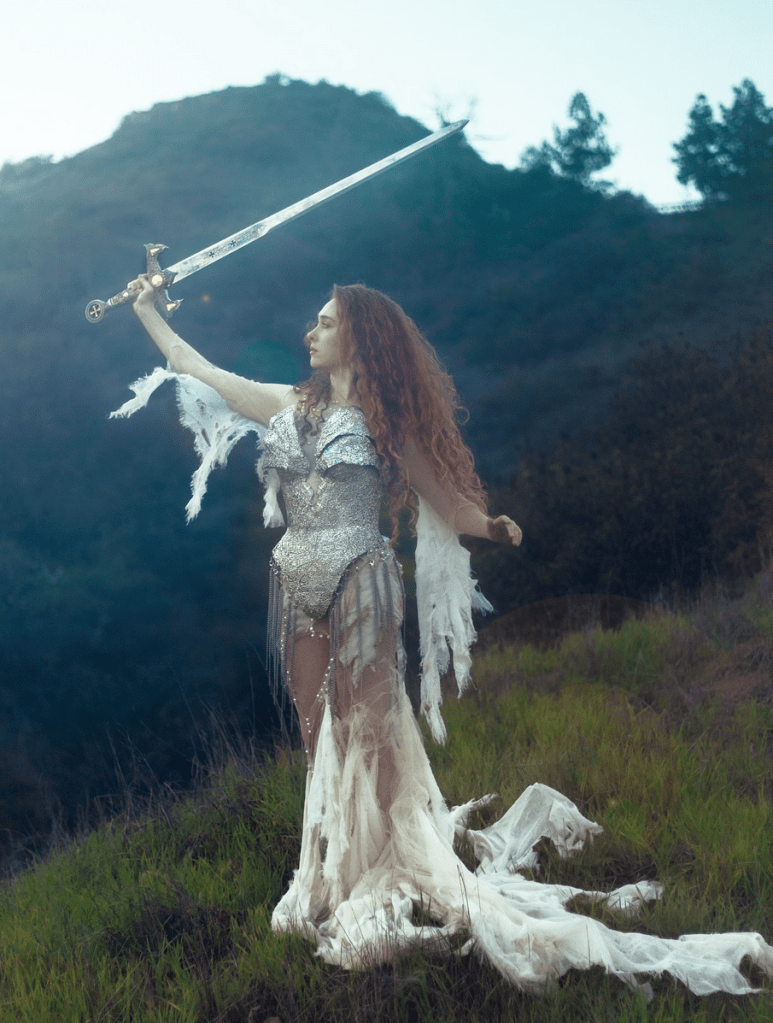
Was she simply uninterested in a conventional life? Or was it men she did not care for? To every country outside of France, this question is largely irrelevant. The iconography has outgrown the necessity for historical facts and analysis. Knowing that a woman can be heroic and has been in the past is enough for art to flourish and take root. It was enough for the suffragettes in Britain, the United States and Mexico to independently use her as their figurehead for their own feminist aims. Her impact has gone beyond history and its context, to become something immediately recognisable and meaningful. Even Chappell Roan, in her onslaught of media speculation, felt the suit of a knight would best display strength. The image endures.
However, within France, this is not the case. Any French person will associate Joan of Arc with certain religious and nationalist spheres. In 1920, she was canonised by Pope Benedict XV to become a patron saint of France. Since then, she has become a symbol of right-wing groups including Action française and National Rally. Her virginal status and zealous commitment to France makes her an endearing figure of national commitment in a conventionally attractive package.
The interesting feature of this however is the circumstances around her death. Joan was burned at the stake in 1431 at just nineteen years old. She had been abandoned by King Charles when she was captured by the English-aligned Burgundians. It is widely speculated that her appearance was the reason for her death. However, the court was very much a kangaroo court, resembling too much a witch hunt trial. The English needed to disprove the divine providence of Charles. If they could dispel the legitimacy of Joan’s claims, they would have greater moral allowance to dethrone King Charles. Indeed, her appearance did form evidence in the trial. Her military clothing and haircut, as well as her intellectual prowess certainly raised eyebrows, as did her unusually masculine behaviour. They formed as contributory evidence that her prior claims were not religious, but demonic in nature.
As a result of her death at the hand of the English-aligned traitors, Joan of Arc was designated a saint by the French. They saw a religious maiden murdered despite her clear passion and commitment to Catholicism. Yet the English, who had nothing to gain in sovereignty of respecting her religious commitment, brandished her intellect and appearance as unfeminine ambition, and ultimately as reasons to have her killed. The common thread in both interpretations is the desire to use Joan of Arc as a means to each party’s aims. And what neither considered nor cared for was that Joan herself was just a teenager, surpassing the life imposed upon her.
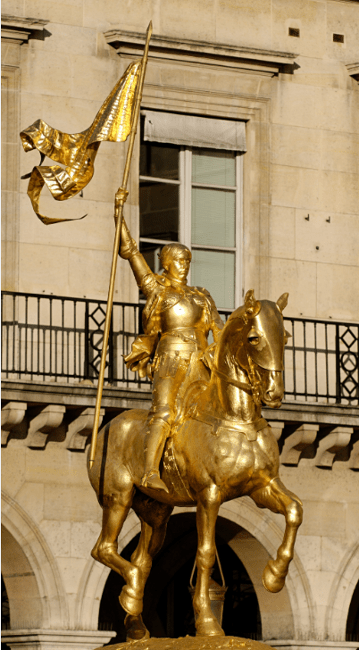
https://en.wikipedia.org/wiki/Jeanne_d%27Arc_%28Frémiet%29
Whether she is used as a figurehead for French nationalism or as a symbol of female strength in overcoming sexist circumstances, it is interesting to recognise our own projections onto a girl who died before she ever became an adult. The devout zealot, the intelligently bored girl or the sapphic woman, we have no idea who she truly was – whether she was none of these or all three. The ever-enduring legacy of the passionate teenage girl becomes a highly interesting case study in what parts of a story different parties will choose to focus on and instrumentalise. With much history between us and her, we are no closer to discovering her true alignment to any of these ideologies, and perhaps we do not want to. Her legacy and malleability as a figurehead are becoming more interesting features than, perhaps, the original story of Joan of Arc herself.
Further Reading
Castor H, ‘Joan of Arc – feminist icon?’ (17 Oct 2014) The Guardian < https://www.theguardian.com/books/2014/oct/17/joan-arc-feminist-icon-uncomfortable-fit >
Miller A, ‘Joan of Arc, for Fascists and Feminists’ (14 May 2020) < https://daily.jstor.org/joan-of-arc-for-fascists-and-feminists/ >
Warner M, Everybody’s Joan (2012) London Review of Books, Vol 34 No 23

