By Frankie Jackman
In recent years Jilly Cooper’s Rivals has undergone a cultural resurgence, notably following its Disney+ adaptation almost forty years after the novel’s publication in 1988, a surprisingly late arrival given the Rutshire Chronicles’ enduring popularity. What follows reads the novel and its adaptation together, taking the show’s reception as the lens through which Cooper’s work is being newly celebrated.

© Arthur Sidley Photography 1978
While Rivals proudly bears its “bonkbuster” badge with honour, over the past few years there has been a reframing of Cooper’s work in cultural discourse. Articles have increasingly appeared that question its relegation to airport fiction status and its dismissal from consideration of literary merit. In particular, Rivals’ frank depiction of female desire has received growing attention. The Guardian has described Cooper’s work as “storytelling that highlights the meandering, textured, sublimely messy inner worlds and wants of women”, while a recent article in The Conversation likewise celebrated that “one of the most remarked-upon aspects of the Rutshire Chronicles was not just the explicit sex, but that the sex depicted was overwhelmingly positive for the women involved – and it was men who had to work at it”. Furthermore, Rivals is celebrated for its depiction of sexuality in a way that is playful, camp, and silly (the defining differentiation between the romance genre and bonkbuster proper, one might say). It makes for a refreshing representation of female desire, a balance encapsulated rather well by executive producer Dominic Treadwell-Collins’s comments on the show’s equal-opportunities nudity policy: “there’s a willy for every pair of tits.”
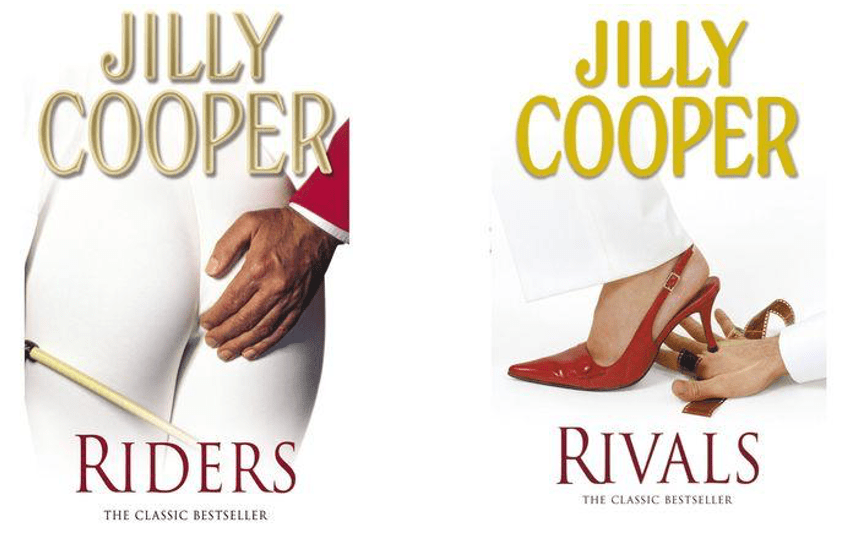
This reclamation is not without merit. Famously, Rivals was one of the first bestselling novels to promote vibrators. However, the recent discourse around Cooper’s work has, I would argue, slipped into what Sarah Projansky identifies as “(hetero)sex-positive postfeminism”. Projansky defines this as a paradigm that rejects “the supposedly anti-sex attitudes of a previous generation in favour of a feminism focused on individuality and independence”. As Justine Ashby argues in her examination of postfeminism in the British cultural frame, this version of feminism simultaneously celebrates female camaraderie and individualism while ultimately “confound[ing] any real attempt to politicise it”. The contemporary discourse around Rivals, in its celebration of unabashed female sexual desire, has left unquestioned who gets to express that desire, where it is located, and how this shapes which forms of sexuality are permitted to become mainstream. This is not to say that recent discussions have been entirely uncritical. Many of the same articles have raised concerns about women’s bodies, consent, and misogyny in Rivals. But such criticisms remain gender-based and thus leave questions of class and race in the white, elite, and conservative world that Rivals inhabits unexamined.
Sexual desire in Rivals is crucially aristocratic. Arguably it is this that permits the female sexual desire to be shameless. The world of Rivals is unapologetically elite, and while this was spotlighted in discourse around Cooper in the 80s and 90s, it appears to have been quietly brushed under the carpet in more recent years. The central romantic and sexual storylines of the Rutshire Chronicles belong, without exception, to the wealthy and the pedigreed, most famously, Olympic showjumper turned Conservative Minister for Sport Rupert Campbell-Black with his Penscombe estate.
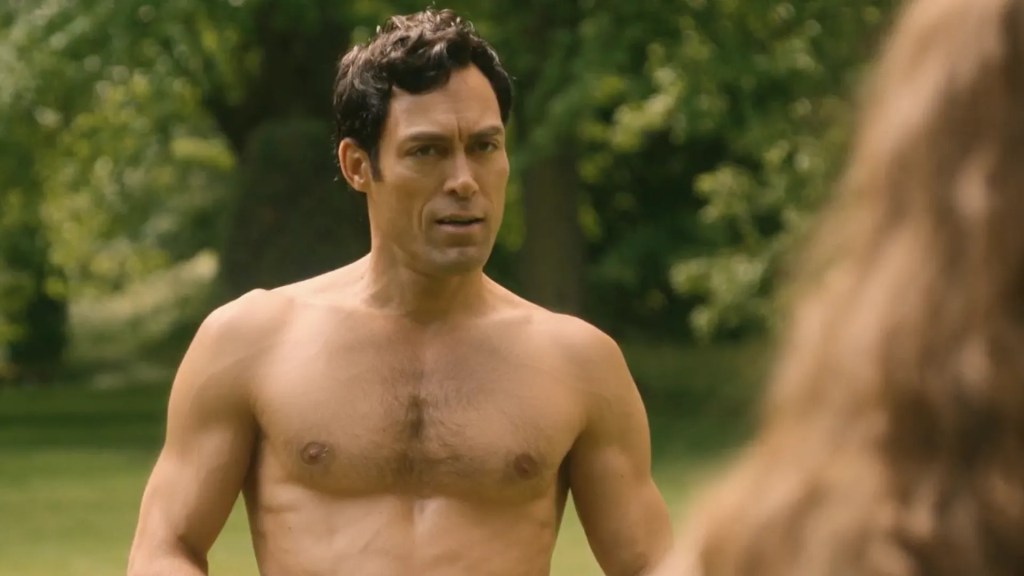
In contrast, the aspirations of the nouveaux riches are mocked, nobody more so than Valerie Jones, the most caricatured and punished character in Rivals, who is hit with every “new money” comic derision you could think of. Valerie is gauche, socially pretentious, and desperate to fit into the aristocratic circle of wives to no avail. And, interestingly, not permitted any sexual desire or pleasure, Valerie is the only female character in the novel to be denied an orgasm, and whose sole sexual scene, in the book and show, is straddling her husband Freddie, entirely uninterested in their sex and more satisfied with watching the TV at the same time.
On the flip side, Valerie’s husband Freddie Jones, a self-made electronics millionaire, is given one of the most tender storylines in the novel. Across Rivals, Freddie and Lizzie (author and neglected wife of James Vereker) begin an affair. Despite the adultery, almost everyone is rooting for them, characters and audience alike (though this is partly enabled by the comic unlikability of Valerie). Freddie rekindles Lizzie’s sense of desirability, and we see their connection unfold through their shared childlike spark and trails of stolen glances, culminating in Freddie chasing a train to retrieve Lizzie’s forgotten manuscript.
However, while Freddie’s storyline is a more ‘positive’ one, his character is still a class-based caricature, just a different one (one that happens to be far more pronounced in the novel than in the television adaptation). Firstly, Freddie’s tenderness is enabled by his working-class identity. His warmth, attentiveness, and vulnerability are linked to the familiar “man of the people” archetype, making his emotional openness possible in contrast to the aristocratic men of Rutshire, who are so often portrayed as emotionally detached. The result is a recognisable stereotype in which working-class people are positioned as more emotionally “real” than their upper-class counterparts.

Furthermore, Freddie and Valerie slot neatly into the deserving versus undeserving working-class binary. Freddie is industrious and deferential enough to navigate the elite world of Rutshire, yet spirited enough to resist complete assimilation. Valerie, meanwhile, embodies everything that is supposedly embarrassing about social aspiration. This dynamic is most notable in the shooting weekend incident in Rivals, where Freddie earns respect by proving himself remarkably skilled with a shotgun while remaining pointedly uninterested in joining Tony Baddingham’s clique.
And then there is the question of race. In the Disney+ adaptation, Cameron Cook (played by Nafessa Williams) is one of the characters most frequently held up as evidence of Rivals’ feminist credentials. Cook is celebrated as a woman who commands her own pleasure, she “orders Rupert around like a sergeant-major, and who demands what she wants and gets it”. Yet almost nobody writing in celebration of the TV depiction of Cameron Cook mentions that Cameron is a black woman navigating desire in a white world.
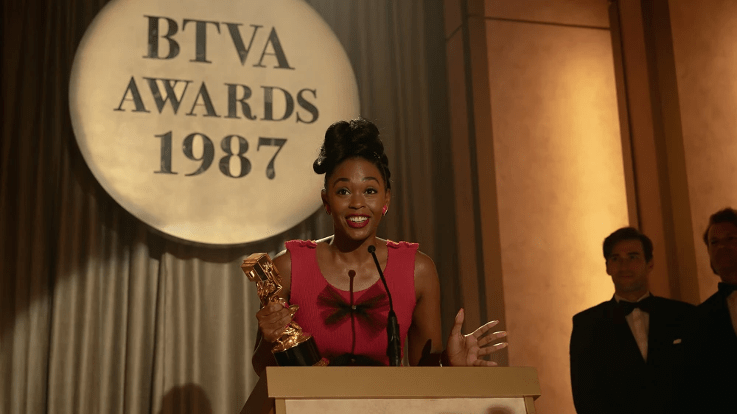
© Image courtesy of Disney+
In the novel, Cameron Cook is not black, Cooper describes her as having “pale skin”, and her casting was the show’s own decision. I do not necessarily believe this was an example of “colour-blind casting”, which is defined as the “practice of casting actors from different racial or ethnic backgrounds in roles haphazardly, regardless of the very obvious implications this may have on the story being told”. However, Cameron’s experience as a black woman is still only made known once or twice in the show. Most notably, when the character Declan O’Hara admits he was “not expecting a woman, and God forbid a black one” to be a producer at Corinium Television, confessing he had taken Cook for a ‘publicity girl’. But the question of race is dropped in the show almost as quickly as it arrives, which, given that this is middle England in the 1980s, strains credulity.
The struggles Cameron faces throughout the show are otherwise attributed entirely to her gender. Cook knows she will be doubted and that she will have to work harder, but this is consistently framed as primarily a woman’s burden, not a racial one. Specifically, the sexual relationship between Cook and Tony Baddingham, and the power dynamics between a black woman and her white male boss within an also white-dominated male industry, could do with considerably more attention in the show than they receive. Cameron’s outsider status throughout the show is ultimately put down to her American and “new money” identity, collapsing her into the class narrative, potentially xenophobic at a push, rather than sitting with the intersectionality of being a black woman in Rutshire. The reclamation discourse does much the same thing. Cameron is held up as proof of female sexual liberation, while they remain incurious about which woman, exactly, is being liberated, and at what cost.
Rivals is a joyful, filthy novel and while the reclamation of Cooper’s work as an example of female sexual desire is not without merit, it is certainly depoliticised. The shameless desire of Rutshire is not available to everyone in Rutshire, and it never was. A genuinely feminist reclamation of Jilly Cooper would have to contend with all of this, with the conservatism and the class politics underwriting the sexual liberation and politics, and the whiteness of the world in which all of it takes place. Until then, we are celebrating female desire, but only in the right postcode.
Further Reading
Burge, Amy; McAlister, Jodi; Ireland, Charlotte, ‘Prince Charming with an Erection’, Contemporary Women’s Writing, 17:2 (2023), pp.137-155
Projansky, Sarah, Watching Rape: Film and Television in Postfeminist Culture (New York: 2001)
Ashby, Justine, ‘Postfeminism in the British Frame’, Cinema Journal, 44:2 (2005), pp.127-132
Newton, Omari, ‘“Colour blind casting” is an absurd and insidious form of racism’, YVR Screen Scene (2018)

