By Dolla Merrillees
Visitors hoping to encounter an exhibition centred on Frida Kahlo’s (1907–1954) paintings and the richly layered inner world that her biographer, Hayden Herrera, described as “full of tangents, ambiguities and contradictions”, may find in Frida: The Making of an Icon a surprisingly superficial account of one of the twentieth century’s most recognisable artists.
Unlike Tate Modern’s Frida Kahlo retrospective (2005), which foregrounded the emotional, intellectual and political complexities that shaped Kahlo’s life and informed her intensely autobiographical paintings, Frida: The Making of an Icon, curated by Tobias Ostrander, Estrellita B. Brodsky and Tate Modern Assistant Curator of International Art Beatriz García-Velasco, is primarily concerned with tracing the construction of her posthumous public image.
That is, of course, a perfectly legitimate curatorial premise. Yet it also reflects a
broader tendency within museums to anchor exhibitions around celebrated artists while devoting much of the gallery space to the images, objects and cultural associations that have accumulated around them. With just 33 original works by Kahlo set alongside more than 200 objects and works by artists who have engaged with her legacy—including her contemporaries and later figures such as Tracey Emin and Ana Mendieta—the exhibition risks allowing Kahlo’s cultural mythology to eclipse her achievement as a painter. It leaves visitors asking whether this approach genuinely deepens our understanding of her art or simply reinforces the powerful iconography that has come to define her public image.
One cannot help wondering what Kahlo herself would have made of the cult that has grown up around her. What would this fiercely intelligent, lifelong revolutionary socialist, openly bisexual and defiantly bohemian nonconformist have thought of the thriving commercial industry that has transformed her into a lifestyle brand?
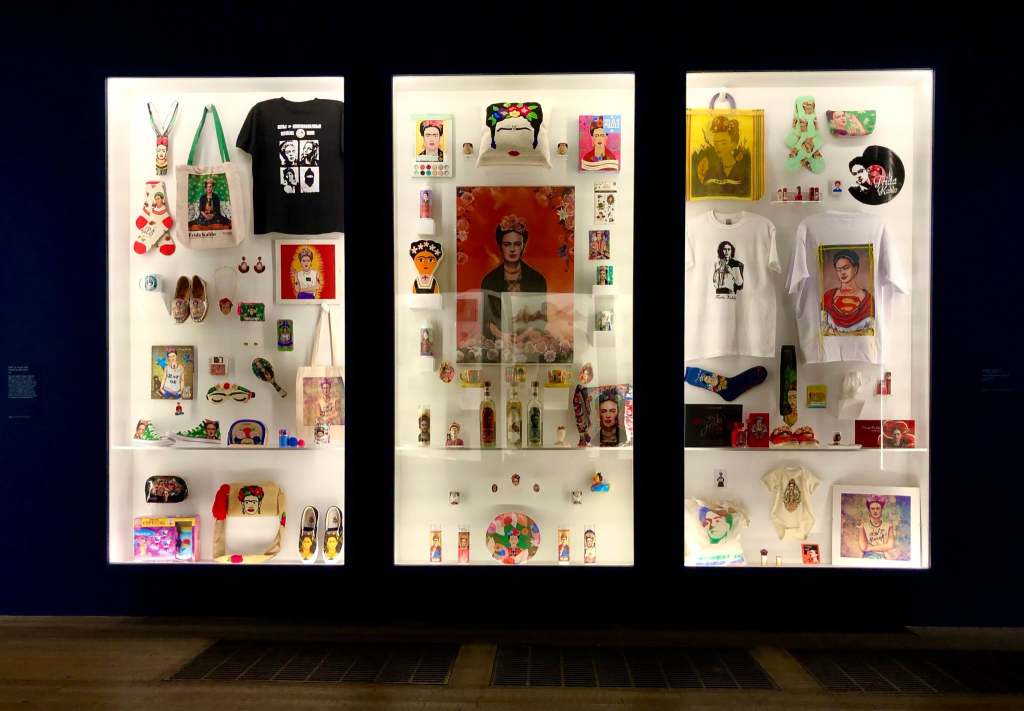
Today, her image adorns everything from coffee mugs and jewellery to Barbie dolls dressed in stylised Tehuana costume, self-portrait tote bags and devotional-style candles that recast Kahlo as a secular saint. Much of this merchandise appears not only within the exhibition’s narrative but also in the museum shop, where the story of Kahlo’s commodification itself becomes a commodity.
When Kahlo died in 1954, she was admired within artistic circles in Mexico and internationally, although her reputation was still frequently framed through her relationship with her husband, the muralist Diego Rivera. Over the following decades, however, her stature grew steadily. By the 1970s and 1980s, renewed interest in her paintings coincided with the rise of feminist art history, a growing international fascination with Mexican art and culture and the publication of Herrera’s landmark biography, Frida: A Biography of Frida Kahlo (1983).
Tracing Kahlo’s life from her childhood in Coyoacán, through her recovery from polio and the catastrophic bus accident at the age of eighteen that left her with lifelong pain and disability, to her turbulent marriage to Rivera, her affairs—including with Leon Trotsky—her political convictions and her uncompromising artistic vision, Herrera revealed the profound ways in which Kahlo transformed personal suffering into art. As Herrera observed, Kahlo “painted herself bleeding, weeping, cracked open.”
The exhibition opens with what is arguably its strongest section, introducing visitors to Kahlo through personal possessions, photographs, garments and paintings that trace the formative experiences that shaped both her artistic practice and the public identity she would later cultivate. Among the highlights are examples of her distinctive Tehuana dress and jewellery, together with a portrait of the eighteen-year-old Kahlo taken in the family home by her father, Guillermo Kahlo.
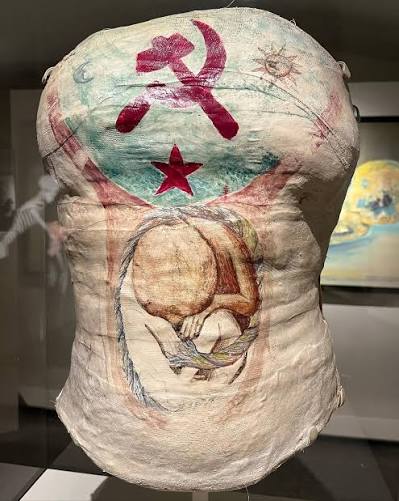
Particularly poignant is the pencil sketch The Accident (1926), in which flattened bodies lie scattered across the wreckage of the collision while Kahlo’s bandaged body rests on a stretcher in the foreground. Also on display is an undated photograph in which she restages the catastrophe using a toy cart and doll. Nearby, her painted orthopaedic corset Hammer and Sickle (and Unborn Baby) (c. 1950), stands as a deeply personal testament to the lasting physical consequences of the accident and Kahlo’s inability to bear children.
Offering a markedly different perspective, the intimate black-and-white photographs made in the 1930s by her friend and occasional lover, Julien Levy reveal Kahlo partially undressed yet entirely self-possessed. The images attest not only to her ease before the camera but also to the extraordinary magnetism she exerted on those around her. Levy himself described her as “a kind of mythical creature, not of this world.”
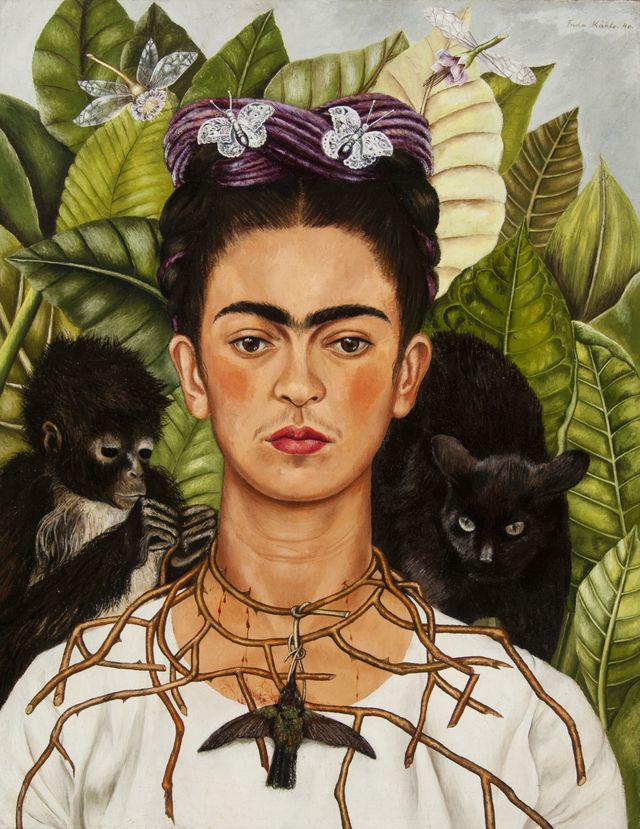
The second section explores Kahlo’s affinities with Surrealism, a movement with which André Breton famously associated her, declaring that her work had “blossomed forth…into pure surreality.” Yet what emerges most clearly is the extent to which Kahlo resisted any single artistic categorisation. Her work draws upon a rich visual vocabulary encompassing Surrealism, pre-Columbian culture, Mexican folk traditions, the natural world, Catholic devotional imagery and medical iconography, through which she unflinchingly explored bodily suffering, birth, miscarriage, sexuality, life and death, as seen most powerfully in her Self-Portrait with Thorn Necklace and Hummingbird (1940).
Her engagement with Mexican devotional traditions is equally evident in Survivor (1938), a small-scale oil painting on metal inspired by the stylistically naïve Catholic ex-voto. By adapting this familiar devotional format, Kahlo transformed a vernacular artistic tradition into an intensely personal visual language.
The exhibition’s concluding sections privilege contemporary recreations of Kahlo’s image while giving far less attention to the lasting influence of her emotional honesty and radically personal approach to self-representation on later generations of artists. At its strongest, this legacy is explored through works such as Kiki Smith’s From Heart to Hand (1989), Judy Chicago’s Birth Tear Embroidery 3 (1984), Catherine Opie’s Self-Portrait/Cutting (1993) and Mary McCartney’s photograph Being Frida (2000), depicting Tracey Emin dressed as Kahlo. As Emin herself has remarked of Kahlo, “Women can relate to her.”
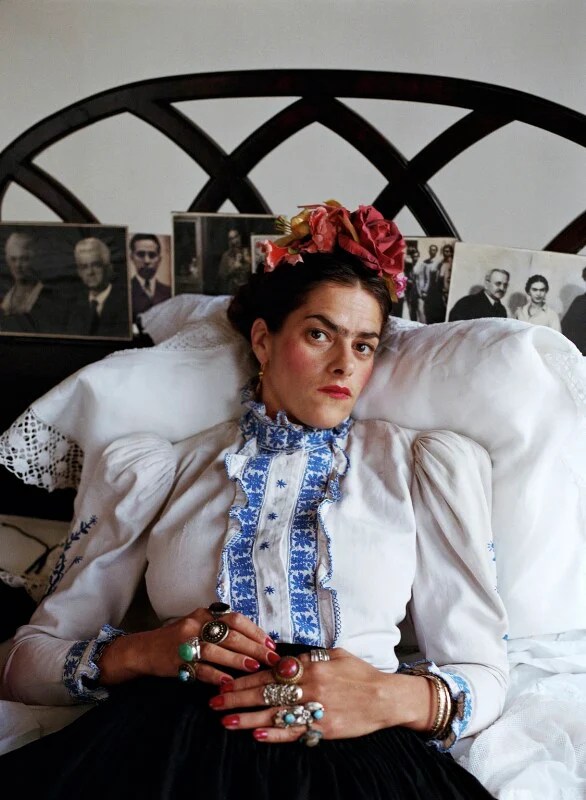
Dame Tracey Emin dressed as Frida Khalo
At its weakest, however, the exhibition descends into superficial appropriation. A succession of contemporary artists who don Kahlo’s distinctive costume, adopt her unmistakable unibrow or floral headdress, insert her likeness into their own compositions, or reproduce her instantly recognisable features as shorthand for broader statements about feminism, identity, gender or political activism. In doing so, they reduce a complex artist to a symbolic vehicle for their own artistic or ideological concerns.
Yet it is the final room that reveals the exhibition’s central contradiction. Intended to examine Kahlo’s transformation into a global cultural symbol, it instead succumbs to the very phenomenon it sets out to explore. Filled with examples of the commercial appropriation of her image and leading directly into a gift shop selling Kahlo merchandise, the exhibition stops short of interrogating the culture it so vividly documents. It is an oddly uncritical conclusion to an exhibition about one of the twentieth century’s most unflinching artistic voices. “I never painted dreams,” Kahlo remarked. “I painted my own reality.” The tragedy is that the exhibition ultimately leaves that reality overshadowed by the endlessly marketable fiction of the icon.
Further Reading
Gutiérrez, C. (dir.) 2024, Frida, documentary film, Amazon MGM Studios.
Herrera, H. 2018, Frida: The Biography of Frida Kahlo, Bloomsbury Publishing,
London.
Lowe, S.M. (ed.) 2006, The Diary of Frida Kahlo: An Intimate Self-Portrait,
introduction by C. Fuentes, Abrams, New York.

