By Keerthana Chari
From writing the electric-frequency dystopic novel (Giungla Domestica (Domestic Jungle), 1975) to poetry about subconscious introspection (‘Dal paese interiore’ (‘From the Interior Country’), 1982), Gilda Musa truly did it all. An Italian poet, writer, and journalist, she studied literature in Italy (Milan, Rome), Germany (Heidelberg), and England (Cambridge), writing both in Italian and German. Starting her literary career as a poet, she began writing science fiction prose in 1963 with the publication of her short story, ‘Memoria Totale’(‘Universal Memory’). Musa rose to prominence in Italian science fiction, or ‘fantascienza,’ in the twentieth century. Umberto Eco called Musa’s work a “cultured promotion of the science fiction story.” In the 1960s and 1970s, while science fiction remained a male-dominated genre, female writers began gaining popularity, such as Ursula LeGuin, Octavia Butler, and Madeleine L’Engle. The list goes on––at least, for works in English. Musa, crafting fantastical worlds across multiple languages, never reached a global audience, instead fading into obscurity following her death.
It was not until 2021, when writer Loredana Lipperini selected ‘Universal Memory’ for publication in the feminist anthology, Le scrittrici della notte (Women Writers of the Night, 2021), that Musa’s world came to life once again, through her very first prose story, centered on the timeless challenges of deep emotions, mental illness, and fractured self-identity. ‘Universal Memory’ is the very essence of Musa’s science fiction: resplendent and unpredictable. Her work, which once shaped the Italian canon, now demands revisiting.
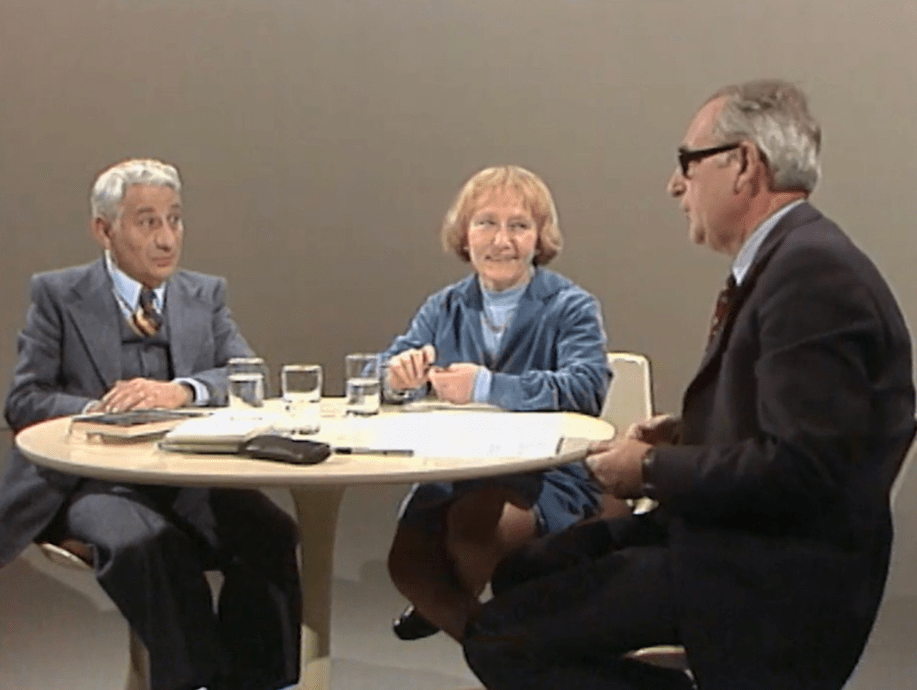
While Musa’s stories can be approximated by the terms “speculative fiction” or “sci-fi-fantasy,” they in truth exist outside of any genre altogether. In 1972, Musa published, Festa Sull’Asteroide (Party on the Asteroid), containing eight stories of varying lengths, including ‘Universal Memory,’ which is twenty pages long. In the book’s introduction, sci-fi columnist Aurelio De Grassi commented on the singular quality of Musa’s prose works, which existed outside established tropes of her time (and the modern day). De Grassi considered the American ‘psionics’ subgenre of the 1950s-60s, sci-fi stories with principles connecting psychic powers and electronics, the closest fit for Musa’s work. In an interview with Incontri conducted by Eros Bellinelli, Musa says, with regard to her writing of both poetry and prose, “They are one and the same….I don’t see a difference.” Her switch to predominantly prose publications in 1963 was a natural expression of her artistry and her science fiction, rather than adhering to a prescribed standard of literature developing in the field. In Musa’s own words, her writing contains an integral scientific element, valued as highly as the literary medium through which it is conveyed: “Science is truth. And literature is truth.” Bellinelli ventures, “So, science and humanities should not be divided, they should instead be seen continually as similar?” “Always similar. Each counts upon the other,” says Musa.
‘Universal Memory,’ where Musa’s prose style first takes shape, retains a poetic-like syntax reminiscent of her earlier works, playing with rhythmic phrasing and varied sentence structures. Although ‘Universal Memory’ is a speculative fiction story, much of what is surreal is entangled with what is abstract. Musa’s text is dotted with dense metaphors and nuanced personification, which turn commonplace objects mystical and sinister. As the story progresses, these literary devices seamlessly carry the reader to a liminal space between time, place, and imagination.
‘Universal Memory’ centers on Anna, a young Italian woman spending a day alone at home while her husband is away travelling. At last given a chance for rumination, she rediscovers painful and buried experiences from her past. The first half of the story lacks explicit supernatural elements. But, as Anna looks deeper within herself, she suddenly discovers the entire world: Anna’s “memories” extend beyond the scope of her own life, pulling from faraway cultures and times. To Anna’s surprise, she seems to know all the details of these other lives, all the way back to the start of human existence. Eventually, as mirrored by Musa’s increasingly freeform prose, Anna’s own reality becomes less distinguishable, and she fights to retain her identity despite the horrifying weight of the “universal memory” within her. The ending leaves ambiguity as to whether she emerges successful.
Musa uses literary devices to describe the setting of ‘Universal Memory,’ crafting a personified landscape that ranges from snow on the roof, to tree branches, to the repeated motif of a gurgling pot on the stove. Her metaphors are often nested and abstract. ‘Universal Memory’ gains its momentum from this setting, including Anna’s house in Milan and the different spaces she travels through in her memories. In Musa’s poetry, Eco noted the tension she creates between the objective correlative (the use of objects to evoke themes and imagery) and surges of visible emotion which “rebel” against it. Indeed, the quiet, but ever-present tension, and nearly “sentient” quality of the setting is a testament to Musa’s precision and renders Anna’s subsequent emotions more shocking and vivid.
Also evident in ‘Universal Memory’ is the breadth of Musa’s knowledge of history, philosophy, and languages, a product of her global background of study. She integrates temporally and regionally specific vocabulary such as “landau” (18th–19th-century carriage), “astrakhan” (fur from Karakul lambs) and “krater’ (ancient Greek vase), far removed from 20th-century Italy, creating an immersive universality to Anna’s consuming memories. The story’s epigraph comes from Hermann Broch’s The Death of Virgil, and by the conclusion Musa explores the concept of free-associative thinking. She also employs passages of dialogue in other languages like Spanish, German, French, and Latin, which adapt accordingly to the moment of time and place that Anna finds herself “reliving.” Musa subverts literary traditions of cross-lingual references to advance the construction of her speculative world.
Most curiously, Musa utilizes sudden switches from third-person perspectives to a first-person perspective in which Anna herself narrates. Anna deals with depressed feelings, perhaps due to post-World-War-II trauma, as her memories include scenes from bomb shelters and allude to her brother in concentration camp. In this context, the seemingly bizarre perspective shifts may capture a trauma-induced dissociation or a fractured self-view resulting from her mental instability. Whether the shifts are happening in Anna’s head or are imposed extraneously by Musa remains unclear. Regardless, they act as a sinister precursor to the second half of the story: Anna’s immersion into the memories of strangers continues, in a rapid and destructive fashion. Suddenly, Anna has the whole world and all of time inside of her mind. Does Anna’s instability generate this uncontrollable force, as a supernatural extension of her mental illness? Or, is she predestined to experience this universe of memories, regardless of her well-being? Here, Musa blurs the line between abstract emotion and paranormal forces, using long, unending blocks of text to rapidly transition between Anna’s different “memories.” The story becomes nearly unrecognizable––and a style of speculative fiction all on its own.
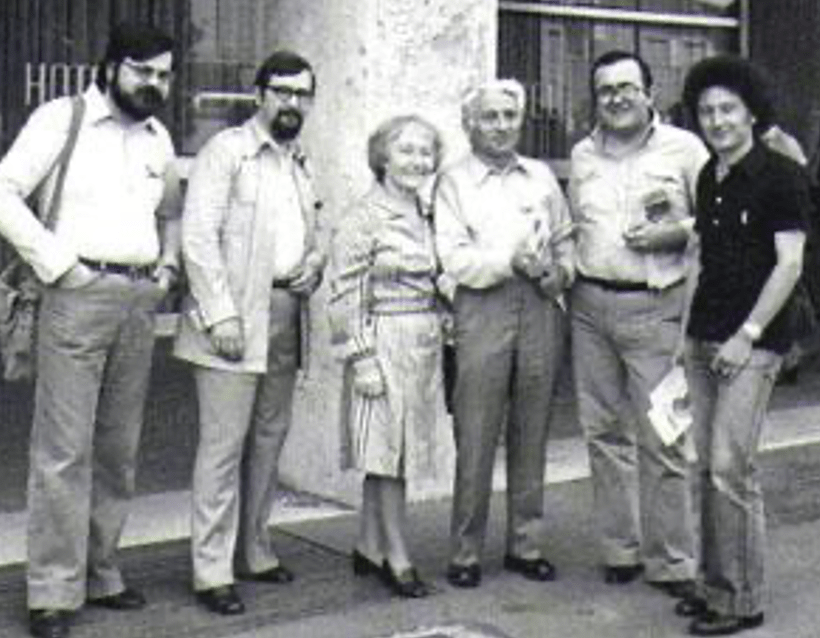
Source: Delos, Accessed via: https://www.mattatoio5.com/fantascienza/70-giungla-domestica-di-gilda-musa
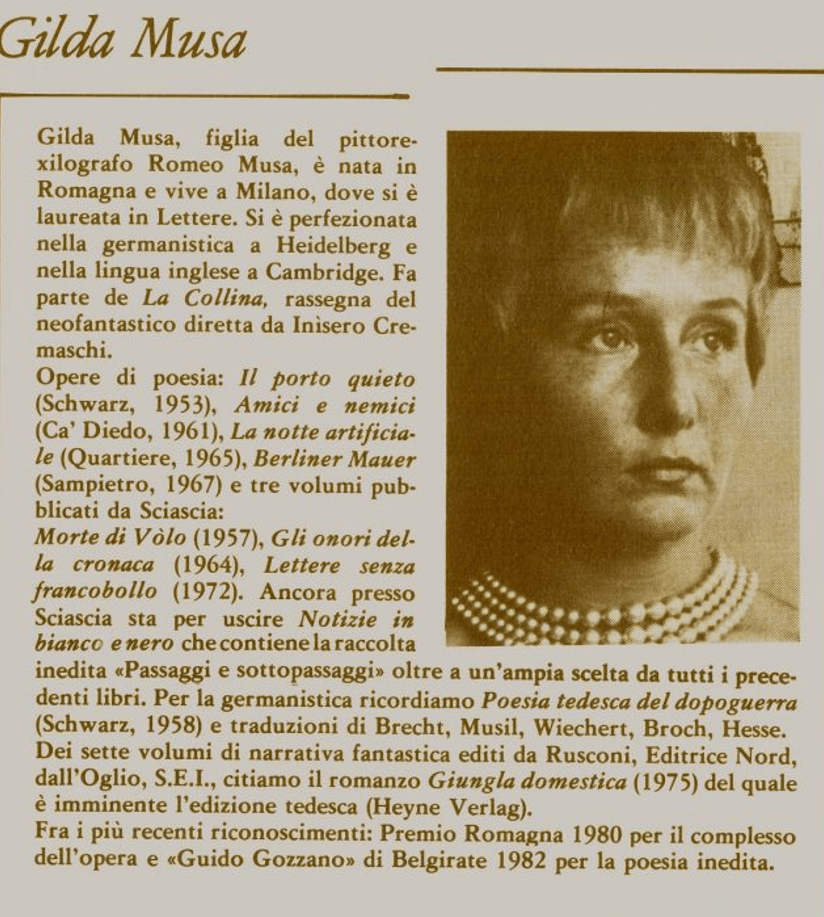
While breaking these literary boundaries, Musa was also making strides for the voice of women in science fiction. In her article feature in Quinta Generazione (Figure 1), every review of her poetry was written by a man, and this was a representative demographic of her colleagues in the field. While perhaps not a primary focus of Musa’s approach to writing, her perspective, particularly in ‘Universal Memory,’ grants the reader access to the deep interiority of the everyday Italian (and universal) woman of her time. By wielding speculative elements, Musa transforms the ordinary into extraordinary.
Musa’s exploration of warped time and introspection remains potent today, evoking Proust’s approach to memory and the worlds of the interior. Her shifting perspectives used to represent the same character emulate Joyce’s Ulysses and the postmodernist view of the self. Ahead of her time, Musa bridged these innovations in standard fiction literature with a poetic sensibility and the imaginative exploration of science fiction. Her distinctive voice draws from each of these genres, yet strays altogether from any one. Rather than becoming inscrutable, Musa strikes deeply at the psyche, wielding the fantastical to evoke the deepest realms of our fears, desires, and imagination. She envisioned a rich, multi-faceted speculative and science fiction, not only in content, but in form too.
Musa’s science fiction could be set on a foreign planet or in the infinite recesses of a woman’s mind––no matter how outlandish the premise, readers can find themselves reflected in her metaphor and wit. Musa recognized that what makes science fiction meaningful is its ability to feel deeply, incredibly human.
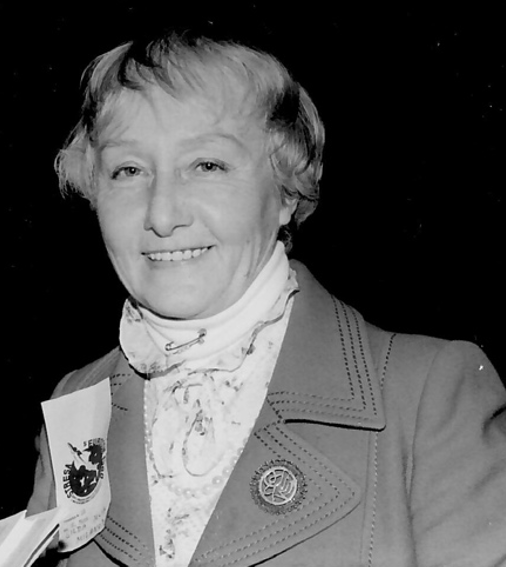
Accessed via: https://www.isfdb.org/cgi-bin/ea.cgi?129262
Quotes from the Incontri interview have been translated from the original Italian. Those interested in viewing the full interview can find a link below. Also included is an English translation of ‘Universal Memory.’
Further Reading
Bellinelli, Eros. ‘La poesia della fantascienza.’ Interview with Gilda Musa and Inisero Cremaschi. Incontri. Fatti e personaggi del nostro tempo, February 7, 1979. La Nostra Storia. https://lanostrastoria.ch/documents/01k818851sa23hr2w8258y9r7g.
Chari, Keerthana (trans.), “Universal Memory,”. Yale Journal of Literary Translation, Issue 14, Fall 2023, pp.56–81. https://www.yalejolt.com/issue-14
Ianuzzi, Giulia, Distopie, Viaggi Spaziali, Allucinazioni; Fantascienza Italiana Contemporanea, Mimesis Edizioni, 2016.
Musa, Gilda, ‘Memoria Totale’ in Loredana, Lipperini (ed.), Le Scrittrici Della Notte, Il Saggiatore, Milano, 2021.
Musa, Gilda, Festa sull’Asteroide, (Introduction by Aurelio De Grassi), Milano, Dall’Oglio, 1972.
Musa, Gilda, ‘Poems’, Quinta Generazione 11, no. 103/104 (1983). Reproduced in ‘Gilda Musa – Poesie del 1983.’ Biblioteca Dea Sabina, Associazione Culturale Dea Sabina, June 8, 2025. https://www.abcvox.info/gilda-musa-poesie-del-1983-pubblicate-dalla-rivista-quinta-generazione-n103-104-anno-xi-1983-biblioteca-dea-sabina/.

