By Maisie Corkhill
Natalie Heller Mills, the trad-wife influencer of Caro Claire Burke’s Yesteryear (2026), is a feminist. This might be hard to believe as we watch her proclaim herself as the perfect mother, wife, and ‘flawless Christian woman’ in the first pages of the novel. Even when the veneer of this performance falls, Natalie would never admit to being part of ‘feminism, that nasty witch’, as she calls it. And yet she consistently articulates issues that fall directly within a feminist struggle, such as the unnaturalness of motherhood, the unpaid labour required to bring up children, and (albeit in the service of ridiculing another woman) she correctly identifies power imbalances in the capitalist workplace that continue to prevent women’s equal integration into the workforce. In other words, even in this character’s inconsistencies, laced with malice and spite, we witness the impossible position of women in capitalist societies. What is in equal parts compelling and concerning is that I don’t believe Burke meant for Natalie to be read as a feminist. In Burke’s writing Natalie is reduced to a stick to beat the ‘tradwives’ with, rather than a vehicle to expose both the historical systems of oppression and contemporary incel-culture that have created this new impossible category of attainment for women.

In the 1970s, the Marxist-Feminist scholar Silvia Federici co-founded a movement called
“Wages for Housework”. Their demand was based on a simple premise. That the work done in the home, including the cooking, cleaning, servicing the emotional and sexual needs of the husband, reproduction (because it reproduces the workforce) and bringing up children is the essential labour that supports all other labour and therefore keeps the wheels of capital turning. That this unpaid, unacknowledged labour of women in the home is seen as a biological inevitability, or natural calling is, at least in part, a fiction that Federici traces back to the rise of capitalism in the 16th and 17th centuries. In Caliban and the Witch (2004) Federici argued that the witch hunts were representative of a genocidal campaign waged against women in the wake of the transition of feudalism to capitalism, with women feared so much by the state that ‘from the pulpit to the written page’, Federici writes, ‘all cooperated in the vilification of women, constantly and obsessively’ (Caliban, 115). From this defeat arose, in Federici’s words, ‘a new model of femininity’: ‘the ideal woman and wife—passive, obedient, thrifty, of few words, always busy at work, and chaste.’ (Caliban, 118). And thus the blueprint for the ‘tradwife’ was born at the end of the 17th century. According to Federici’s work, the housewife is not a tale as old as time, but a tale that was told at the birth of capitalism to lay the foundations for massive industrial and economic growth.
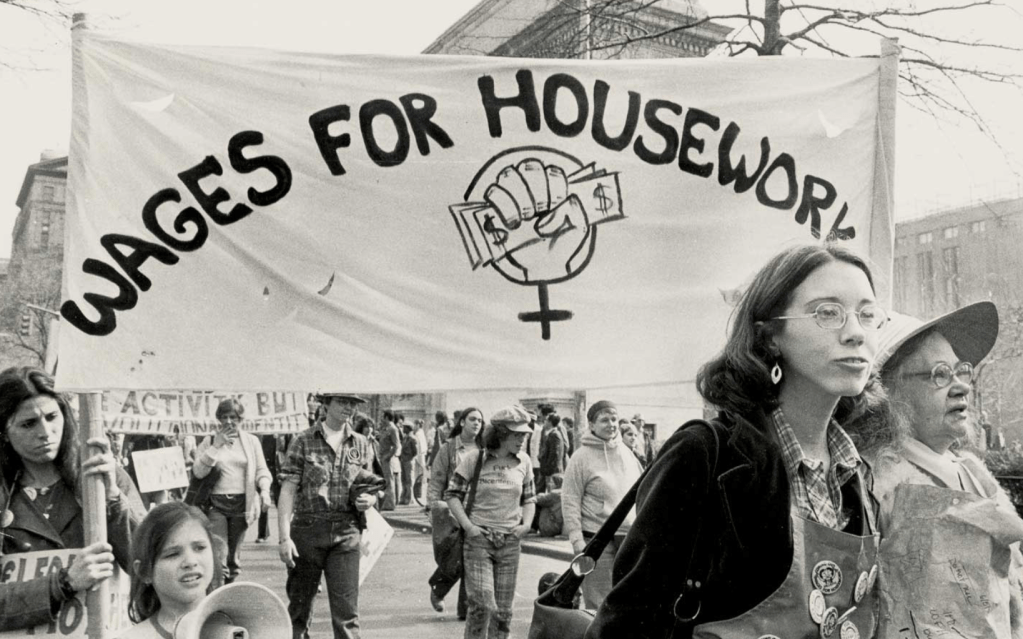
Radcliffe Institute / Bettye Lane
On paper, it seems the viral tradwives have got what Federici asked for. They do the work of the house, and they are paid: eye-watering sums from social media revenue and affiliate deals. But this is the opposite, uncanny version of what Federici fought for. After publishing “Wages Against Housework” the ideas came under fire from left-wing and liberal feminists such as Carol Lopate, who were concerned that a wage would valorise housework and preclude many women from undertaking other work. As Federici wrote in her rebuttal, this is to wilfully misunderstand the terms of the movement, as ‘to demand wages for housework is to refuse to accept our work as biological destiny’ (Patriarchy of the Wage). Federici identified the wage as an introduction of choice. For better or worse, when your labour is waged you can choose whether to work. And if the conditions of life force you into wage-slavery, that is still different from true slavery, because at the most fundamental level, you still have a choice:
‘you work, not because you like it, or because it comes naturally to you, but because it is
the only condition under which you are allowed to live. But exploited as you might be,
you are not that work’ (“Wages for Housework”).
Federici and her co-authors saw housework as ‘one of the most subtle and mystified forms of violence that capitalism has perpetrated against any section of the working class’. This is why tradwives are so disturbing. They do not represent wages for housework, but instead the all-encompassing victory of capitalism to repackage the housewife into an advertisement, to make it desirable to the populace. Via social media the housewife is not only legitimised but romanticised, and used to sell women the tools of their own subordination: aprons, cast-iron pots, bone-broth cocoa that will give you a postpartum glow! (according to Hannah Neeleman of the infamous ‘BallerinaFarm’).

This is what Yesteryear takes aim at, and misses. Rather than looking at the history, or indeed the dystopian political context that has given rise to the tradwife, Burke instead makes an example of one. As she wrote in a piece for the Guardian, ‘I figured if I couldn’t subvert the image of the tradwife, then I could subvert her world instead – and see how long it takes before she starts to scream’. This approach – which The Times referred to as ‘weirdly sadistic’ – means that more meaningful critiques end up falling through the gaps. There is a limp, mildly condemnatory take on the husband, Caleb, whose weaponised incompetence leads Natalie to start Yesteryear Ranch to ‘fix him’. Caleb’s father is a Trump-inspired politician who hosts confederates at his rallies. With this man Natalie bargains her womb for the money to buy the ranch: ‘That’s the deal. I’ll pay for this little farm fantasy, and in return you’ll give my son a big American family’. Burke honours the open secret that you need significant pre-existing wealth to build this kind of ‘empire’, as Natalie refers to it. Here we diverge from Federici, whose work focuses predominantly on the proletariat working-classes and their oppression from above. Which raises a question Burke never fully addresses: what happens when you exploit yourself?
But is Natalie truly exploiting herself? Perhaps the most ‘trad’ thing about Yesteryear is that Natalie is dispossessed of any capital from her own ‘empire’. ‘Caleb’s name, and Caleb’s name alone, will be on the deed for the ranch’. When he discovers the Instagram payments, they too are redirected to his account. Here is the unsettling potential behind the romanticisation of ‘trad’ lifestyles. If we choose to see social media earnings as a form of wages for housework (which of course they are not, although they may appear to be) the wages in Yesteryear are redirected to the husband, thus continuing historical cycles of oppression. But Burke is not so interested in this as punishing Natalie for her choices: the book practically screams, “look at you, you silly bitch, you chose this”. Burke even reposted a reviewer on Instagram who squeals gleefully at “the most insufferable crazy ass chick I have ever read in my life!”. In her efforts to make Natalie ‘scream’ Burke simultaneously loses sight of her true target and adds fuel to the reductive trope of the ‘crazy woman’.
What these ‘tradwives’ represent is not an innocent revival of domestic life but the polished, exfoliated and preened face of a hyper-traditional fantasy that benefits capitalism and promotes extreme political ideologies. As Burke herself pointed out, the term ‘tradwife’ began on incel forums. It represents the ultimate wet-dream of the patriarchy: getting women to consent to their own oppression and sell the dream along the way. Federici and her movement fought to make the invisible labour of women in the home visible, so it could be challenged. Now it is not only visible but perfectly staged, filmed with a ring-light, and repackaged as liberation to be sold to women everywhere.
Further Reading
Caro Claire Burke, Yesteryear (2026)
Caro Claire Burke, (2026) ‘Serve, smile, procreate,’ The Guardian, 29 March. Available at: https://www.theguardian.com/books/2026/mar/29/serve-smile-procreate-yesteryear-author-caro-claire-burke-on-the-rise-of-the-tradwife
Silvia Federici, Caliban and the Witch: Women, the Body and Primitive Accumulation (2004)
Silvia Federici, “Wages Against Housework” (1942)
Silvia Federici, Patriarchy of the Wage: Notes on Marx, Gender, and Feminism (2021)

