By Olivia Hurton
‘She was a poet on a street corner trying to recite to a crowd pulling at her clothes’
– Arthur Miller on Marilyn Monroe
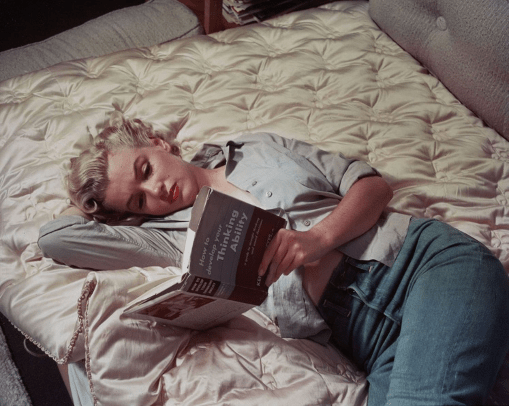
Marilyn Monroe (1926-1962) was the bleach-blonde-haired beauty, the Hollywood actress, the sex symbol. She was a manufactured persona that Norma Jeane Mortenson, a girl who was abused and abandoned as a child in Los Angeles, could hide lifelong insecurities behind. So effective was this shield of physical radiance and irresistible girlish charm, as immortalised by celluloid hits like Gentlemen Prefer Blondes, The Seven Year Itch and Some Like it Hot, that it consumed the media’s attention and largely overshadowed interest in the richness of her interior life. Even Joyce Carol Oates, the author of Blonde (2000), a fictive biography of Monroe, and usually an astute commentator, went as far as to say that she ‘seems to have been a naturally gifted actress because, perhaps, she so lacked an inner core of identity’. Yet Marilyn was deeply concerned with her identity and emotional life. She drew on psychologically scrutinising acting techniques like the Method, which depend on performers excavating personal memories to give substance to dramatic roles, and was a devotee of Freudian psychoanalysis. What is less known, however, is that in conjunction with acting, it was through the reflective practice of writing poetry that Monroe came to explore the depths of her interiority.
In 1962, when Monroe died under mysterious circumstances, owing to an intentional or accidental drug overdose, her personal possessions found their way to the revered American acting teacher Lee Strasberg, and later his widow Anna. Among the papers they inherited were sporadically used notebooks, letterheaded paper from lavish residences like the Waldorf Astoria and the Beverly Hills Hotel, and loose sheets which contained confessional poetry, fragmentary outpourings, song lists and occasional lines of film dialogue. Misspellings, crossings outs, and indifference to lineation pepper the compositions. Despite the editorial challenges posed by these idiosyncrasies, in 2010 Stanley Buchthal and Bernard Comment published a volume that collated the papers, Fragments: Poems, Intimate Notes, Letters by Marilyn Monroe, making them accessible to a wider readership.
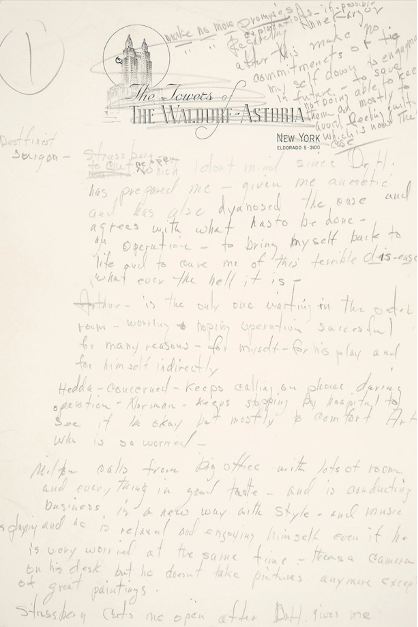
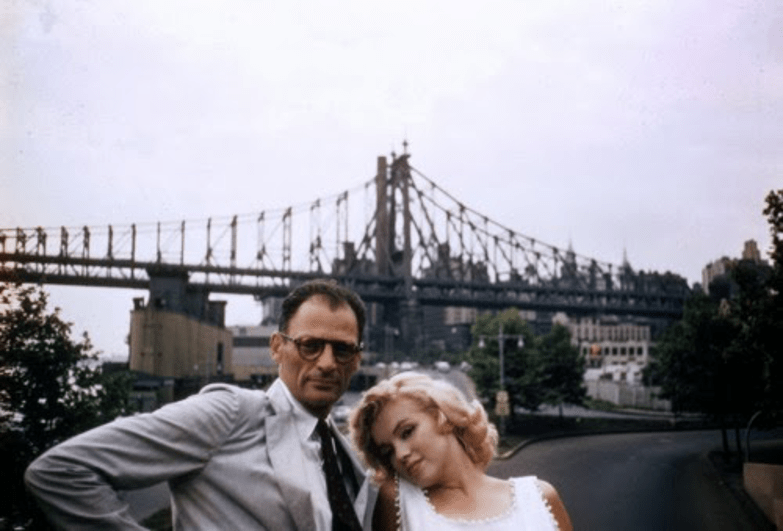
What is clear from Monroe’s poems is that, for her, the act of composition was a form of psychoanalysis, a means of penetrating the unconscious mind. Her lyrics are free and associative, with occasional evidence of redrafting to achieve a more polished form. The effect is often theatrical, as if reading the poem is witnessing Monroe’s consciousness perform a drama of self-enquiry. This is the case in a poem about Brooklyn Bridge—likely a nod to the 1955 play A View from the Bridge by Arthur Miller, whom Monroe met the year it premiered and later married—which moves from erratic suicidal yearnings to an appreciation of the subtle beauty to be had, even in the welter of modern urban life:
Oh damn I wish that I were
dead—absolutely nonexistent—
gone away from here—from
everywhere but how would I do it
There is always bridges—the Brooklyn
bridge no not the Brooklyn Bridge
because But I love that bridge (everything is beautiful from there
and the air is so clean) walking it seems
peaceful there even with all those
cars going crazy underneath. So
it would have to be some other bridge
an ugly one and with no view—except
I particularly like in particular all bridges—there’s some-
thing about them and besides these I’ve
never seen an ugly bridge
The poem begins as an urgent death wish: Monroe’s ‘Oh damn I wish that I were/dead’ is a blunt, colloquial echo of Hamlet’s ‘O that this too too solid flesh would melt’ (1.2.133). It shares with the Shakespearean soliloquy a desire for physical and psychological release, one that is persistently frustrated by the dashes that stagnate Monroe’s flow of thought. When considering a possible method of suicide, the poet observes that ‘There is always bridges’. But ironically, it is the thought of the Brooklyn Bridge that draws her out of introspection and into the material world, which offers quiet consolation and sensory delight. Standing on it, she is inspired with a sense of optimism, ‘everything is so beautiful’ and the ‘air is so clean’—even if these thoughts are only diffidently acknowledged in brackets.
Darkness and paranoia soon resurface. The bridge only ‘seems/peaceful’, for beneath it ‘cars [are] going crazy’, a reminder of the frantic chaos of the metropolis and Monroe’s mental unease at the start of the poem. The symbol of the bridge is significant, too. As Monroe tells us, there’s ‘some-/thing about them’. Bridges represent a distanced perspective, literally from the urban waste land and figuratively from the tortured self, promising calm and respite. They are structures of connection, geographically yoking together Brooklyn and Manhattan, but also, if seen metaphorically in light of Monroe’s romantic relationship with Miller, they are an affirmation of the possibility of fulfilling intimacy. If elsewhere the actress wrote, ‘I am always/alone/no matter what’, ‘I’ve/never seen an ugly bridge’ suggests a movement towards hope and faith.
https://nycpast.org/2014/03/20/a-decisive-moment-marilyn-monroe-in-new-york/
Besides an interest in psychoanalysis, Monroe’s poetry is suffused with the spirit of nineteenth- century British Romanticism. This is not a coincidence. In her personal library of over four hundred books, she kept volumes of poetry by Blake, Shelley, Burns and Wordsworth. Like her Romantic predecessors, Monroe’s lyrics find nature to be a source of ‘tranquil restoration’, as Wordsworth put it in ‘Tintern Abbey’, but this is not due to its sublime beauty. Rather, for Monroe, nature’s spiritually consoling qualities derive from its apparent capacity to triumph over hostile external environments—sentiments the actress-poet, who’d been overwhelmed by personal setbacks, related to. For example, in an imagistic poem addressing ‘Life’, she identifies with nature’s robustness, how its fragility deceptively conceals strength and its adversities unleash an intensified sense of vitality: ‘Life—/I am of both your directions/ Somehow remain hanging downward/ the most / but strong as a cobweb in the/wind—I exist more with the cold glistening frost’.
However, Monroe complicated this perception of nature in a poem of 1955. Written in the comfort and luxury of her three-room suite at Park Avenue’s Waldorf Astoria, the actress dreamed of the humble resilience of a river besieged by threatening forces:
That silent stirring river which stirs
and swells itself with whatever passes over it
wind, rain, great ships.
I love the river—it is never unmoored
by anything
it’s quiet now
And the silence is alone
except for the thunderous rumbling of things unknown
distant drums very present
but for the piercing of screams
and the whispers of things
sharp sounds and then suddenly hushed
to moans beyond sadness—terror beyond
fear
The cry of things dim and too young to be known yet
The sobs of life itself
As the river is invaded by ‘wind, rain, great ships’ it ‘stirs/and swells’, a response registered in lines that unsteadily grow and contract. But Monroe insists upon its strength in the face of these disruptions; they are only superficially ‘pass[ing] over’ the river and do not pose a threat because, as she asserts with admiration, it is ‘never unmoored/by anything’. Indeed, the river’s ‘silence’ is meant to be taken as a measure of its serenity and repose.
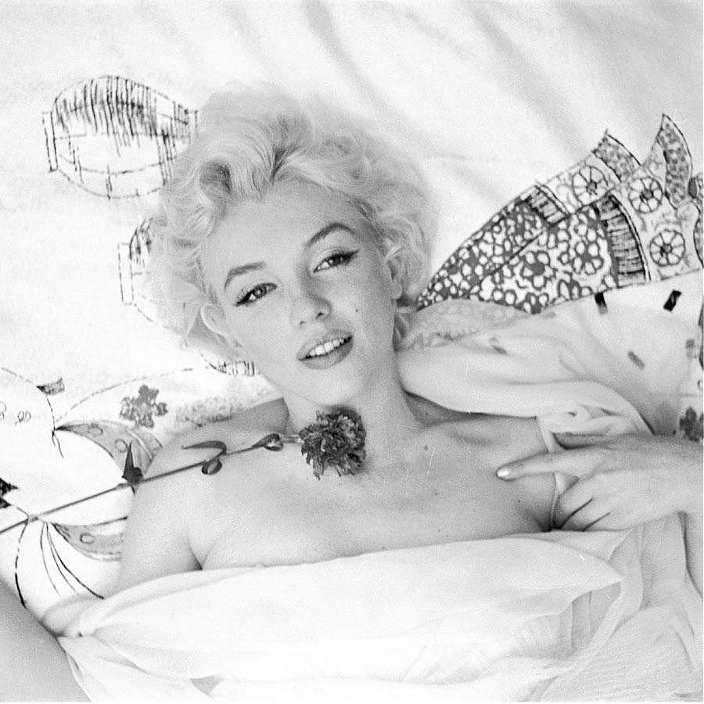
Yet this becomes more troubling when a cacophony is heard further off, which Monroe dramatically evokes through ominous assonances and startling alliterations (‘thunderous rumbling’, ‘distant drums’, ‘sharp sounds’). The vague form of these descriptions, ‘things dim’ and indecipherable, adds to the unnerving sense of menace. Even silence now takes on a sinister quality, representing grief that surpasses expression (‘hushed/to moans beyond sadness’). At the poem’s emotional climax, the terrors are described as the ‘sobs of life itself’, indicating existential breakdown. From the poet’s initial optimism and conviction, there has been a collapse into a maelstrom of emotional anguish. The river’s alluringly placid surface has exposed a chasm of unfathomable terror. It recalls photographer Cecil Beaton’s paradoxical characterisation of Monroe. ‘She romps, she squeals with delight […] It is an artless, impromptu, high-spirited, infectiously gay performance’. He added inauspiciously, ‘It will probably end in tears’.
Monroe’s poetry also reveals the actress’s deep-rooted anxieties about the fading of her beauty, upon which her economic livelihood and self-esteem were dependent. In a lyric written in 1956 while Monroe was residing at Parkside House in Surrey during the tumultuous filming of The Prince and the Showgirl (her spats with director and co-star Laurence Olivier were frequent), she sensitively sketches a character study of ‘an old woman’ paranoid about confronting her aged, ‘toothless’ reflection:
it is not to be for granted
in life less that the old woman hides—
from her mirror glass—the one she polishes so it won’t be dusty—
daring sometimes that to
to see her toothless gasp and if she perhaps very gently smiles
years only she remembers—
her life or imagined youth pain
her pale chiffon dress
that she wore on a windy
afternoon when she walked
where no one had ever been
her blue eyed clear eyed baby who
lived to die—the woman’s youth years have
not left. The woman stares & stares in space
Although the mirror shows the woman a haggard reflection she does not wish to see, she continues to polish it ‘so it won’t be dusty’, suggesting that peering into it is a masochistic temptation. When she is ‘daring’ enough to confront its gaze, she is able to see her past self, one who wears a youthful ‘pale chiffon dress’ on an ominously ‘windy/afternoon’. Indeed, what should be a nostalgic memory is fraught with ‘pain’: the old woman recollects her baby ‘who/lived to die’ and her solitude is implicit in the fact she walks ‘where no one had ever been’. While to the outside world she is a shell of her youthful incandescence, psychologically ‘the woman’s youth years have/not left’. Both past and present selves coexist, shrouded with mental disturbance and misery. Working in the Hollywood film industry, which has always unhealthily fetishized youth, this poem, written when Monroe was thirty, can be seen to afford her momentary mental relief from its pressures. The actress achieves this by employing a third-person perspective, displacing her misgivings about growing older onto a dramatic character, and in doing so, enabling her to understand them objectively.
https://www.facebook.com/photo/?fbid=24235960085987671&set=gm.10162950439063001&idorvanity=31246488000
Norman Rosten, a close friend of Monroe and Miller’s, wrote that the actress ‘had the instinct and reflexes of the poet, but she lacked the control’. Marilyn Monroe’s poems are revelatory precisely because of their raw and unfettered emotionalism. They lay bare the hieroglyphics of a secret soul, affording the actress space to speak, unguarded and in a continual quest for self-knowledge. At the same time, this trove of archival poems reveals the actress’s highly conscious acts of self-interrogation and wilful literary experimentation, dispelling the notion that Monroe was the paradigmatic ‘dumb blonde’, an identity she often endorsed on-screen ironically and for financial gain. Beneath the indestructible sexual allure was a sharp, searching intellect, one that looked to poetry to achieve psychological clarity. By diligently writing and concentrating on analysing her thought processes, Monroe hoped to get closer to figuring out how to exist when confronted with unbearable pain and debilitating solitude. On a loose sheet entitled ‘re-relationships’, she mused hopefully, ‘I think to love bravely is the best and accept—as much as one can bear’. One hundred years after her birth, the world hasn’t stopped loving her back.
Further Reading
Ed. by Stanley Buchthal and Bernard Comment. (2010) Fragments: Poems, Intimate Notes, Letters by Marilyn Monroe. London: HarperCollins Publishers.
Sarah Churchwell. (2004). The Many Lives of Marilyn Monroe. London: Granta Books.
Jacqueline Rose. (2012) ‘A Rumbling of Things Unknown’, London Review of Books, 26 April. Available at: https://www.lrb.co.uk/the-paper/v34/n08/jacqueline-rose/a-rumbling-of-things-unknown (Accessed 2 June 2026).
Ed. by Yona Zeldis McDonough. (2002). All The Available Light: A Marilyn Monroe Reader. New York: Touchstone.

