By Elodie Harper
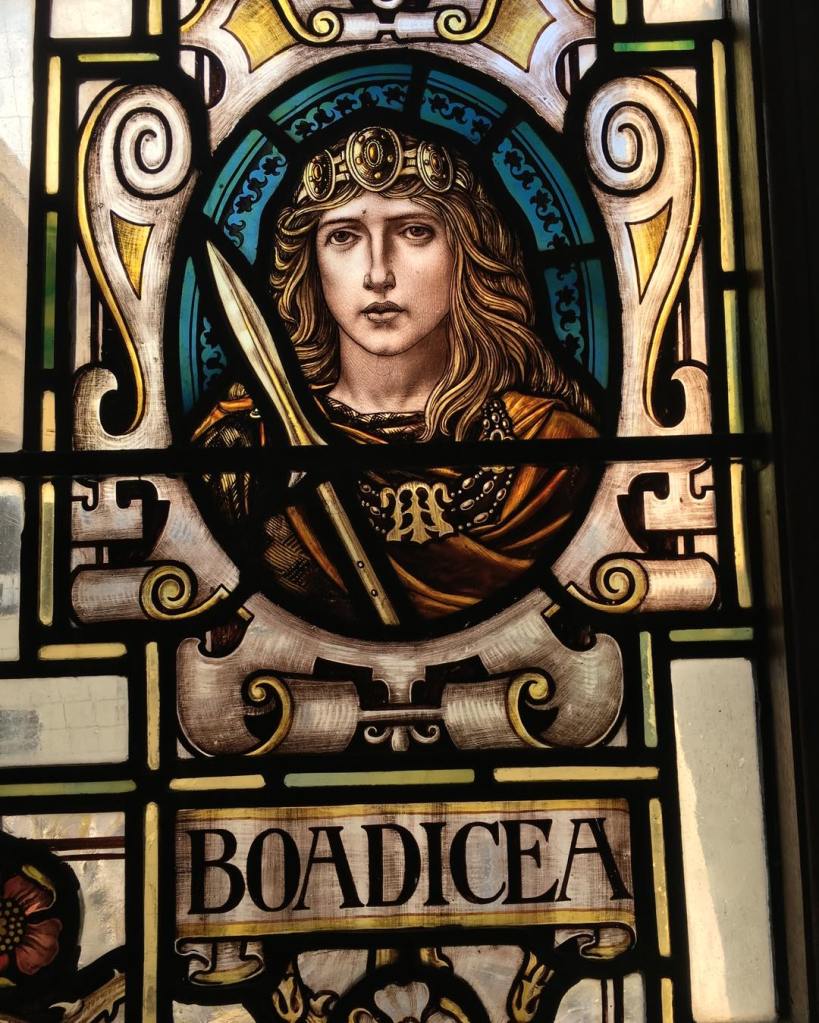
Boudicca haunts the curriculum of British primary schools, rampaging through textbooks with her flaming red hair and fearsome chariot, a rare woman among all the ancient kings. As children we learn about her as the leader of the Iceni tribe of East Anglia, a rebel queen who almost succeeded in driving the Romans from first century Britain, burning down London in the process. She is often presented as a semi-mythical figure rather than a real military commander, or else like Queen Elizabeth I as a wholly ‘unique’ woman outside the norms of her time. The comparison between the two queens is no accident; Elizabeth Tudor styled Boudicca in her own image as propaganda, which is why we now think of Boudicca with red hair.
Yet Boudicca was not unique for her time. She belonged to a world where women could wield immense political power, whose ancient societies we are still only just beginning to understand, not only by digging out new evidence at archaeological sites, but also from scaling back centuries of sexist assumptions. Boudicca is a fascinating enough figure on her own, but she becomes even more interesting when we see her alongside the other women of her time. None more so than her own daughters.
© Colchester Town Council
Much of what we know about Boudicca is thanks to the Roman historian Tacitus. His father-in-law Agricola was an eyewitness to the Boudiccan revolt, having fought against the Iceni rebels under the command of Gaius Suetonius Paulinus in 60/61 CE. While Tacitus is hardly impartial, his account still gives us valuable information. When I was reading his biography of Agricola as research for my book Boudicca’s Daughter, one line in particular struck me; in describing Boudicca’s rise, Tacitus tells us that the Britons do not distinguish between the sexes when choosing commanders. This brief explanation for her role gives a fleeting glimpse of a society very different from Rome. We all know women did not sit in the senate, command legions, or stand for public office, and even more than these practical hurdles to women holding imperium in Rome, it was simply unthinkable. Even today, we are so used to thinking of the women of the classical era as oppressed, it can be hard to believe different power structures co-existed. Yet for the ancient Britons, women holding power was not only possible, but perhaps quite ordinary.
In the same year that Boudicca was rebelling against Rome, another woman was governing part of Britain on Rome’s behalf. Cartimandua of the Brigantes tribe ruled the North of England as a client Queen, and although she was loyal to Rome, Tacitus criticises her scandalous choice to discard one husband for another. Cartimandua’s decision to change her man is more than gossip fodder – it again suggests ancient Britain had different gender power dynamics, this time in the case of sexual/familial relationships rather than on the battlefield. Cartimandua also provides an interesting potential overlap with a series of Iron Age chariot burials in Yorkshire, the Brigantes heartland, in which both men and women were buried with the trappings of power and wealth. Boudicca is famous for her war chariot, and the Yorkshire burials suggest Britain had other powerful women-charioteers.
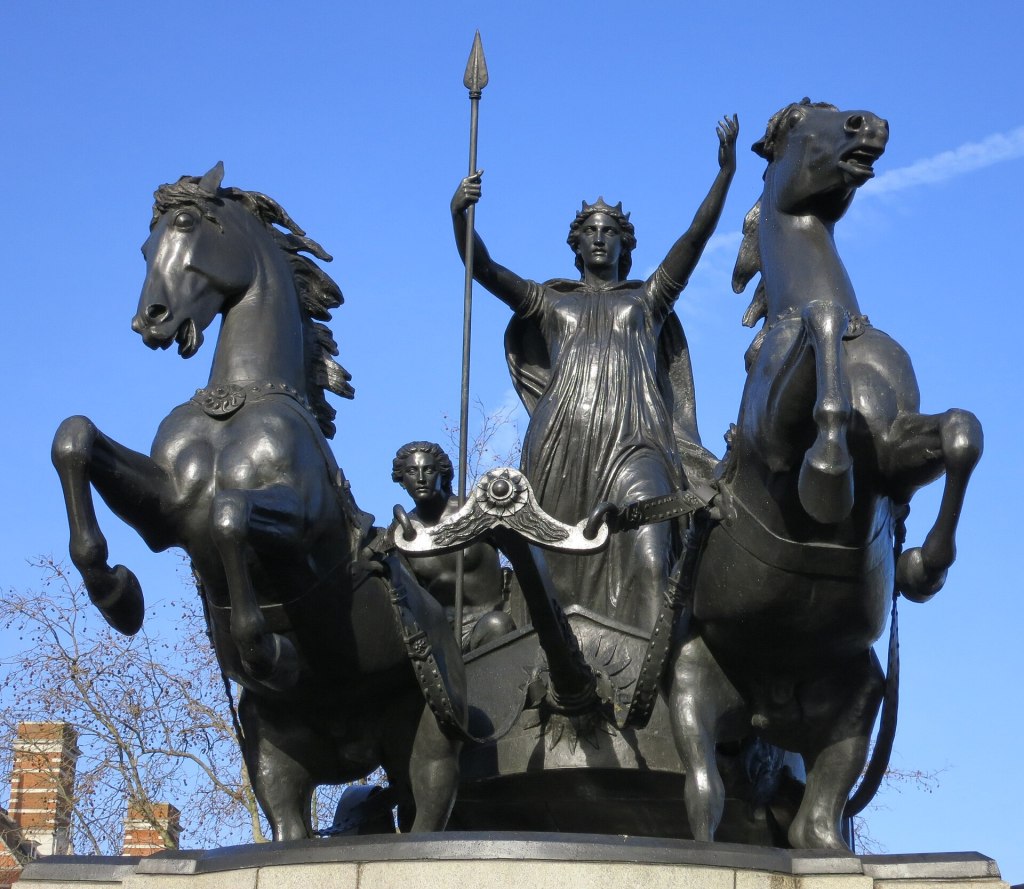
Our understanding of Boudicca as one woman among many is also a helpful approach to considering the women of her own family. Perhaps even more surprising than a tendency to overlook direct contemporaries like Cartimandua, is the scant attention given to Boudicca’s two daughters. In the Victorian monument to Boudicca by Thomas Thornycroft, which stands on Westminster Bridge facing the Houses of Parliament, the rebel leader is shown as one of three, though not three of equal importance. In Thornycroft’s statue, both daughters are cowering beneath their mother, visually in her shadow, bare-breasted, and from some angles, impossible to see at all. Yet from the little we know about Boudicca’s daughters, they were key to the revolt.
https://en.wikipedia.org/wiki/Boadicea_and_Her_Daughters#/media/File:Boudica_statue,_Westminster_(8433726848).jpg
It is Tacitus who again gives us the details. Boudicca and her husband Prasutagus – who like Cartimandua was a client ruler for Rome – had two daughters. After his death, Prasutagus attempted to hand over the Iceni kingdom to his daughters, requesting in his will that they become client rulers for the emperor Nero. The Roman leadership in Britain took offense at this, dispatching soldiers to humiliate the family. Boudicca was flogged, her two daughters raped, and the family wealth looted. It was this atrocity, together with widespread financial oppression against the Iceni people, that prompted Boudicca to launch her rebellion. According to Tacitus, the three women rode across East Anglia in a chariot, mustering rebels with their tale of violence and injustice.
The account by Tacitus immortalises Boudicca’s daughters as nameless victims. Yet however horrific the sexual violence committed against them, the assault is only a fragment of their story, just one event in two multifaceted lives. They were both heirs to a kingdom, who would have been raised to rule during a politically turbulent period, not through marriage but in their own right. And they may not have been the only ancient British women destined to inherit power this way. In January 2025, evidence of matrilocality was discovered at an Iron Age burial site of the Duotriges tribe in Dorset. This means that the men of the Duotriges tribe joined their wives communities’ on marriage, moving to become part of another household. Matrilocality is rare; wherever it is found, it suggests a society where women held significant power.
When we look at the lives of Boudicca’s daughters, historical texts and archaeological discoveries can only take us so far. Ultimately, there is so much we will never know. Tacitus does not tell us if the two women died in the Iceni rebellion, if either were captured or else survived, whether they took their own lives like their mother or else lived to witness the brutal aftermath of her fall. Fiction is one way to fill the gaps left by these questions.
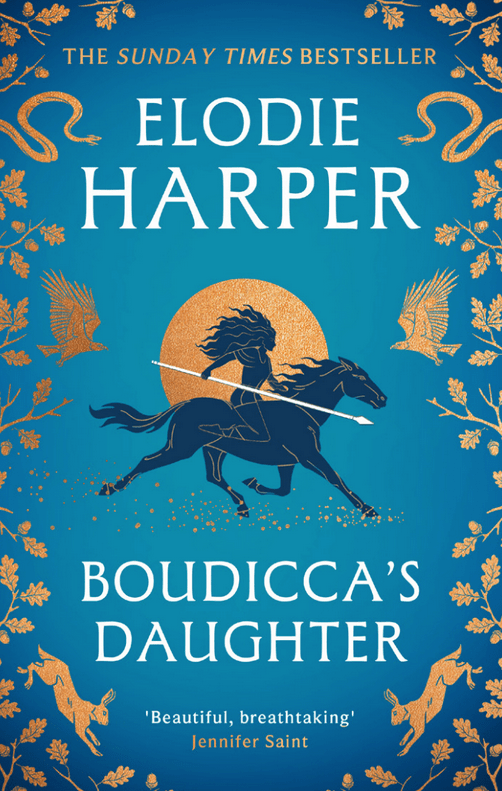
In writing about Boudicca’s daughters, my first step was to give them names – Solina and Bellenia – but in reimagining their stories, I tried to focus above all on the choices they may have faced. Would their mother’s death have prompted a lifelong quest for vengeance, or might the experience of war and defeat have led to a painful compromise with Rome? What might the sisters’ relationships have been like with each other, with the father who gifted them a kingdom, and above all with the mother whose legacy – if they survived – must surely have overshadowed everything they did? Boudicca’s daughters are two of history’s many thousands of half-forgotten women. We can never understand who they truly were or how they might have lived, but I believe the act of enquiry and remembrance is itself worthwhile.
Elodie Harper is a Sunday Times Bestselling author and Boudicca’s Daughter published by Head of Zeus is out now.
Further Reading
Boudica Britannia, Miranda Aldhouse-Green (Pearson, 2006)
Boudicca’s Daughter, Elodie Harper (Head of Zeus, 2025)
The Celts, Alice Roberts (Heron Books, 2015)
A History of The Roman Empire in 21 Women, Emma Southon (Oneworld, 2023)


.jpg)