By Dolla Merrillees
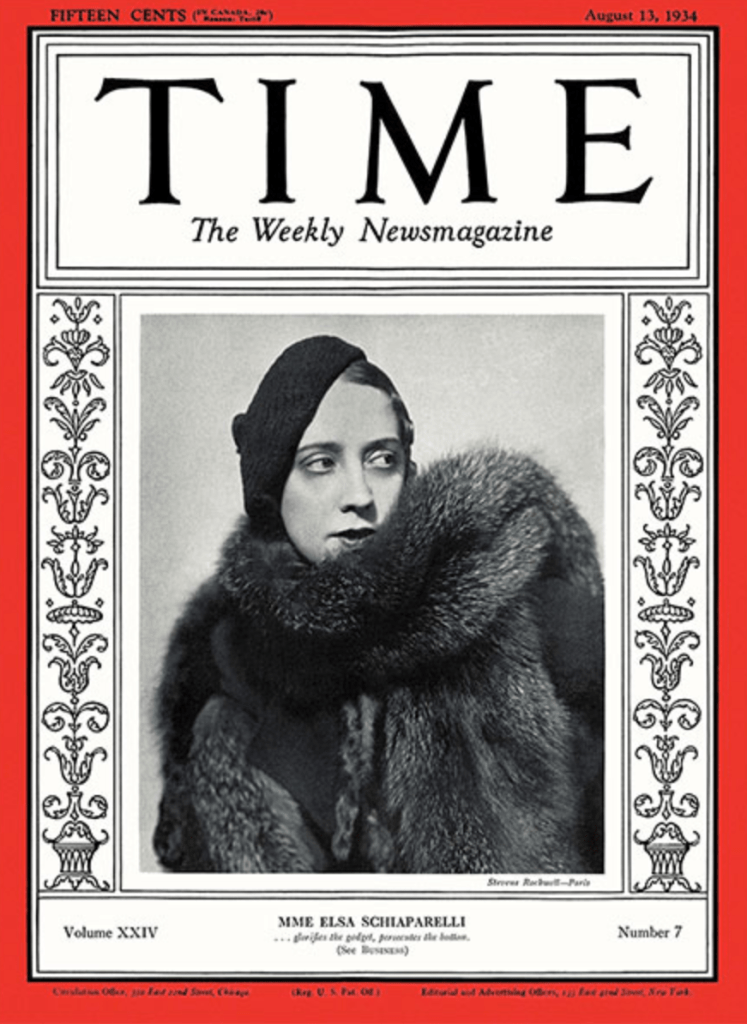
On Time’s 12 August 1934 cover, a stylish woman is shown in profile, her gaze turned away. She is wrapped in a luxurious fur coat, cut generously so that it engulfs the body and rises high around the neck, creating a sculptural silhouette that feels almost architectural. A close-fitting hat sits low, slightly angled across her head, sharpening the line of her face and drawing attention to her eyes and dark lipstick. Captured in black and white by the American fashion photographer Frederick Stevens Rockwell, the image holds a quiet tension between restraint and drama. The sitter? Elsa Schiaparelli (1890-1973), the Italian-born couturière who made Paris her home.
https://content.time.com/time/covers/0,16641,19340813,00.html
While not the first woman to appear on the cover of Time, Schiaparelli’s presence marks a significant cultural moment. It reflects fashion’s growing alignment with broader cultural and intellectual currents during a period in Europe marked by political instability and the lingering effects of the Great Depression. Schiaparelli, a leading figure of the avant-garde, stands firmly at its centre. In the accompanying article, she is described as “madder and more original than most of her contemporaries,” the designer to whom the word “genius” was most often applied.
How Schiaparelli, who had no formal training in fashion, became such a formidable and enduring presence is the subject of a comprehensive multidisciplinary exhibition at the Victoria and Albert Museum. Schiaparelli: Fashion Becomes Art, curated by Sonnet Stanfill, Lydia Caston and Rosalind McKever in collaboration with Maison Schiaparelli, brings together more than 400 objects, spanning garments, perfumes, accessories, photographs, archival material and artworks by Picasso, Cocteau and Vertès amongst others.
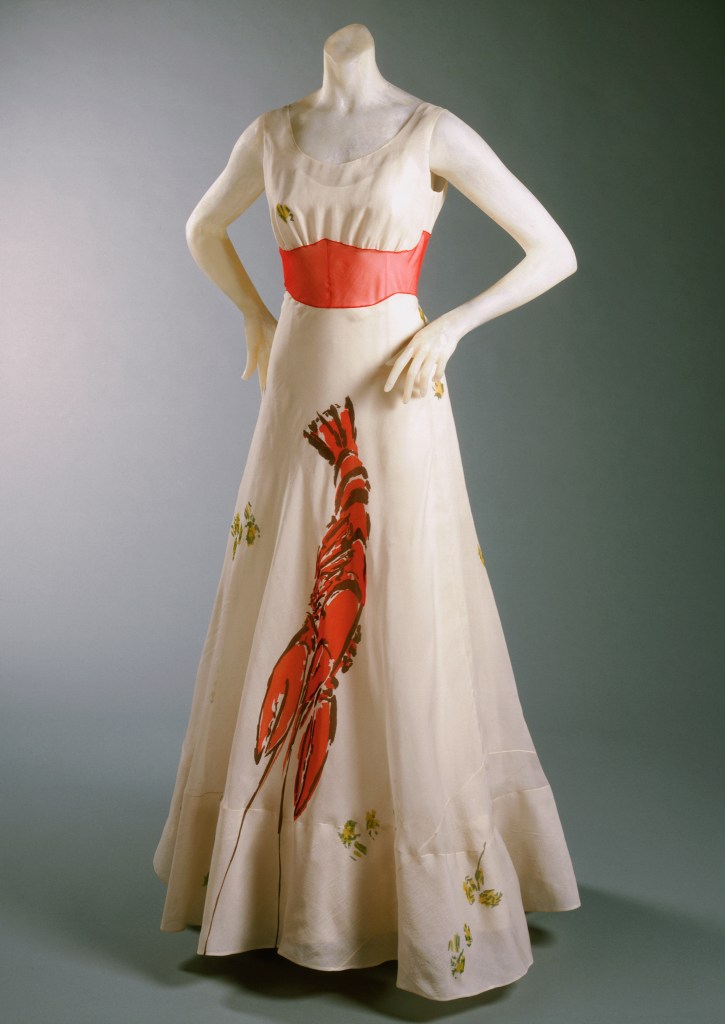
The exhibition is organised around four key themes, Designing the Modern Wardrobe, Creative Constellations, Beyond Paris and A Golden Thread, which together chart the evolution of Schiaparelli’s couture house from its beginnings in 1920s Paris to its contemporary revival under Daniel Roseberry (born 1985). Along the way, it illuminates the intellectual and artistic milieu that shaped her practice, from her collaborations with Surrealist artists to her enduring fascination with illusion, wit and the subversion of dress. Highlights include the trompe l’oeil bow-knot sweater of 1927, which signals the playful inventiveness that would define her work and the 1937 Lobster Dress designed in collaboration with Salvador Dalí.
Born in Rome into an intellectual and aristocratic yet deeply conservative Catholic family, Schiaparelli was the daughter of an Orientalist scholar and the niece of the distinguished astronomer Giovanni Schiaparelli. His work, and his interest in spiritualism and psychic phenomena, exerted a lasting influence, nurturing in her a lifelong fascination with astrology and invisible forces, a preoccupation that surfaces repeatedly in her practice.
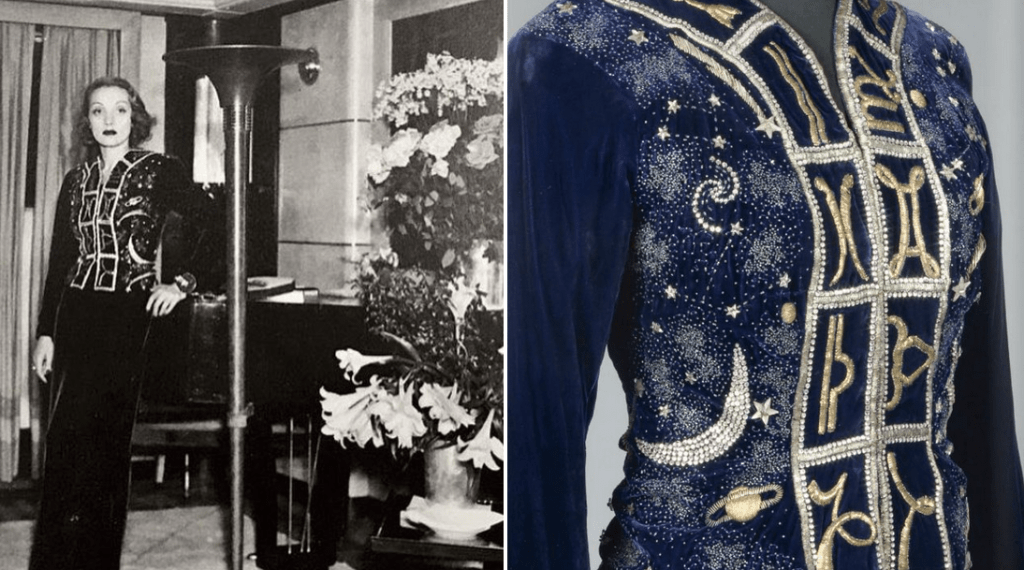
The titles of some of her most notable collections—Pagan (Autumn 1938), Zodiac (Winter 1938–39), and Circus (Summer 1938)—reflect this enduring sensibility, expressed in the exhibition through works such as the midnight blue Zodiac Jacket, with its constellations of silver and gold planets, famously worn by Marlene Dietrich in 1938 and a vivid pink silk twill jacket adorned with acrobats and prancing horses. Together, these works signal a sustained engagement with the poetics of the unseen.
While much has been written about Schiaparelli she remains, as her granddaughter Marisa Berenson observes, “an enigma…a mystical woman with a secret world of her own.” Her autobiography, Shocking Life (1954), captures this complex and contradictory persona. A lifelong rebel against convention, she describes herself as inhabiting “some kind of fifth dimension: unpredictable but, in reality, disarmingly simple…profoundly lazy but works furiously…of concrete age, but in reality has never grown up.”
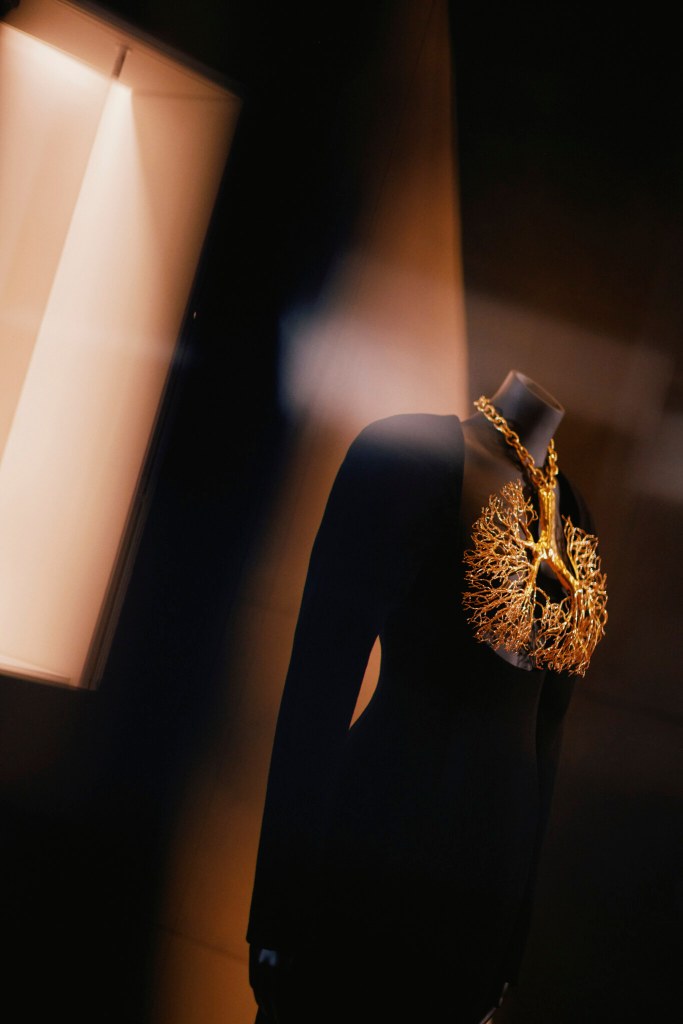
The exhibition’s scenography, designed by Nebbia, plays deftly on these dualities, unfolding as a sequence of immersive spaces that collapse distinctions between past and present. A temporal interplay that is also made explicit through curatorial juxtapositions such as Roseberry’s Lungs Dress (2021) and Schiaparelli’s Skeleton Dress (1938), created in collaboration with Dalí.
©V&A Press Office
This blurring of boundaries extends into the displays themselves. At times they are richly sensual, as in the fur-lined, gold-toned perfume room, which echoes the 1936 fur bracelet by the Swiss-German artist Meret Oppenheim. Elsewhere, surfaces become more graphic, with walls layered in a collage of the designer’s press clippings, while the spatial choreography encourages visitors to double back and encounter the same garment from a shifted perspective, so that looking itself unfolds as a recursive act.
Yet the exhibition also carries a subtly disquieting quality, heightened by lighting by Studio ZNA that ebbs and recedes, reinforcing an atmosphere aligned with Schiaparelli’s engagement with Surrealism. At times, however, these effects come at a cost. The overall impression lacks visual coherence and the low light levels required to protect sensitive materials can be so dim as to frustrate viewing; a more carefully modulated ambient light would have allowed visitors’ eyes to adjust more effectively to the lower luminance of the objects. In one instance, the combination of the display case and lighting renders one of the most iconic accessories, the Shoe Hat(Winter 1937–38), famously worn by Daisy Fellowes, almost impossible to see.
At times it is also difficult to follow the exhibition’s narrative arc. It remains unclear whether the focus is on Schiaparelli herself, her relationship to art, or the broader trajectory of the maison. While the dialogue between Schiaparelli and Roseberry is evident, with his work clearly shaped by her legacy, the exhibition’s central premise remains somewhat diffuse. Given that the Musée des Arts Décoratifs, Paris held a major retrospective of her work in 2022–23, a more clearly defined curatorial position would have helped distinguish this iteration.
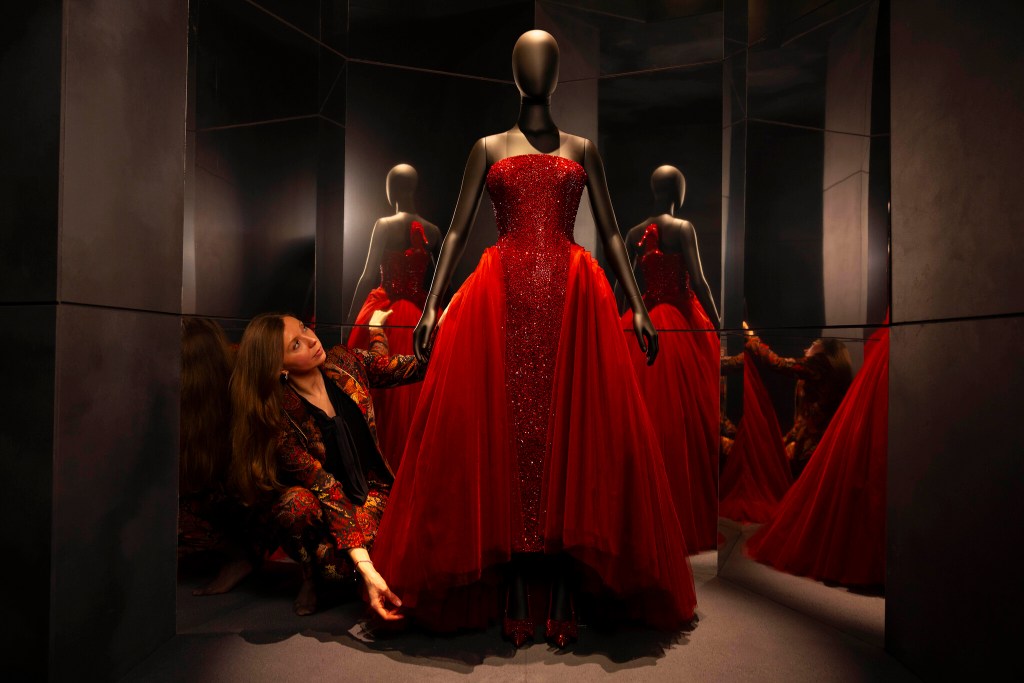
While Roseberry’s work is interspersed throughout the exhibition, it is primarily concentrated within two gallery spaces. Highlights include a jacket from Autumn/Winter 2021, worn by Lady Gaga for Vogue Italia, which brings together a collage of artistic styles through fractured anatomical elements and Surrealist and Cubist motifs; a sculptural scalloped corset dress from Spring/Summer 2025; and a red sequinned ball gown, worn by Ariana Grande to the 2025 Oscars, which nods to the iconic red ruby slippers in The Wizard of Oz. However, there is comparatively little material within the exhibition itself on Roseberry, his influences, or his relationship to art, although the accompanying catalogue provides some additional context.
©V&A Press Office
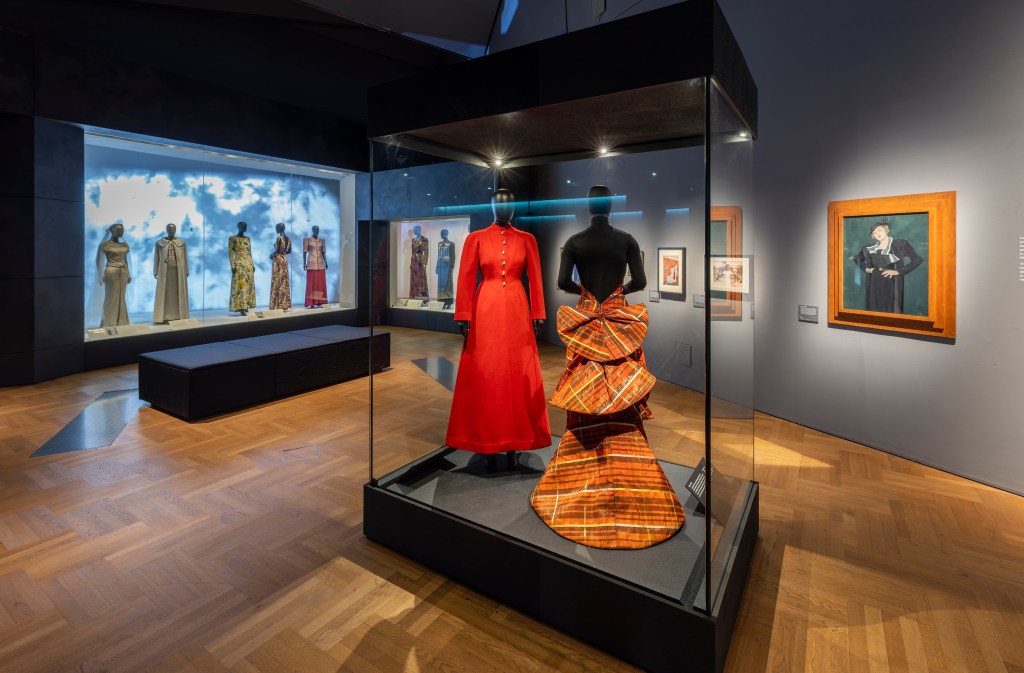
As the first exhibition in the United Kingdom dedicated to Schiaparelli, the project draws on newly developed research that explores her place within London’s fashion milieu, including the establishment of her salon on Upper Grosvenor Street (1933-1939). This engagement with British fashion and textile production finds elegant expression in a silk taffeta tartan skirt from 1949, attesting to her enduring affinity for Scottish tartans. Schiaparelli herself recalled this period in her autobiography as “an enchanting life in London…that afforded me excellent publicity, and allowed me to form wonderful friendships.”
It is through this lens that the V&A’s own holdings come into sharper focus. Widely regarded as the most significant collection of Schiaparelli garments in Britain, they enable the exhibition to present some of her most innovative and experimental designs, including the Tears evening dress (1938), with its trompe-l’œil print giving the illusion of shredded animal flesh, developed in collaboration with Dalí. Considered one of her most celebrated designs, it is seen by some as anticipating a “punk” sensibility several decades before the movement emerged.
©V&A Press Office
In 1954, after more than twenty-five years in practice, Schiaparelli retired from the world of couture. As she wrote in her autobiography, she had “overcome great difficulties” and “enjoyed immense success,” and now had to consider “what all this meant” to her. That question does not end with her. While she dismissed the word “creation” as the height of pretension, the exhibition above all makes clear that her work, her artistic sensibility, her fierce independence continues to resonate, insisting on a broader, more radical understanding of creation beyond dress into something more subversive and enduring, not only for her, but for us.
The exhibition Schiaparelli: Fashion Becomes Art is on view at the Victoria and Albert Museum, London until 8 November 2026.
References
Schiaparelli, Elsa. 1954. Shocking Life. London: J. M. Dent & Sons. Reprint, London: V&A Publishing, 2018.
Carron de la Carrière, Marie-Sophie, ed. Shocking: The Surreal World of Elsa Schiaparelli. London: Thames & Hudson, 2022.
Secrest, Meryle. Elsa Schiaparelli: A Biography. London: Penguin Books, 2015.

