By Dilyana Apostolova
No discussion of our subject can begin properly without addressing her marvellous, near-improbable name. In Bulgarian, Bistra (spelled Бистра in Cyrillic) is an adjective as well as a female given name. It means ‘clear’ and is used almost exclusively to describe liquids, as in ‘clear water’ or, more aptly, ‘clear wine’. The surname Vinarova derives from vino (вино) — Bulgarian for ‘wine’ and likely a nod to the occupation or predilection of some rosy-cheeked great-great-great-grandfather. On its own, neither name is unusual, but the combination is so implausible and so fitting that it reads like a work of fiction. It is the sort of larger-than-life name one gives to a main character when one does not want to be subtle.
Bistra Vinarova certainly lived up to her female-lead name. She was born in 1890 to an upper-class family in Sofia, Bulgaria — a mere twelve years after the country’s liberation from five centuries of Ottoman rule. What had been a sleepy medieval town of winding cobbled streets dominated by minarets was now a fast-industrializing metropolis with a skyline pierced by factory chimneys. The spirit of the age was a brew of optimism, patriotism, and a hunger for all things modern and European. To the young Bistra and her family, who relocated to Vienna in 1906, those included modern European art.
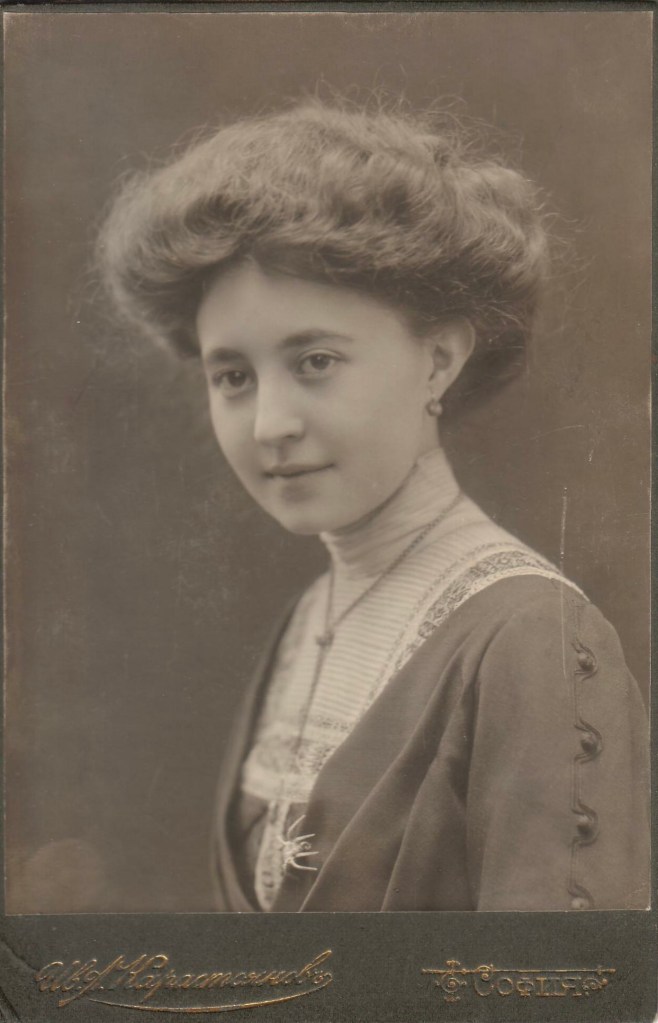
https://nationalgallery.bg/bg/exhibitions/bistra-vinarova-radeva-1890-1977-beyond-the-portrait/image-2/
First taking up art lessons as a private pupil in 1908, Vinarova eventually enrolled in the Dresden Academy of Fine Arts in 1911. There she met Conrad Felixmüller, a leading young expressionist of the German avant-garde, and the two struck up a lasting friendship that would prove fundamental to her artistic journey. Felixmüller was associated with Die Brücke (‘The Bridge’), a group of artists who profoundly influenced the evolution of modern art. Inspired by Die Brücke, Vinarova experimented with new modes of expression: crude drawing techniques, bold non-naturalistic colours, emotional tension, and violent, often sexually charged imagery. Later, it was again Felixmüller who encouraged her to leave Dresden for Munich in 1916. There she would be closer to the other seminal German expressionist group, Der Blaue Reiter (‘The Blue Rider’), which Wassily Kandinsky and Franz Marc had founded four years earlier.
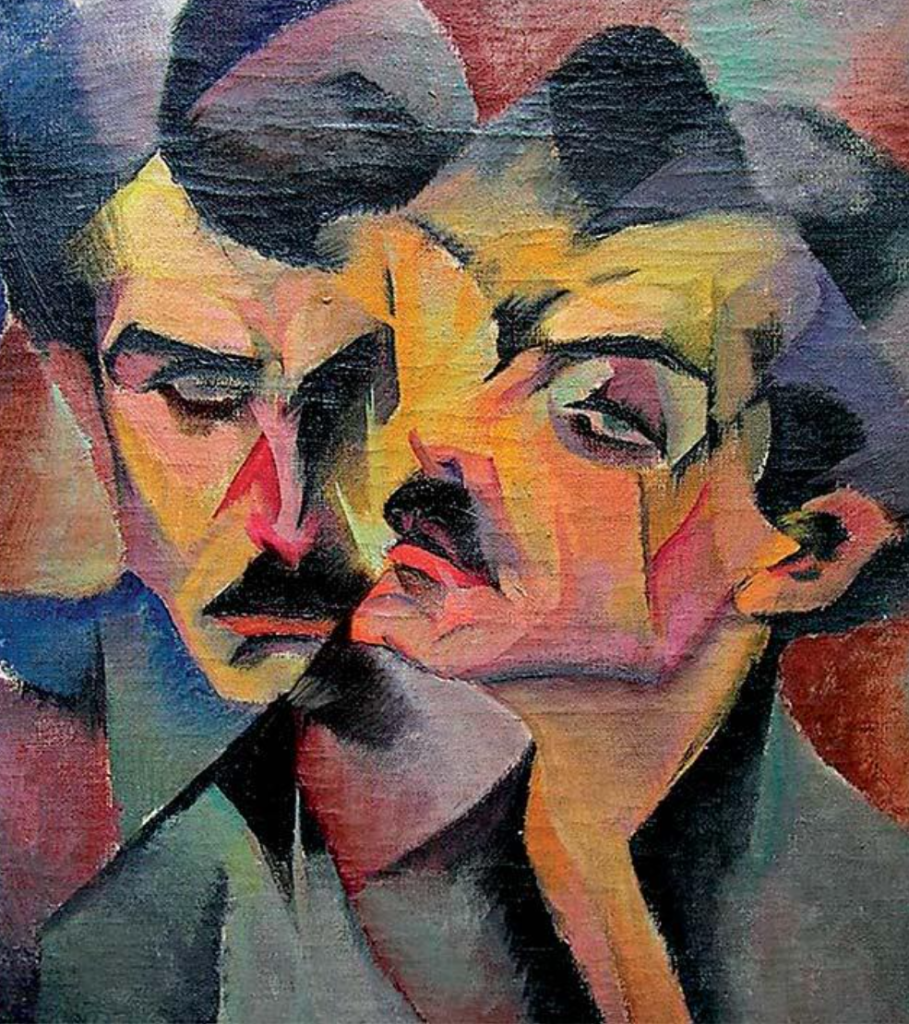
https://e-vestnik.bg/imgs/art_show/Dvama_Kartina-na-Vinarova-o.jpg
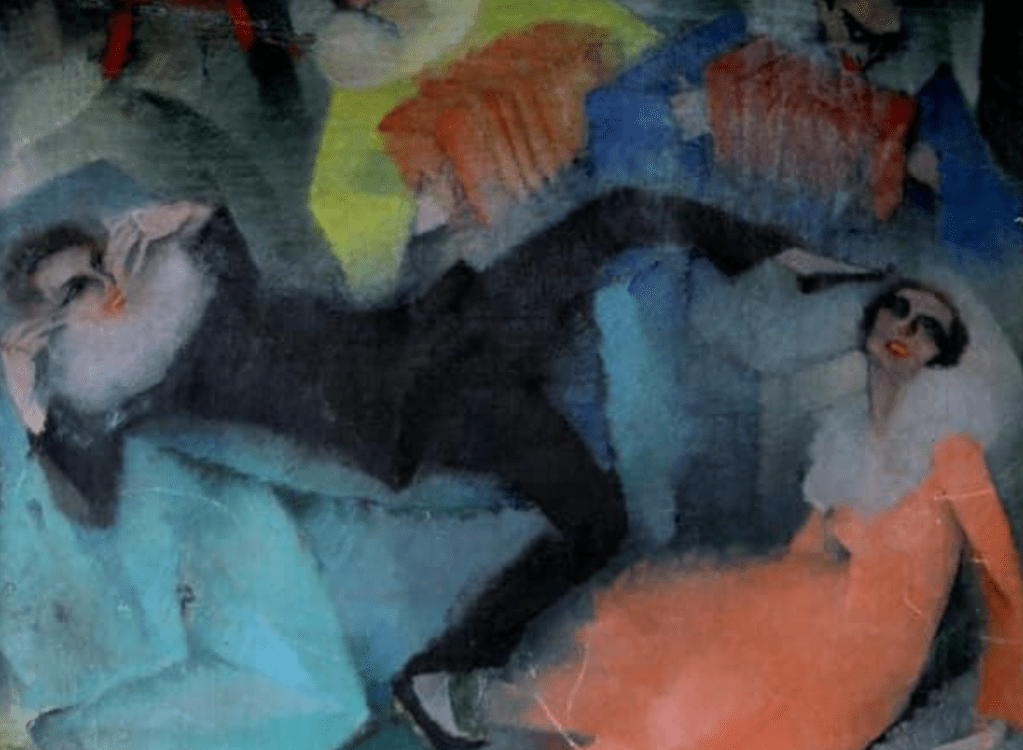
The move to Munich marked the beginning of Vinarova’s most fruitful creative period. She trained under Hans Hofmann, a renowned German-American painter who bridged Cubism, Expressionism, Fauvism, Symbolism, and Neo-Impressionism, all of which can be traced in Vinarova’s work. But she didn’t stop there. She threw herself headfirst into the intellectual cauldron of interwar Central Europe. Her art from the period resonates with the ideas of Bergson, Nietzsche, and Freud. She nurtured close friendships with avant-garde artists such as Annie Ehrenfest, Roland Steiner, and Theresa Bernstein. Between 1915 and 1922, she participated in Die Brücke exhibitions in Berlin, Munich, Lviv, Moscow, and Vienna alongside the likes of Otto Dix and Oskar Kokoschka.
The Die Brücke circle took great interest in lithography and wood carving, and Vinarova herself experimented with black-and-white graphical art — an undeservedly underrated genre, and one in which she excelled. The stark contrast, the crude forms, and the unrelenting linearity strip the compositions of all superfluous colour, detail, and undulation. There are no distractions, no noise, and no reprieve, only raw immediacy that lays bare the subjects and reduces them to their essence. It is not a stretch to say that these are some of Vinarova’s finest works. In 1922 in Vienna, her first solo exhibition of black-and-white graphics opened to rave reviews, including by Rainer Maria Rilke, who dedicated several poems to her. Another exhibition attendee, the Greek literary giant and Nobel Prize nominee Nikos Kazantzakis, was so taken with her art that he asked for her hand in marriage.
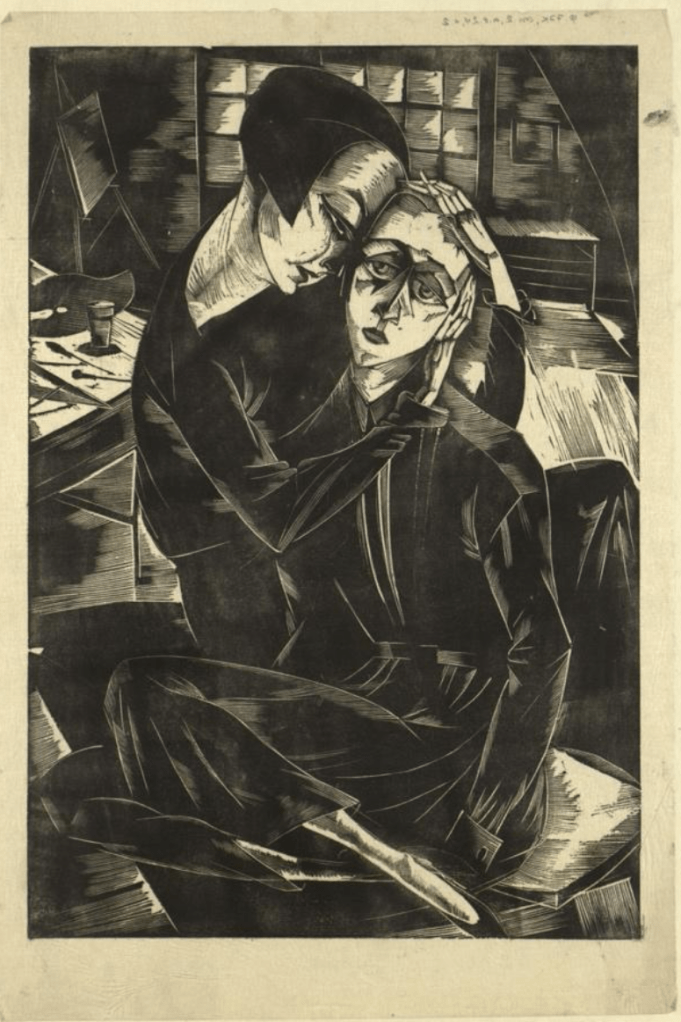
Kazantzakis, great as he was, did not win Vinarova’s heart. In 1924 she married Simeon Radev, a prominent Bulgarian diplomat and writer whose political career and literary oeuvre have unjustly overshadowed his wife’s work. A knee-jerk feminist reading might go as far as accusing Radev of impeding her work, but that is not supported by the sources. Theirs was, by all accounts, a love marriage, and a very happy one. It is true that Vinarova paused her artistic career between 1925 and 1940 as she accompanied her husband on missions in Ankara, Washington, London, and Brussels — but so did he. A seasoned diplomat, by 1924 Radev wanted to retire and focus on writing, but his superiors in government had other plans. For her part, Vinarova embraced her new role as diplomatic spouse, hosting events modelled after the intellectual salons of a bygone era. The Radevs’ social circle brimmed with writers and artists such as Ezra Pound, Eugene O’Neill, and Paul Claudel. When she was not supporting her husband, Vinarova attended concerts and exhibitions, nurtured her artistic friendships, and travelled to Paris to visit the workshops of Matisse and Picasso. She took up painting again when Radev was recalled to Sofia in 1940. Her style grew more realistic, perhaps in response to the brutal reality of war. After the coup of 9 September 1944, Bulgaria’s new, Soviet-style socialist regime barred both spouses from public life. Radev was forced into retirement, Vinarova’s membership in the Union of Artists was rescinded, and their possessions were nationalized, reducing them to destitution. For a time Vinarova, Radev, and their son would survive on nothing but Radev’s meagre pension; he ended up selling the rights to his memoirs for a pittance. Despite holding three degrees, their son was refused employment for years.
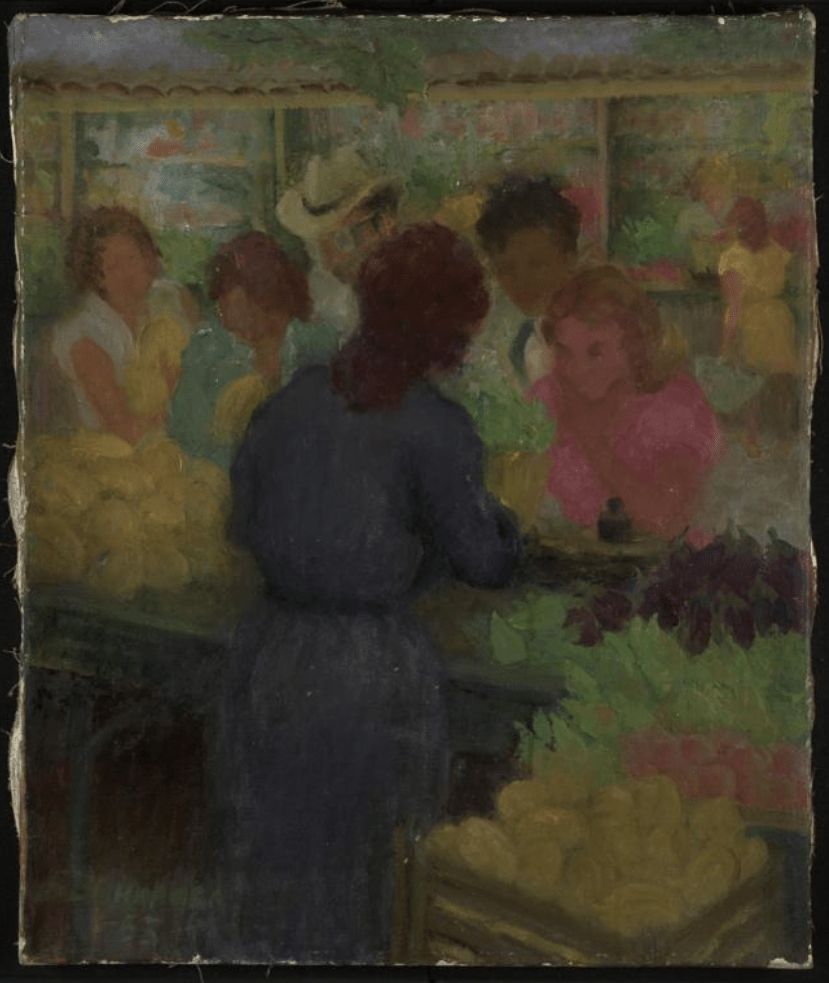
Eventually, the Radevs were partially rehabilitated by the regime, allowing Vinarova to exhibit again — albeit strictly within the party line. She continued to paint in what was effectively intellectual and spiritual exile until her death in 1977, remaining largely forgotten until the early 2010s when the opening of her family archives renewed interest in her. Nevertheless, Vinarova seems to have found refuge in her art, and perhaps a quiet rebellion. Her mature style is almost impressionistic, bursting with vivid colours, soft lines, and the golden light of summer. Serene landscapes, countryside scenes, still lifes of fruits and flowers, and portraits of ordinary folk and loved ones define her later work. A return to nature, perhaps, and a rejection of the fatally contrived social constructs of the twentieth century.
References
Plamena Dimitrova-Racheva, Apostle of the New Art: Bistra Vinarova (1890–1977), trans. by
Vladimir Tzvetkov and Chtiliana Rousseva (Agato, 2013).
‘Бистра Винарова и Никос Казандзакис: Историята на едно писмо, което остана без
отговор’ [Bistra Vinarova and Nikos Kazantzakis: The Story of a Letter That Was Left Without Response], Foundation Pygmalion, n.d.
https://www.pygmalionfoundation.org/%d0%b1%d0%b8%d1%81%d1%82%d1%80%d0%b0
-%d0%b2%d0%b8%d0%bd%d0%b0%d1%80%d0%be%d0%b2%d0%b0-%d0%b8-%d0%bd
%d0%b8%d0%ba%d0%be%d1%81-%d0%ba%d0%b0%d0%b7%d0%b0%d0%bd%d0%b4
%d0%b7%d0%b0%d0%ba%d0%b8%d1%81-%d0%b8/ [accessed 11 January 2026]
‘Между дипломацията и изкуството: Връзките на Бистра Винарова със световния
културен елит’ [Between Diplomacy and Art: Bistra Vinarova’s Connections with the Global
Cultural Elite], Foundation Pygmalion, n.d.
https://www.pygmalionfoundation.org/%d0%bc%d0%b5%d0%b6%d0%b4%d1%83-%d0%b
4%d0%b8%d0%bf%d0%bb%d0%be%d0%bc%d0%b0%d1%86%d0%b8%d1%8f%d1%82%
d0%b0-%d0%b8-%d0%b8%d0%b7%d0%ba%d1%83%d1%81%d1%82%d0%b2%d0%be%
d1%82%d0%be-%d0%b2%d1%80%d1%8a%d0%b7/ [accessed 11 January 2026].
‘Бистра Винарова след обществено-политическите промени — не само да оцелееш, но
и да намериш опората’ [Bistra Vinarova After the Socio-Political Changes — Not Merely
Surviving but Finding Support], Foundation Pygmalion, n.d.
https://www.pygmalionfoundation.org/%d0%b1%d0%b8%d1%81%d1%82%d1%80%d0%b0
-%d0%b2%d0%b8%d0%bd%d0%b0%d1%80%d0%be%d0%b2%d0%b0-%d1%81%d0%bb
%d0%b5%d0%b4-%d0%be%d0%b1%d1%89%d0%b5%d1%81%d1%82%d0%b2%d0%b5
%d0%bd%d0%be-%d0%bf%d0%be%d0%bb%d0%b8/ [accessed 11 January 2026].
 Bluestocking Oxford
