By Ruby Tipple
In modern art, the image of ‘the double’ — particularly in self-portraiture — is a complex and fascinating form of artistic self-representation. Artists have been continually seized by the compulsion to deconstruct identity in this way. Recent films like The Substance and Mickey 17, for example, or postmodern art like Jorge Macchi’s Vidas Paralelas (Parallel Lives) draw attention to the contemporary relevance of such a construct, but also its instability: to double oneself is a purposeful act of fragmentation.
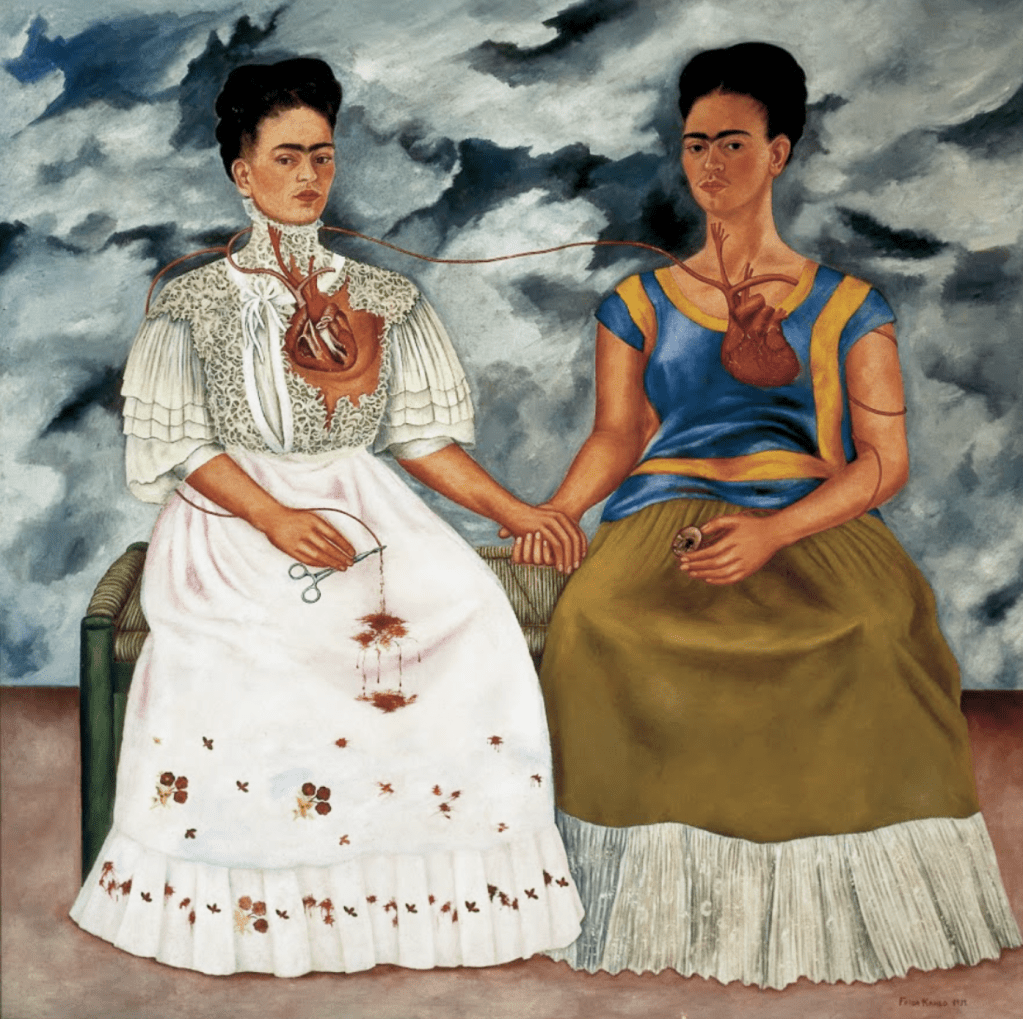
Frida Kahlo’s infamous The Two Fridas (1939) sits within this modern artistic tradition — but adapts it, too, to ask the viewer important questions about the impact of race, patriarchy on identity and self-expression. The painting is from the middle of Kahlo’s artistic career — a career primarily focused on self-portraits which highlight her struggles with disability, lost love and turbulent interpersonal relationships, as well as paintings containing incisive political comments on capitalism, Marxism and Mexican identity and heritage.
Painted in her trademark surrealistic style — a burgeoning art movement in Mexico at the middle of the twentieth century, defined by symbolism, folklore and fantasy — The Two Fridas is a visually arresting and complex self-portrait with rich imagery.
Two versions of Frida sit in front of a stormy sky, connected by one artery. They share life and blood, yet the connection is precarious. One Frida is in traditional Tehuana clothing, holding an oval portrait of her ex-husband Diego Rivera in her lap in seeming-dedication. The other is in a Victorian wedding dress, surgical forceps in hand. She has cut away at herself — blood spurting and dripping down the white cloth: her torn-apart heart exposed. Frida holds hands with herself, and the two versions make direct eye contact with the viewer.
173.5cm x 173cm
https://en.wikipedia.org/wiki/The_Two_Fridas#/media/File:The_Two_Fridas.jpg
It is one of Kahlo’s best-known works because of the questions it raises about her own personal identity and relationship with fellow artist Diego Rivera, whom she married in 1929. But strictly autobiographical interpretations of the piece are oversimplified, for they fail to fully appreciate the wider implications and universality of her art.
First, the portrait evokes a range of feeling by showing the uneasy balance between her Mexican and German identity. The conflict inherent in this representation of a dualistic, mixed-race identity serves as a distinct comment on Kahlo’s historical context: it is metaphorical for Mexico’s colonial past and the struggles of carving out identity in the recent aftermath of the culturally transformative Mexican Revolution. A traditionally-dressed Frida, painted in the style of Mexican folk art, is proud of her post-dictatorship Mexican heritage —but it exists alongside a much more Europeanized version of herself as well. Here, she is thus neither fully Mexican, nor fully European. And of course, with the portrait’s depiction of the clashes between competing cultures, and acute sense of not belonging, it continues to speak to the mixed-race experience today.
40 cm x 28 cm
https://en.wikipedia.org/wiki/Memory,_the_Heart#/media
This exploration of race links to Kahlo’s comments on gender as well, and the gendered complexities of a woman’s identity, especially in relation to men. The feminist legacy that her art has left behind, with powerful displays of female autonomy, sometimes sits awkwardly with her comments on love and its overpowering nature. In her journals, she wrote of her paradoxical desire to retain a distinct female identity, while also writing of her all-consuming love for her husband.“Diego was everything; my child, my lover, my universe,” she confesses.
There is undoubtedly a link between Kahlo’s decision to paint The Two Fridas and her divorce that same year. Initiated by Rivera, it was a marriage marked by health struggles, clashing personalities, and, in particular, infidelity — including an affair between Rivera and Kahlo’s sister, Cristina. These turbulent events translate to an incisive, deeply-personal exploration on the canvas of the cost of love to a woman’s sense of self, and whether women can conform to marriage without erasing their personalities and historical identities.
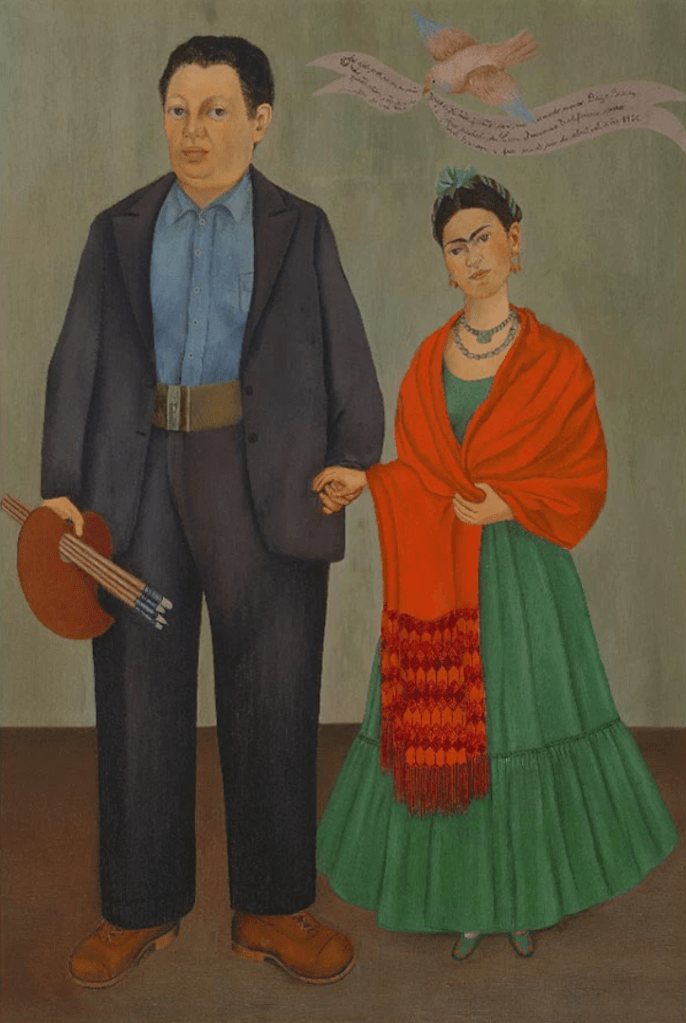
Kahlo’s early paintings of the 1930s placed her identity as an artist as subordinate to her identity as Rivera’s wife. Frieda and Diego Rivera (1931) is one such example. Rivera, in this painting, dominates the canvas compared to the petite Frida, and a bird carries a banner in the background which reads: “Here you see us, me Frieda Kahlo, with my dearest husband Diego Rivera.” Ironically, although Frida paints this image, it is her husband Diego who is holding the paintbrushes. He is the artist; he has power and status — not her.
100.01 cm x 78.74 cm
https://en.wikipedia.org/wiki/Frieda_and_Diego_Rivera#/media/File:Frieda_and_Diego_Rivera.jpg
The painting, in summary, is a clear representation of Kahlo’s feelings of love, awe, and devotion towards her husband. However, less than a decade later in The Two Fridas, there is a marked difference in how she represents herself artistically.
Art historians such as Cris Hassold and Marilyn Sode Smith have interpreted Frida’s act of self-mutilation in The Two Fridas as symbolic of Kahlo’s pain after the apparent end of her relationship. And indeed many of Frida’s self-portraits explore her experiences of chronic pain and disability in response to her childhood polio, as well as a bus accident in her teens which left her to endure lifelong physical pain from her injuries. It is the violence of these specific experiences which combine with her emotional heartbreak in The Two Fridas to add a more vivid dimension to her already-palpable sense of pain.
In the painting, the bridal Frida shows the ultimate sign of commitment to Rivera through marriage and the subsequent suppression of her traditional identity, but she still sees herself to be ‘unloved’ by him. The contrast between the virginal whiteness of her Victorian dress and the scarlet blood dripping onto its linen is a striking and heightens the sense of heartbreak.
In contrast, the Tehuana Frida is committed to Rivera in an act of devotion, grasping his oval portrait in a locket with reverence and devotion. They have retained, it seems, the connection present in Kahlo’s earlier work: love for her husband as more important than artistic recognition. This gives blood — and therefore life — through the connecting artery that sustains the other Frida in the aftermath of her physical and emotional pain.
To depict herself in this way — in marriage as ‘unloved’ and, as her conventional self, as the committed but ultimately unrecognised lover, pining for a relationship that is bound to end — is significant. It speaks to the struggle of retaining an autonomous identity in relationships and marriage. Kahlo presents this dilemma as a nearly impossible one for women to navigate and it remains an issue contended with by many women today.
The two versions of Frida look at the viewer, stoic and defiant, and demand acknowledgement of these broader questions which The Two Fridas poses. It is evidently not just a work relevant to her own personal circumstances in post-revolution Mexico after a heartbreaking divorce, but one which holds universal significance for a modern audience, displaying Kahlo’s extraordinary use of ‘doubling’ to address questions of race, patriarchy, and fragmentation of identity.
References
Andersen, Corrine. 2009. “Remembrance of an Open Wound: Frida Kahlo and Post-Revolutionary Mexican Identity.” South Atlantic Review 74 (4): 119-30. http://www.jstor.org/stable/41337719.
Hassold, Cris. 1994. “The Double and Doubling in Modern and Postmodern Art.” Journal of the Fantastic in the Arts 6 (2/3): 253-74. http://www.jstor.org/stable/43308220
Herrera, Hayden. 2003. Frida: A Biography of Frida Kahlo. London: Bloomsbury.
Frida Kahlo’s ‘The Two Fridas’: Great Art Explained. https://www.youtube.com/watch?v=rxKR2cHmlPY


