By Raluca David
For most of history, humans’ conception of their own nature, the philosophy of human nature, was dominated by dualism, the belief that two phenomena existed: the material body and the transcendental mind. This Cartesian ‘mind’, championed by René Descartes, was criticised three centuries later by Oxford philosopher Gilbert Ryle as the ‘illusion’ or ‘the ghost in the machine’ (1949). At that time, psychologists ignored the ‘mind’ altogether. Just emerging as a reputable scientific discipline, psychology sought to preserve its scientific standing by grounding itself as behaviourist, interested only in input (stimuli) and output (human behaviour), since whatever happened inside the brain could not yet be measured objectively.
That changed dramatically in the 1950s, when in Cambridge, Donald Broadbent for the first time described a ‘phenomenon’ that happened in between the input and the output. He found that not all stimuli were responded to behaviourally. Some were ignored. This was a great challenge to behaviourists: how could they detail a mechanism where some input simply vanished? As, for instance, in the case of ‘dichotic listening’, listening to two different messages over headphones in the two ears. If asked to shadow what they heard in one ear, volunteers in Broadbent’s experiments subsequently could not remember anything played to the second ear. What happened to stimuli in the second ear? They were being filtered out.
With this, the ‘ghost in the machine’ returned, only this time not transcendentally, but scientifically, as integral to the brain circuit. ‘Filtering’ was the first ‘internal process’ to gain a formal ‘mechanistic’ description. It was soon named by Broadbent ‘attention’. Immediately after, in Oxford, a young DPhil student, Anne Treisman, pursued it further in her thesis.
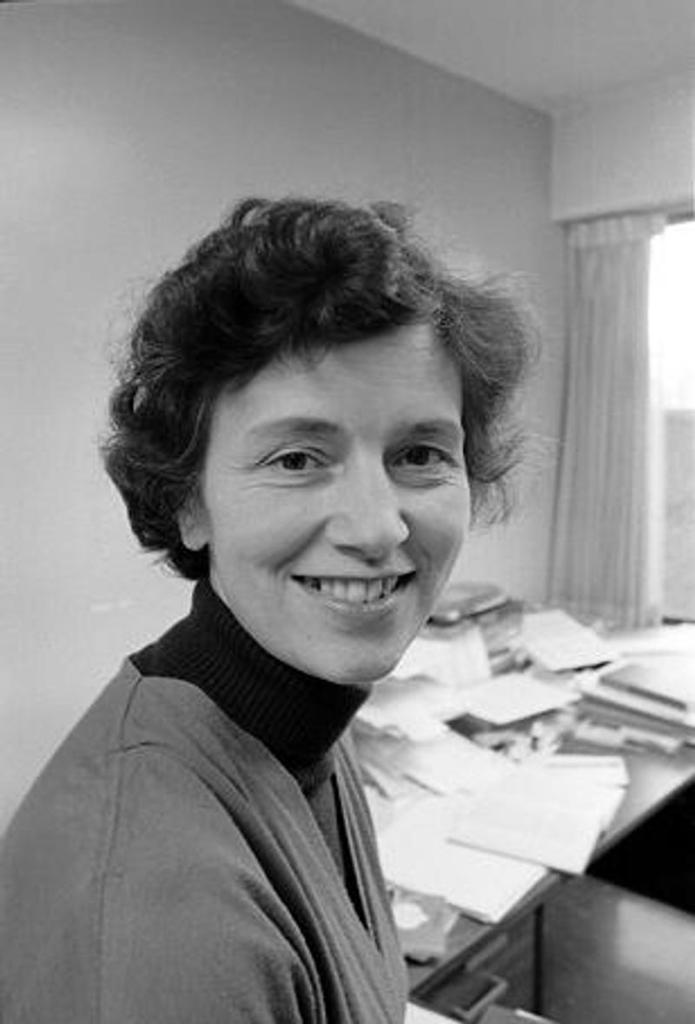
The University of British Columbia Collections
https://open.library.ubc.ca/collections/arphotos/items/1.0152626
It was Treisman’s work that truly took ‘attention’ one step further to retrieve the concept from the realms of behaviourism entirely and align it with the most significant revolution in psychology, the cognitive revolution. How did she do it? To explain, one must first understand Broadbent’s Filter Theory of Attention by imagining a filter in a professional camera, as an extra layer to be inserted in front of the lens. The apparatus as a whole remains, as Broadbent explained, ‘mechanistic’. Treisman’s experiments departed from that. They used Broadbent’s set-up of an earset and two streams of words spoken into the ears. The key change was that the two messages were switched midway through between ears. Volunteers accidentally switched too, reporting one or two words from the wrong ear before returning to shadow the request ear. Treisman’s results revealed that some stimuli got past Broadbent’s ‘filter’. This meant it could not be entirely ‘mechanistic’. There was cognition behind it, motivation. It allowed for some bottom-up distraction, yet top-down considerations ultimately prevailed to draw the volunteers back to the task.
Treisman was not suggesting that there was some puppeteer homunculus sitting inside the brain making decisions. She proposed that attention was a cognitive mechanism designed to prioritise what stimuli are ‘selected’ for the brain to process, based on our current goals (what are our targets) as well as past experience (what has been so far important to us, e.g our own names, which is why those can be heard in the ignored ear). Treisman did not use ‘attention’ to vaguely explain away the unknowable ‘mind’. She offered a formal description of how attention might work, involving an attenuation that created a hierarchy of processing based on importance. It was a model not too dissimilar to present-day computational neuroscientific ones.
Yet it was in the visual realm that Treisman made her most memorable breakthrough. Anne’s conception of selective attention closely followed her day’s foremost discoveries in neuroscience. In 1961, while Treisman was finishing her DPhil, Hubel and Wiesel, working in the USA, recorded from electrodes placed directly on neurons inside cats’ brains. Their results were striking; single neurons coded for specific features, such as particular tilts of a line on a screen. Subsequently, other researchers found neurons or brain regions specifically responding to colour, movement or direction. This led to the so-called ‘binding problem’. If single neurons or areas responded selectively to specific features, the question was how the brain unified these features into a coherent mental picture that allows us to identify objects or people and experience events? Treisman believed the unifying mechanism was attention.

Anne Treisman’s ‘Feature Integration Theory of Attention’ (1980) gave a response to the most pressing question in cognitive neuroscience between 1960 and 1990, the ‘binding problem’. Attention to specific spatial locations was key to binding maps of different visual features and knowledge stored in memory. She provided experimental evidence that when spatial attention lacks, features are not correctly bound. ‘Illusory conjunctions’ occur, whereby if distracted by visual objects similar to a target, people erroneously bind features from adjacent distractors that do not belong together. Similar errors are made by patients with brain lesions to the parietal lobe, a brain area responsible for spatial attention.
The scope of Treisman’s work was truly impressive. She took ‘attention’, and with it, psychology, away from behaviourism and into the revolution of cognitive science; she gave a formal description to the ‘ghost in the machine’ and reached for the ultimate question in psychology: what consciousness is. Attention was as close as experiments could get to ‘the bound, unitary, interpreted, personal view of the world of experience’ (Treisman, 2003). Over forty years later, we know Anne Treisman’s model, in its full detail such as which features take priority and how the integration takes place, was incorrect, like most early simple models are. Yet unlike others, her model remains hugely influential.

© Photographed by Hao-Hsiang You
I saw Anne Treisman in 2013, when she was Professor Emerita at Princeton University and returned to Oxford to give the inaugural annual ‘Anne Treisman’ lecture. The lecture was entitled ‘Notes from a life in Cognitive Psychology’ and was deeply inspirational to me, then a first-year DPhil student. To take her legacy forward, the ‘Anne Treisman’ lecture has been given yearly by a leading woman in cognitive neuroscience, helping promote women in a field where the latest available data showed they made up only 14% of tenured professors in the USA. Role models are the best way to change this, and Anne Treisman continues to be a model for how a woman can shape a field of science deeply and with far-reaching influence.
References
Broadbent, Donald E. Perception and Communication. New York: Pergamon Press, 1958.
Hubel, D. H, and T. N Wiesel. “Receptive Fields, Binocular Interaction and Functional Architecture in the Cat’s Visual Cortex.” The Journal of physiology 160, no. 1 (1962): 106–154.
Ryle, Gilbert. The Concept of Mind. Chicago: University of Chicago Press, 1949.
Sibener, Leslie J, Megan A Kirchgessner, Sheila Steiner, Chiaki Santiago, Daniela Cassataro, Marley Rossa, Caterina P Profaci, and Nancy Padilla-Coreano. “Lessons from the Stories of Women in Neuroscience.” The Journal of neuroscience 42, no. 24 (2022): 4769–4773.
Treisman, Anne M., and Garry Gelade. “A Feature-Integration Theory of Attention.” Cognitive psychology 12, no. 1 (1980): 97–136.
Treisman, Anne M. “Contextual Cues in Selective Listening.” Quarterly journal of experimental psychology 12, no. 4 (1960): 242–248.
Treisman, Anne M. “Monitoring and Storage of Irrelevant Messages in Selective Attention.” Journal of Verbal Learning and Verbal Behavior 3, no. 6 (1964): 449–459.
Treisman, Anne M. “Consciousness and Perceptual Binding.” In Alex Cleermans (ed.) The Unity of Consciousness: Binding, Integration and Dissociation. Oxford: Oxford University Press, 2003.
Wolfe, Jeremy M. “Forty Years after Feature Integration Theory: An Introduction to the Special Issue in Honor of the Contributions of Anne Treisman.” Attention, perception & psychophysics 82, no. 1 (2020): 1–6.

