By Emily Dillon
Upon entering the Sackler Wing of Galleries at the Royal Academy of Arts, London, one is apprehended by an intimidating figure standing sentry to the next rooms of the exhibition. This is Mrinalini Mukherjee’s Pakshi: part-soldier, part-phallus, entirely commanding. Pakshi translated from Sanskrit is ‘bird’, but the Royal Academy have here presented Mukherjee’s hemp figure without comment or explanation, allowing the viewer to assess this imposing monolith on their own terms.
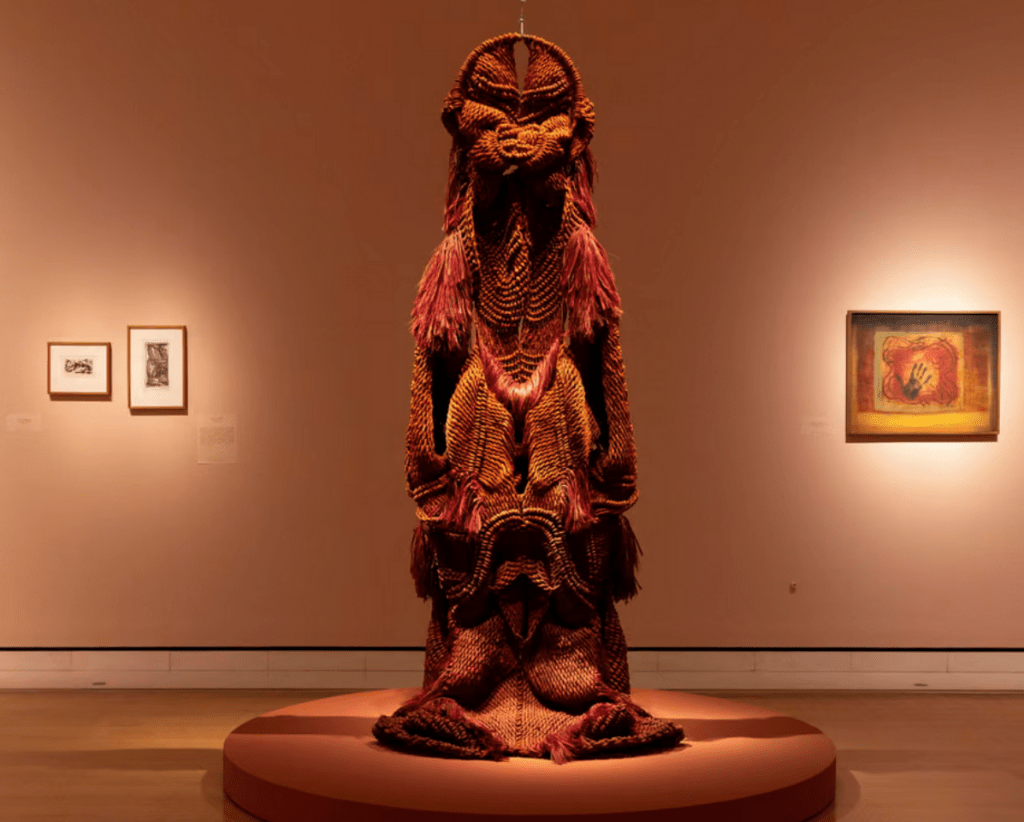
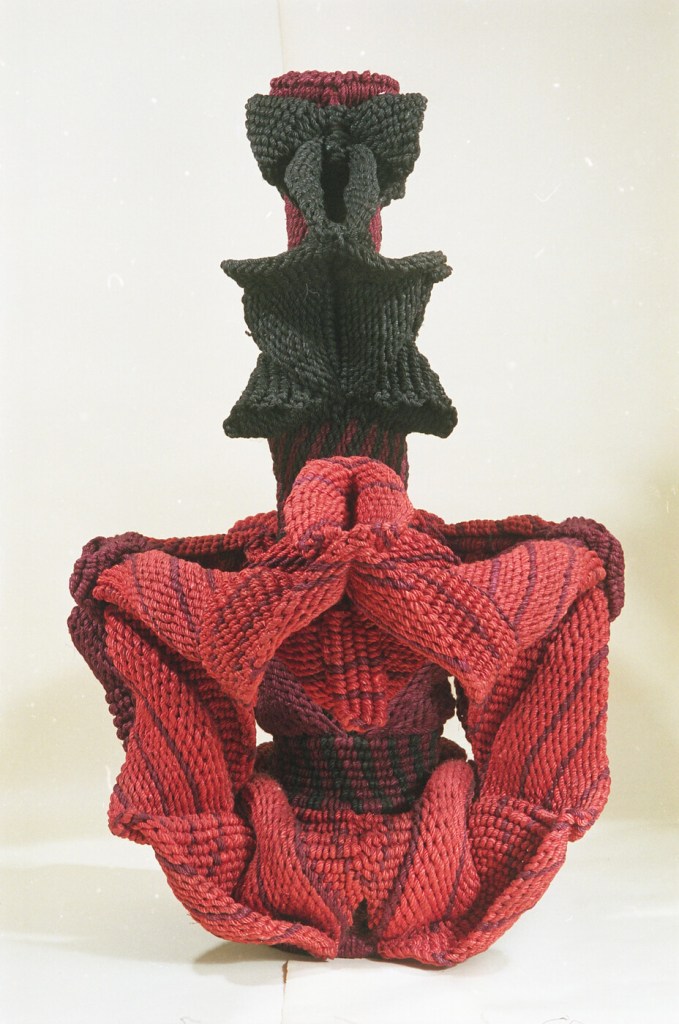
Pakshi is emblematic of Mukherjee’s most famous works, sculptures using macramé
techniques and constructed from dyed hemp and fibre. Born in 1949 in post-partition
Mumbai, Western India, to artists Benode Behari and Leela Mukherjee (whose work is shown alongside hers in this exhibition), Mukherjee turned to fiber in 1972 and incorporated depictions of gender, sexuality, nature, and myth in her constructions. At the time, fiber was used in traditional crafts in India but was not seen as being a serious artistic medium by her contemporaries, most likely because textile work has long been associated with domesticity and feminine labour. However, other movements in India, such as women spinning cloth under Gandhi’s leadership to protest British colonial rule, repurposed textile arts as a form of political expression. Mukherjee contested the distinction between fine art and craft, and with that the gendered—and Western—dictum of what form art should take
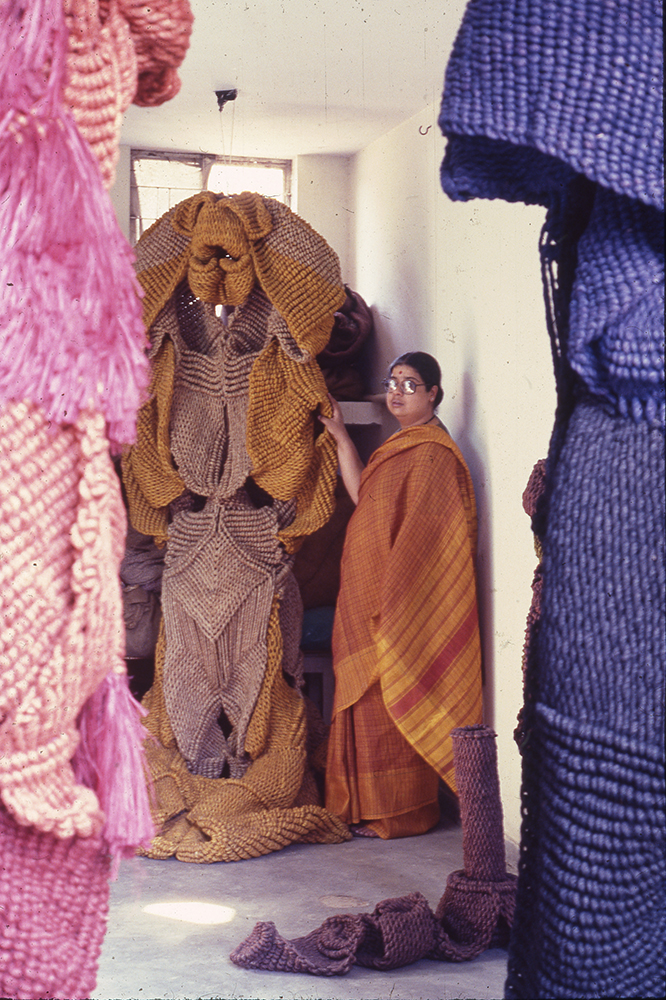
© Photography by Ranjit Singh, Mrinalini Mukherjee Foundation
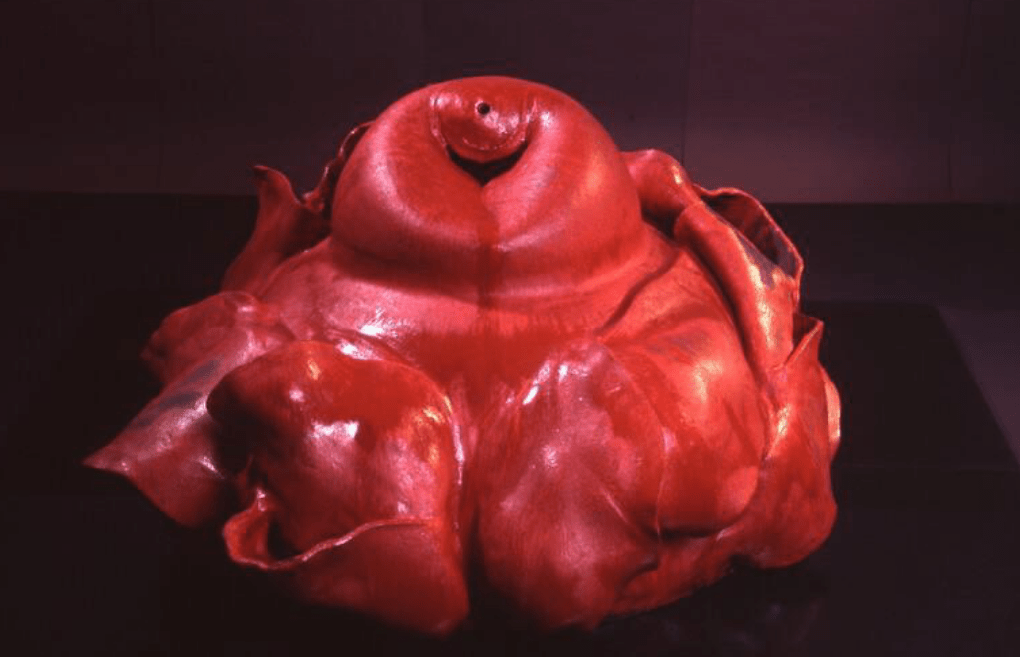
Yet Mukherjee excels in other mediums too. Her ceramics like Earthbloom and Burgeoning
Cluster (both 1996) fuse botanical and anatomical life. Both brim with a primordial sexual energy. Earthbloom is the female anatomy in pulpy, unnerving red, while Burgeoning Cluster’s tendrils and offshoots make the clay appear as if it is mutuating and reproducing in real time. Mukherjee’s experiments with ceramic came later in her career than her more famous hemp works, beginning in 1995, but in moving to a new medium she lost none of her power.
Mukherjee’s work is showcased alongside pieces from a constellation of her friends and
family who influenced her practice. Leela Mukherjee’s Untitled (1992) series of watercolours
on handmade Nepali paper teem with mythical figures and playful dancers. Leela, like her
daughter, was also a sculptor, but moved to painting from woodcarving as she grew older
and the latter became too physically demanding. Nilima Sheikh’s Majnun Grieving at Laila’s
Grave (2006) is a delicate lithograph depicting the final scene from the 7th-century Arabic
love story Laila and Majnun, a tale where Majnun is forbidden from marrying Laila by her
father. Left bereft, Majunun is driven mad. Sheikh’s sparse linework betrays the emptiness of grief; there are no bells or whistles to obscure the intensity of what Majnun feels as he lays
weeping over his love’s grave. Both of these standouts, along with many other pieces in this
exhibition, breathe fresh life into classic South Asian artistic traditions and myths.
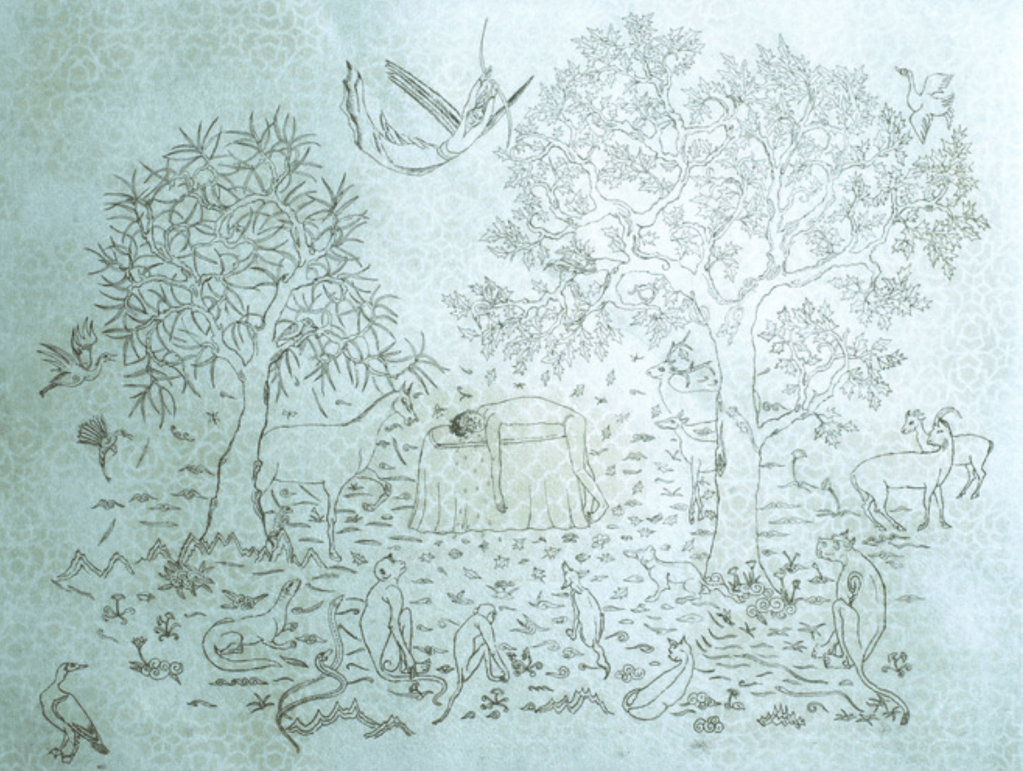
a work inspired by a classic love story which an admiring Lord Byron referred to as the ‘Romeo and Juliet of the East’
https://aaa.org.hk/en/collections/search/archive/nilima-sheikh-archive/object/majnun-grieving-at-lailas-grave
However, these additions from other artworks are positioned mostly around the edges of the
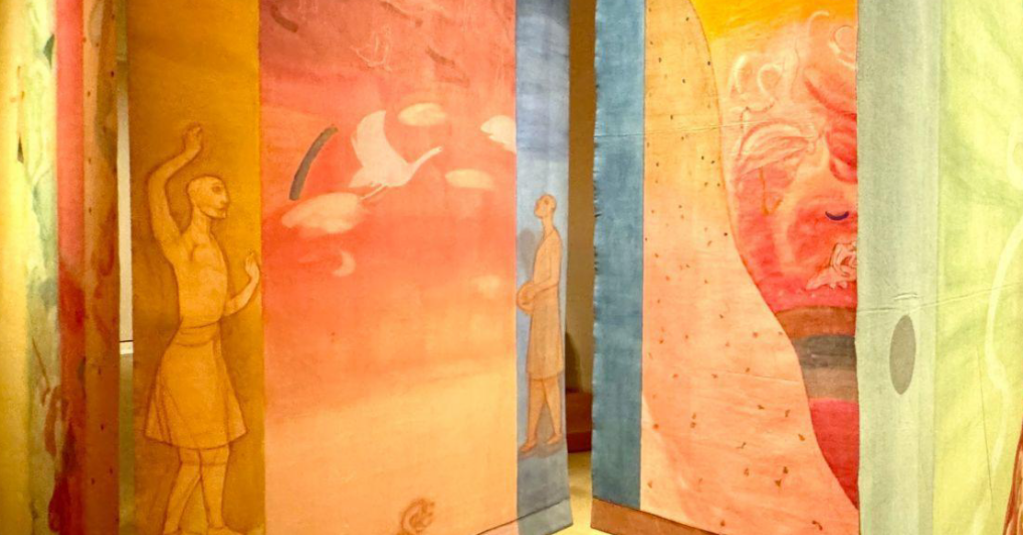
room with one exception. Nilima Sheikh’s series of huge canvases Songspace (1995) takes
up the majority of the floor space in the West Gallery. Sheikh, the wife of one of Mukherjee’s
teachers and a close friend, recreates scenes from folk songs and mythical poetry, the characters bathed in golden yellows and sunset reds and pinks. Still, you can’t help but wish
that this floorspace was taken up with more of Mukherjee’s fecund, exciting sculpture, which
is far more arresting. If this is a story of South Asian art, she is clearly a protagonist, and
deserves more attention than she is afforded. Take Adi Pushp II (1998-99), a cross between stamen and the clitoris rendered in lurid pinks and greens, which is relegated to a corner yet, to my mind, deserves centre stage.
https://aaa.org.hk/en/collections/search/archive/mrinalini-mukherjee-archive/object/adi-pushp-ii-296717
The success of the exhibition’s design is mixed. The three galleries of the Sackler Wing each
collect pieces which are made in the same place. The North Gallery represents Santiniketan,
where Benode Behari Mukherjee taught; the West, Baroda, where Mrinalini studied; and the
South, Delhi, where Mrinalini worked from the early 1970s onwards. This is ineffective as a
framing device. So many artists and mediums are displayed in each room, yet no narrative is
provided to explain how each space influenced practice. For example, the beautiful and
unsettling hemp sculptures are displayed in every room, but unless each place affected each
figure’s genesis, it is unclear why this way of organising the collection was used at all.
Far better is the exhibition’s aesthetic design. The Sackler Wing of Galleries is painted a
fleshy pink and the lighting is pared down to an intimate, soft yellow. It is entirely convincing
that Mrinalini’s fertile figures would have gestated in this environment, which has the
character of a womb in which primeval forms really could burst forth. All in all, A Story of
South Asian Art was a well-done retrospective of Mukherjee and her peer’s work which
required a little pruning. If only each piece was displayed like the solemn soldier Pakshi,
where the Royal Academy’s direction has truly let Mukherjee’s artistic brilliance shine.
A Story of South Asian Art was at the Royal Academy, 31 October 2025 – 24 February 2026
References
Shanay Jhaveri et. al, Mrinalini Mukherjee (2019)
Katy Hessel, The Story of Art Without Men (2022)
 Bluestocking Oxford