By Julia Ledesma
Agnes takes Will’s hand, her thumb and index finger finding where tension gathers in the webbing between his; she applies pressure. We watch her face concentrate, her fingers reading what is contained. Will’s face softens into recognition. Intimacy here is translation. This is Zhao’s visual grammar: the body before language, touch as communication.
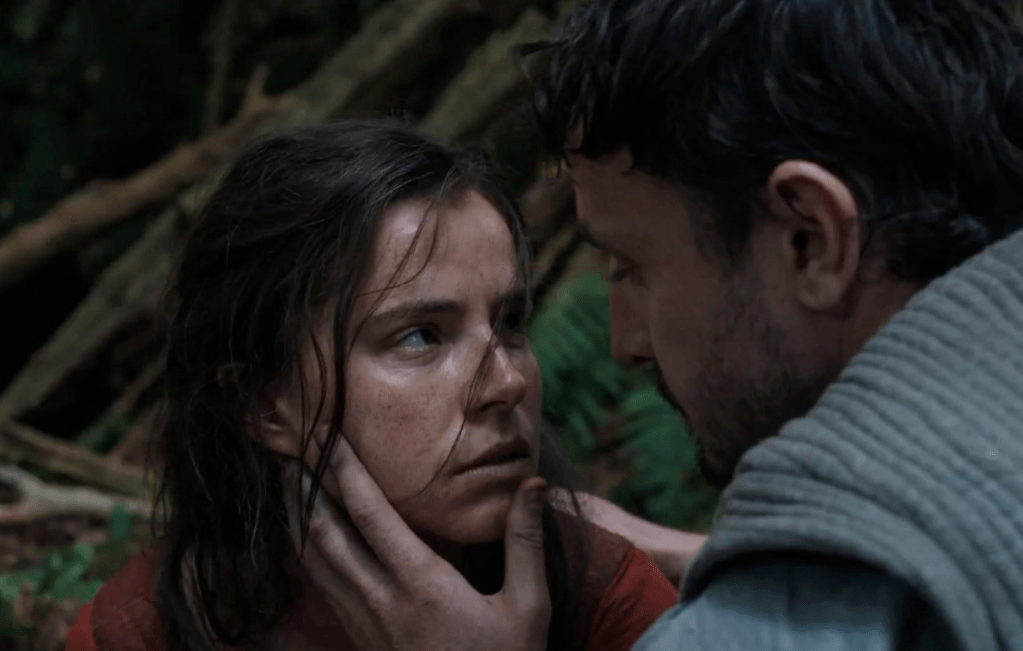
dir. Chloé Zhao, © Focus Features.
Hamnet, adapted from Maggie O’Farrell’s 2020 historical fiction novel, centers on the death of Agnes and Will’s eponymous eleven-year-old son and the chasm his loss opens between them, and within themselves. Will appears only as Will, or William—never “Shakespeare,” the Bard. In other tellings, everyone else exists in relation to him. Here, Agnes’s interiority is given primacy. Zhao’s film insists she is not subsidiary to his genius, nor merely inspirational to it.
The film has a musicality. Gestures repeat. Music loops. Agnes (Jessie Buckley) returns to a whispered, three‑beat command to her husband, Will (Paul Mescal): Look at me. Look at me.
Will and Agnes speak different languages—his learned, articulated, taught in classrooms; hers felt, intuited, read through the body. Together, they make the world legible to each other in ways neither can alone.
In their courtship, Will tells Agnes of Orpheus, whose music beguiles Hades, earning the chance to lead his wife, Eurydice, from the underworld if he does not look back. He loses trust when the gates are in sight, turning to search for her face, and in doing so locking her in the underworld forever.
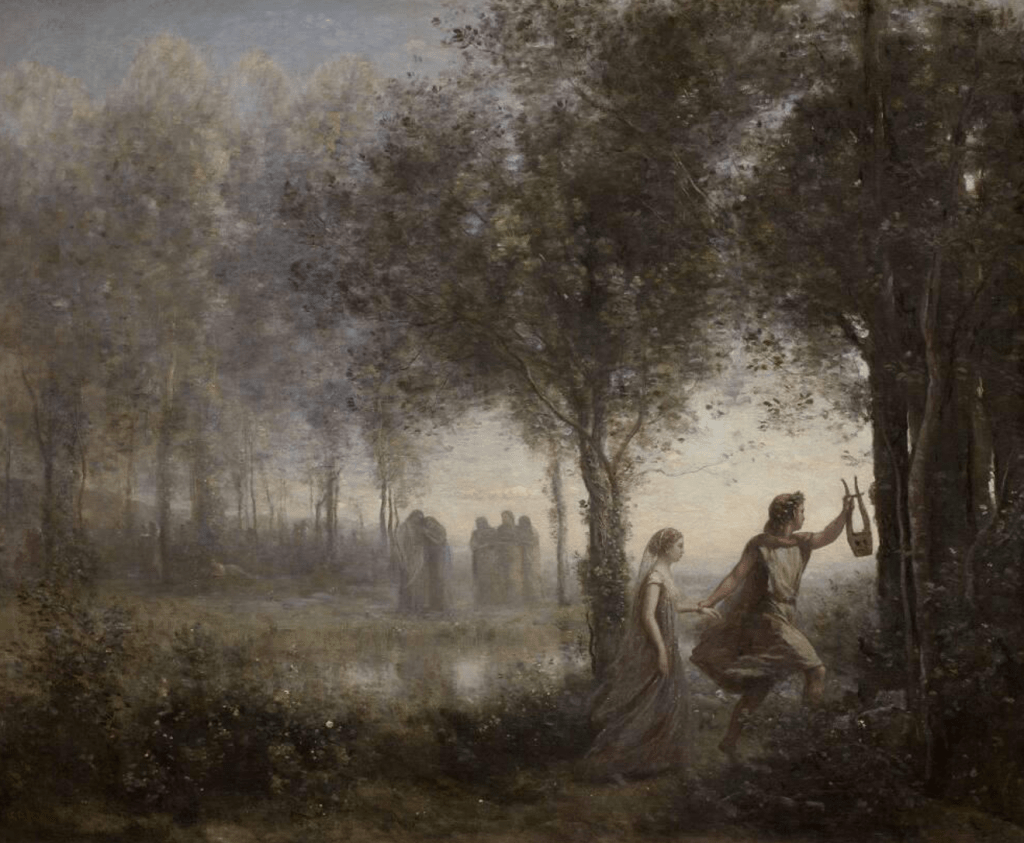
c. 1861, oil on canvas, Museum of Fine Arts, Houston.
During Hamnet’s death, Zhao stages him crossing over through black, veiled fabric—a threshold beyond which the living cannot follow. Agnes releases a guttural, animal sound called forth from somewhere deeper than her throat. She tells him that she would have cut out her own heart to save their son. Yet Will would not know this because, preoccupied with his theatrical career in London, he was not there.
Indeed, Will cannot grasp where Hamnet has gone—a bewilderment that will drive him to bring Hamnet back through art. Zhao’s Will is quieter than O’Farrell’s character, less able to give shape to feeling in the presence of others. Zhao understands that Will has learned emotion is unsafe in real time, that it must be contained and deferred, something Mescal’s psychologically subtle acting conveys.
When Hamnet dies, each seeks solace in what feels familiar. Agnes clings to what remains—the earth, her children, the place where memory lives. Will turns to his writing. He asks Agnes what she sees as she applies pressure to his hand. She answers: Nothing. The physical language that once translated between their worlds runs cold.
Despite its warm reception and string of award nominations, some critics have accused Hamnet of emotional manipulation. They point to Zhao’s use of composer Max Richter’s ‘On the Nature of Daylight’, a piece that has become cinematic shorthand for emotional weight, allegedly engineering tears rather than earning them. Zhao sought out Richter to write the score, but hadn’t heard this track until Buckley shared it days before the shoot ended, inspiring the eleventh-hour re-creation of the final sequence.
To hold the actors in a common emotional register, Richter’s score was played on set during filming. Within it, the composer creates what he calls ‘electronic shadows’—processing Renaissance-era instruments into abstract, unplaceable sounds. When you hear a violin, your mind pictures the instrument and the bow. However, the subtle electronic sound throughout the film offers pure abstraction, connecting us to emotion in a delicate, unmediated way. It hovers between worlds, the sound of what Shakespeare’s Hamlet calls the “undiscovered country”, representing grief that has nowhere to land, suspended in the crossing itself.
In writing this—listening to Richter, re-watching the film, reflecting—I encountered a resistance I hadn’t anticipated. I didn’t know I was holding things that needed releasing. My body was less tolerant; the tension demanded a place to go.
But Hamnet doesn’t offer a single moment of catharsis—one devastating blow, then release. Grief has no immediate endpoint; it endures, lingers, returns. The film asks us to remain inside its loops and cycles, until its shape becomes familiar enough to carry. In a culture that is suspicious of tears and sentimentality, perhaps you felt your own resistance: the impulse to analyze, to look away and to protect yourself from feeling too much. Yet fundamental to Zhao’s offering, is her invitation to recognise our losses in the losses of others.
For Shakespeare’s audiences, death was ever-present. The plague ravaged England’s towns and cities, stealing thousands of loved ones away. They did not need to be persuaded to feel grief. They needed a form capable of holding it. Following scholar Stephen Greenblatt’s reading, Hamlet becomes the space where Shakespeare can finally locate his son, his psychological bewilderment answered through the art of playwriting.
When Agnes travels to London to see the tragedy performed, she discovers where her husband has carried their grief. Zhao stages the performance so that this loss becomes a shared experience, unifying rather than alienating. She films the audience and actors together, collapsing the distance between stage and spectator. Agnes stands among them. The language is unfamiliar, but she recognises the grief made visible in performance.
She turns to Will and beckons: Look at me. Look at me. Zhao captures Will’s released breath before his eyes meet his wife’s. They finally see one another—and each other’s grief. Only after this does Will’s body give way backstage, his deferred grief permitted to surface. Agnes remains, watching.
As Hamlet dies in the play, Agnes reaches forward towards him—towards the threshold she cannot cross. The audience, pulled by the same gravity, reaches too.
Then Agnes envisions her son Hamnet on stage, not the actor. The little boy nods to her before disappearing through an opening that mirrors the forest threshold—where Will told her of Orpheus, where she healed him, and where she gave birth. She watches Hamnet pass back through death into art. For the first time since his death, Agnes laughs. She lets him go.
Hamnet makes a case for such acts of collective human empathy. Psychoanalyst Donald Winnicott wrote, “It is a joy to be hidden, and disaster not to be found.” The paradox is we need privacy, but we need to be seen. Agnes and Will have been hiding in their private grief yet the disaster is that neither has been looking for the other.
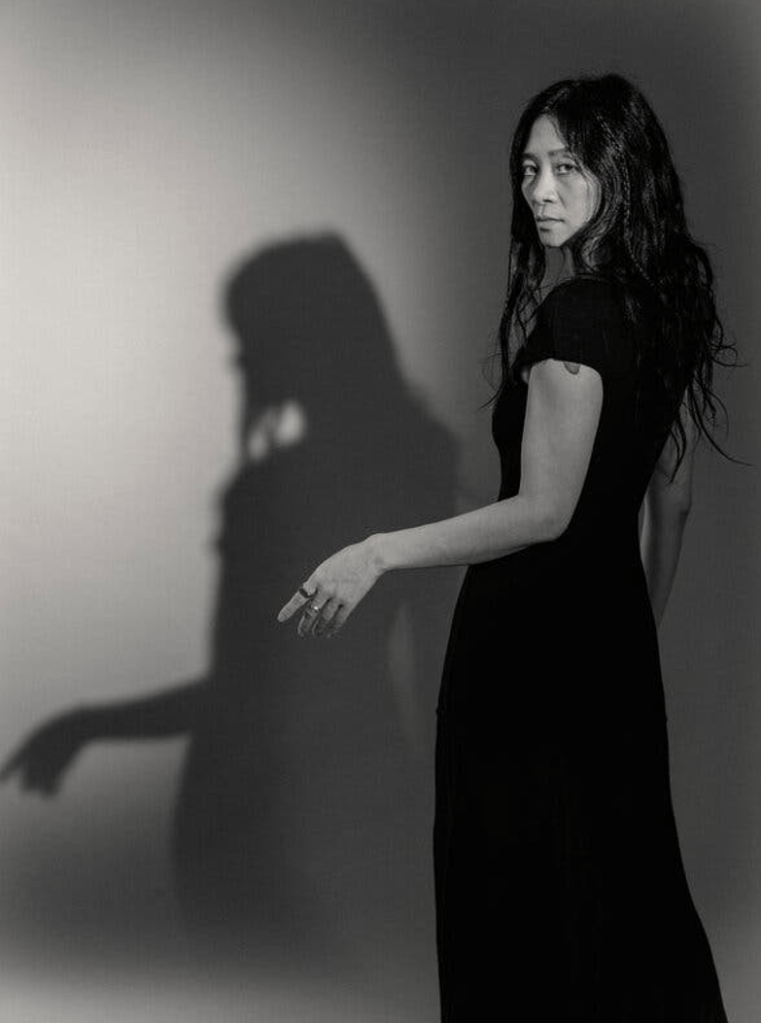
https://www.nytimes.com/2026/01/24/magazine/chloe-zhao-interview.html
As I see it, the film is modelling a culture where grief can be openly expressed, not manipulating us into vulnerability. Zhao asks: will you sit here? Will you yield? You can say no. But if you say yes—if you stay—you are choosing presence over protection, choosing to be found rather than to hide.
Agnes felt seen when she met Will: “He loves me for what I am, not what I ought to be.” Zhao’s film insists we are not automatically visible to each other. Love, like art, requires practice: the choice to keep looking, to risk radical earnestness, even if we cannot ever be entirely known. The tragedy is not looking back at the dead, but refusing to look at those who remain.
References
Chloé Zhao interview with The New Yorker: https://www.newyorker.com/culture/the-new-yorker-interview/chloe-zhao-has-looked-into-the-void
The music of Hamnet with composer Max Richter: https://www.youtube.com/watch?v=-CCHVEVnqAY
Chloé Zhao and Maggie O’Farrell discussing Hamnet for Library Science: https://www.youtube.com/watch?v=y6pX3bfgTYs&t=1s
Stephen Greenblatt, “The Death of Hamnet and the Making of Hamlet”: https://www.nybooks.com/articles/2004/10/21/the-death-of-hamnet-and-the-making-of-hamlet/
 Bluestocking Oxford