By Ava Doherty
Susan Sontag never apologised for her intelligence, and she had a lot not to apologise for. In a society which demanded female humility alongside their brilliance, she defied contemporary norms. Her performance of an intense aesthetic—unsmiling, severe, draped in black—was her armour and burden. Decades after her death, her legacy haunts how young women display intellect in both elite academic and cultural spaces, where such portrayals of depth have become neat narratives and curation comparable only to Instagram.
Sontag’s seriousness was a deliberate act of self-authorship in a male-dominated intellectual world. Her landmark essays Against Interpretation, On Photography, and Illness as Metaphor are filled with dense prose, rigorous citation, and an unwavering commitment to critical engagement. These essays were not just intellectual posturing but rather a challenge to orthodoxy.
In an era when women writers were relegated to “soft” subjects or dismissed as derivative, Sontag’s formidable style was strategic. Seriousness became her passport into conversations from which women were routinely excluded.

https://writersinnervoices.org/2015/06/25/writers-on-writing-susan-sontag/
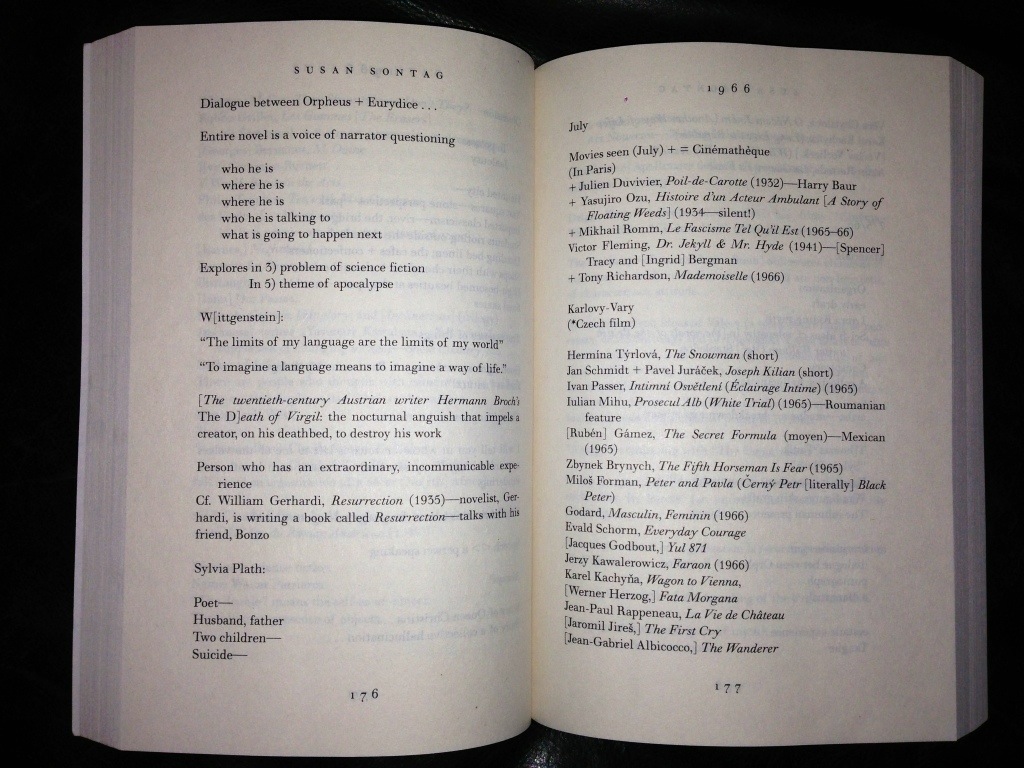
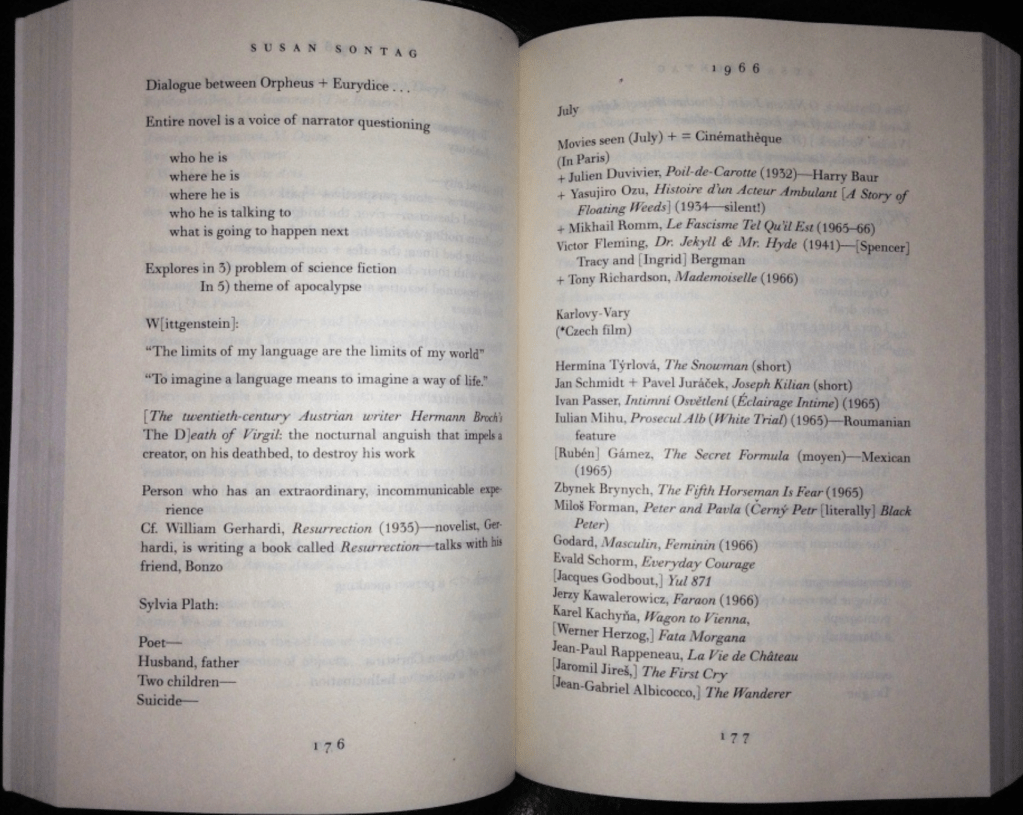
Such access, however, came at a price. The public Sontag, cool, severe, impenetrable, bore little resemblance to the woman who emerges in her diaries, published posthumously. There, we encounter such vulnerability, doubt, and emotional rawness, which she carefully excised from her public work. She understood, perhaps too well, that to reveal uncertainty or feeling in public would be to invite the very dismissal she challenged. Male intellectuals could afford ambivalence; they could, interestingly, be wrong. Women could not.
This tension between public severity and private vulnerability reveals a deeper truth about feminine intellectual authority: it requires constant vigilance. Sontag knew that any shift into conventional femininity, emotional expression, personal revelation, or even confident aesthetic choices (fashion), risked undermining her credibility. She famously disavowed makeup and conventional beauty rituals, finding them incompatible with her presentation as a ‘serious intellectual’.
Young women today navigate remarkably similar terrain. In Oxford politics, for instance, women speakers are frequently criticised for lacking charisma or being “too serious”, a double mechanism which demands gravitas while punishing those who achieve it. The alternative, being perceived as frivolous or intellectually lightweight, remains professionally lethal. Men in these spaces can afford to be charismatic, even buffoonish, without sacrificing authority; however, women cannot afford to. Theresa May’s unfortunate confession about ‘running through fields of wheat’ comes to mind: even a moment of attempted relatability becomes a national punchline when you are a woman in power.
Sontag’s notebooks, with their reading lists and theoretical musings, have become a template for contemporary intellectual self-presentation. Scroll through literary social media, and you will find carefully photographed bookshelves, niche references dropped with studied casualness, and the aesthetics of theory deployed as an identity marker. This performance of depth has become its own genre.
https://biblioklept.org/wp-content/uploads/2013/07/20130717-120729.jpg
The television adaptation of Phoebe Waller-Bridge’s Fleabag captures this phenomenon with characteristic sharpness. In the first series, the protagonist attends a feminist lecture, arms crossed, projecting intellectual engagement while internally monologuing about her daily life. By the second series, she has further developed her performative seriousness; now she is actually attracted to the ideas being discussed, or at least to the priest who is discussing them. It is a brilliant skewering of performative seriousness: the millennial woman who knows she should care about Butler and Beauvoir, who arranges her face into thoughtful concentration, but whose mind is elsewhere entirely, specifically, on a man in a clerical collar (the most honest intellectual position any of us has held during a theory lecture). Unlike Sontag, who genuinely wrestled with ideas in private, Fleabag performs the wrestling in public while remaining emotionally disengaged.

https://www.amazon.co.uk/Fleabag-Season-1/dp/B0951VQN44
This example is the inheritance Sontag did not intend: seriousness as costume rather than commitment. Where Sontag’s engagement with theory was rigorous and sustained, contemporary iterations may remain superficial, references without genuine engagement, the appearance of intellectual depth without its substance. When celebrities invoke complex theory as cultural capital, it risks reducing serious thought to aesthetic shorthand. The tote bag from your favourite independent bookshop does not make a public intellectual, though it does make for excellent personal branding.

https://www.reddit.com/r/popculturechat/comments/175mltm/anya_taylorjoy_street_fashion_ft_the_shakespeare/
We should be careful not to dismiss all of this as mere performance. The young women curating reading lists and aesthetic rigour online are not necessarily frauds; many are genuinely grappling with ideas in a culture that still does not reward them for it. The problem is structural: when intellectual credibility demands constant visible examples, performance and substance become impossible to disentangle. Sontag could disappear into her work; today’s women must market while they think.
This idea matters because it evacuates the seriousness of its political force. Sontag’s severity was resistance; it demanded space for women’s minds in rooms which demanded only their decorative presence. When seriousness becomes an Instagram aesthetic, it loses this oppositional power. Worse, it becomes another form of feminine labour, curating the appearance of depth alongside everything else women are expected to curate about themselves.
The question, then, is whether seriousness remains a viable mode of feminine resistance or whether it has been so intensely commodified that it no longer serves its original purpose. The answer is uncomfortable: both truths can be held without contradiction. For women entering hostile intellectual spaces, seriousness remains necessary armour. The woman who refuses to soften her arguments, who will not perform likability or self-deprecation, still claims power through her refusal. In this sense, Sontag’s legacy endures as a model of unapologetic intellectual ambition.
Yet we must reckon with how this model constrains. The demand for constant seriousness is exhausting and leaves little room for the full range of feminine intellectual expression. It suggests that to be taken seriously, women must adopt a narrow aesthetic of severity, must be Sontag, or nothing, as if intellectual authority were a game of dress-up with only one costume available, always black. This idea is its own problem.
What we need is not to abandon seriousness but to refuse the terms that made it necessary. Sontag’s tragedy was not her seriousness, but the fact that the culture demanded she choose between intellectual authority and emotional authenticity, between seriousness and humanity. Her private diaries reveal a woman who should never have had to be forced to make that choice.
The challenge for contemporary women is to occupy intellectual space without reproducing the same rigid binaries. This position means taking ideas seriously while refusing to perform invulnerability. It means recognising when the aesthetics of theory is a substitute for genuine engagement. It means understanding that seriousness, like any political strategy, must evolve with the conditions it resists.
Sontag gave us a model of intellectual fearlessness which remains invaluable. We honour her best not by replicating her armour, but by constructing a world where such armour is no longer required, where women’s minds are taken seriously on their own terms, without demanding they suppress their humanity in exchange.
References
Sara Ahmed, Living a Feminist Life (2017)
Susan Sontag, Against Interpretation (2001)
—On Photography (2001)
—Reborn: Journals and Notebooks, 1947-1963 (2008)
 Bluestocking Oxford