By Eleanor Davies
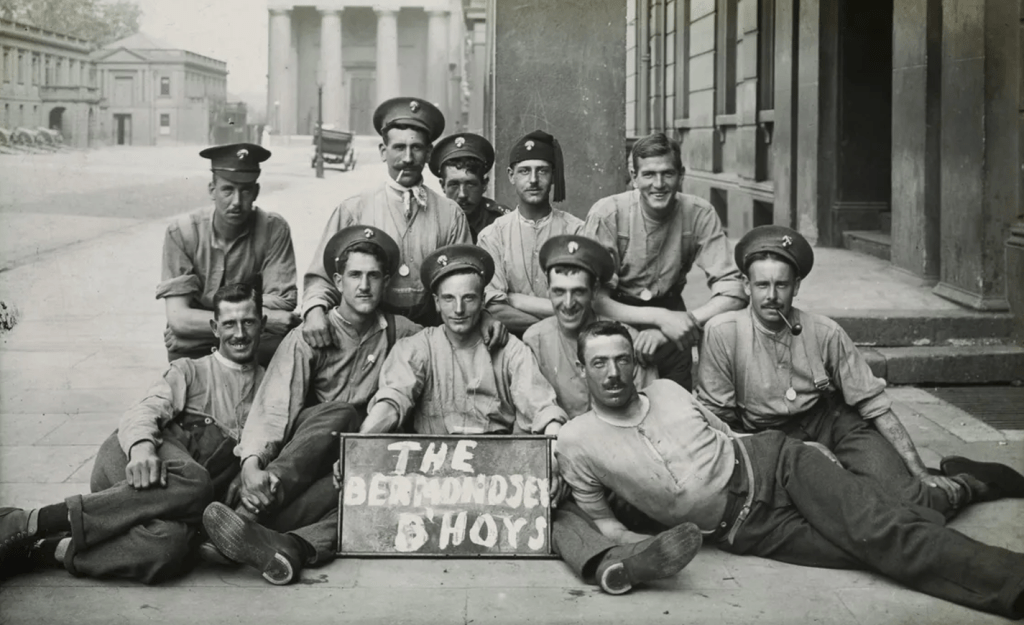
There is a particular unease that attends the viewing of Christina Broom’s (1862-1939) photographs today. Not because her images display the violence or destruction of the early twentieth century, but rather because they don’t. It is most palpable in her images of young soldiers heading to war. The photographs are calm, yet the viewer cannot escape the knowledge of what follows. The dissonance is temporal rather than visual, and violence presses into the image as a burden of hindsight. It is never rendered spectacular.
This withholding is not incidental to Broom’s practice; it is central to how her photographs operate. Across her work, whether depicting military life, suffragette demonstrations, or royal ceremonies, Broom resists the visual strategies that would later come to dominate political photography. Instead, she attends to the ordinary structures of public life, where people gather, march, and wait. Politics appears not as a crisis, but as presence.
https://www.londonmuseum.org.uk/collections/london-stories/introduction-christina-broom/
Often credited as Britain’s first woman press photographer, Broom came to photography late and out of necessity. Born in 1862, she began photographing London’s streets in her early forties, forced to become the major breadwinner after her husband was incapacitated by injury and later tuberculosis. With limited capital and no formal training, she borrowed a camera and began producing postcards, developing and printing them at home in Fulham with the help of her daughter, Winifred. She worked outdoors exclusively, carrying heavy equipment through the city, positioning herself in spaces that were neither designed for women nor particularly accommodating to them. Her practice was pragmatic, commercial, and sustained over decades.
What Broom photographed, consistently, was public life as it was enacted rather than idealised. Her subjects are rarely caught off guard; they appear aware of being seen, and often acknowledge the camera directly. Crowds are central to her work, but they are never rendered anonymous. Individuals remain legible within collectives, their expressions varied, their attention uneven. The public realm emerges not as spectacle but as a shared condition.
Hannah Arendt’s conception of the public realm helps clarify what is at stake in these images. For Arendt, politics does not consist primarily in institutions or outcomes, but in appearance. A public world comes into being, she argues, whenever people gather together to speak and act in one another’s presence. This ‘space of appearance’ is fragile and contingent. It depends upon plurality, upon mutual recognition, and upon the willingness of individuals to show themselves to others. Crucially, Arendt distinguishes such appearance from spectacle. The public realm is not a stage for display, but a shared world that both connects and separates those who inhabit it.
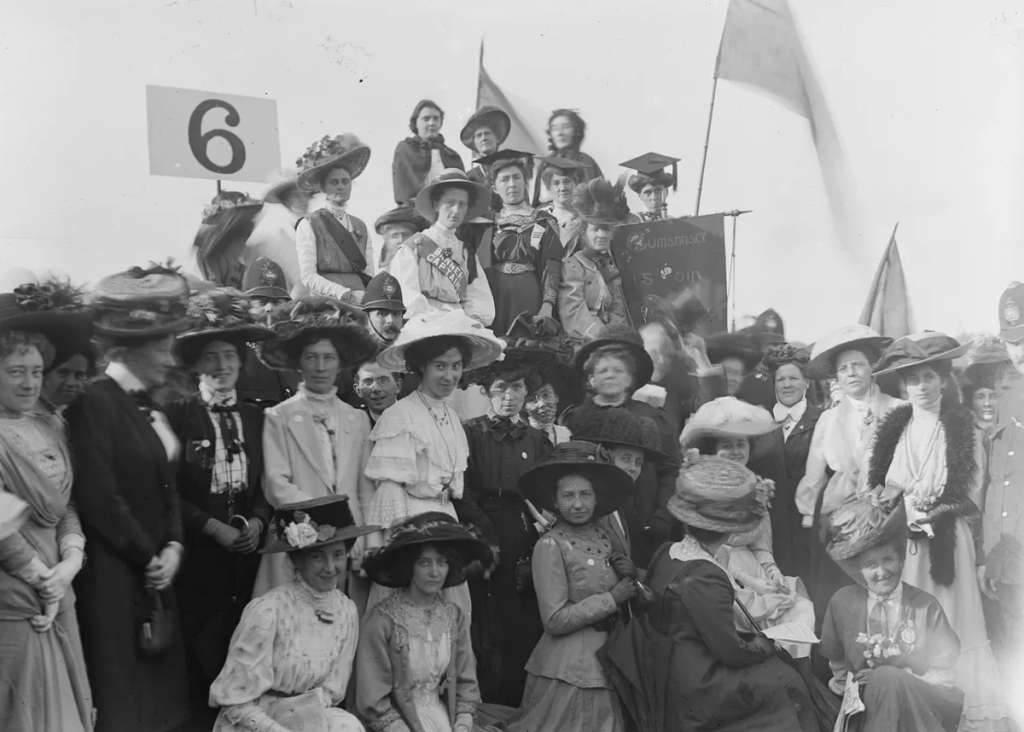
Broom’s photographs can be read as visual articulations of this space. They do not isolate exceptional figures or dramatize confrontation. Instead, they linger on collectivity as a condition: women assembled behind a fundraising stall, suffragettes marching in formation, soldiers posed not as instruments of violence but as participants in an institution that precedes and will outlast them. Politics, in these images, unfolds over time. It is not explosive but durational.
https://www.londonmuseum.org.uk/collections/london-stories/introduction-christina-broom/
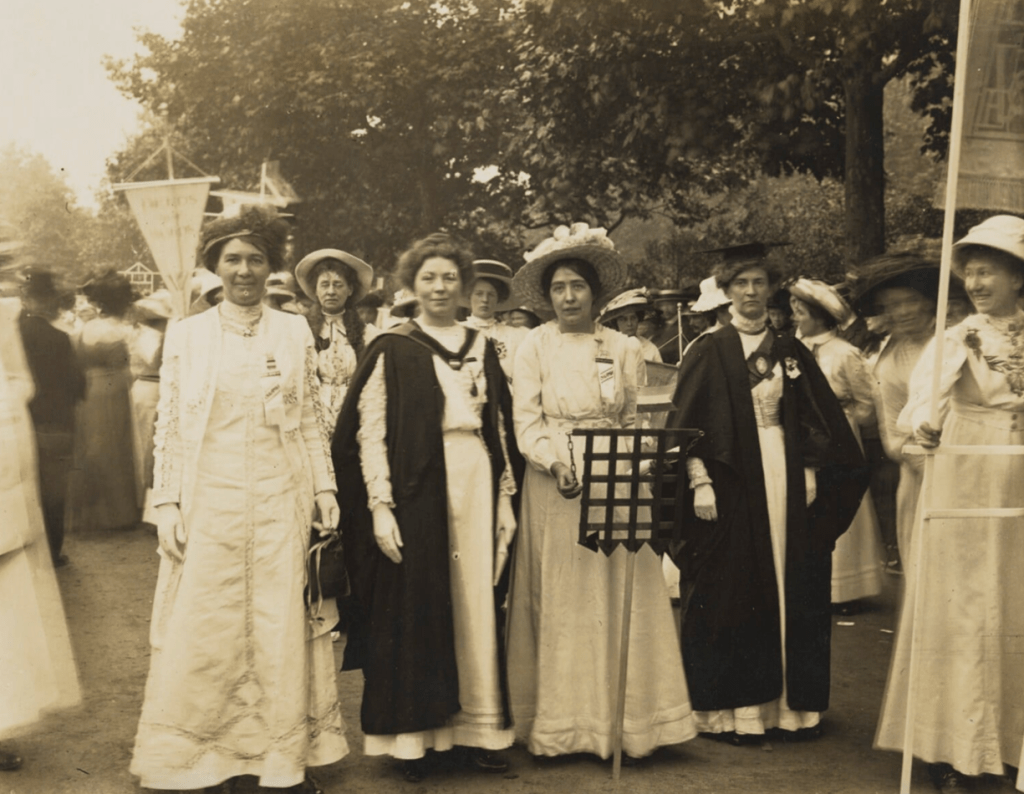
This approach has particular significance in relation to women’s appearance in public space. Feminist critiques of the public–private divide have long noted how women were excluded from political life by being confined to the household, where their labour was rendered necessary but invisible. To appear in public was often to risk moral judgement or social sanction. Against this backdrop, Broom’s photographs of the suffrage movement are notable not because they dramatize conflict, but because they normalise women’s presence. Her subjects do not appear furtive or defensive. They stand, march, converse, and look.
Indeed, the frequency of eye contact in these images is striking. Women meet the camera’s gaze directly, making the photography feel less like capture than encounter. This reciprocity situates Broom’s work within an ethics of looking that differs from dominant traditions of political photography. Many such traditions rely on exposure, mobilising attention by capturing the visibility of violence as proof. Broom’s refusal of spectacle offers an alternative. Her subjects remain visible without being violated or reduced to examples. Instead, they are situated within relations – both with one another, and with the photographer.
https://www.npg.org.uk/collections/about/photographs-collection/featured-collections-archive/christina-broom-pioneering-photojournalist/
That Broom herself was a woman matters here, though not in any simple way. There is little evidence of her personal political beliefs, and it would be speculative to cast her straightforwardly as a suffragist sympathiser. Her motivations were likely practical: the suffrage movement was topical, and her livelihood depended on selling images. Intention, however, does not exhaust meaning. Whatever her personal views, Broom’s photographs participate in a feminist visual economy by virtue of how they render women’s public appearance. Women are framed not as intrusions into politics or spectacles of disruption, but as ordinary citizens engaged in collective action.
This ordinariness is central to the political force of Broom’s work. Arendt argues that freedom is inherent in action. Such freedom, however, requires access. This is where Arendt’s account of the public realm has been criticised for its exclusions, particularly its tendency to bracket off social and economic necessity. Reading Broom alongside Arendt exposes this tension; her public world is populated not by abstract equals, but by bodies marked by gender, class, and labour. Her images show the conditions under which appearance becomes possible.
Broom’s own working life underscores this point. Carrying heavy equipment through the streets, operating without institutional support, and relying on her daughter’s labour in the home, she inhabited the very boundary between private necessity and public visibility that Arendt treats uneasily. Her photographs, in turn, document a public realm sustained not by grandeur or permanence, but by repetition and effort.
https://www.npg.org.uk/collections/about/photographs-collection/featured-collections-archive/christina-broom-pioneering-photojournalist/
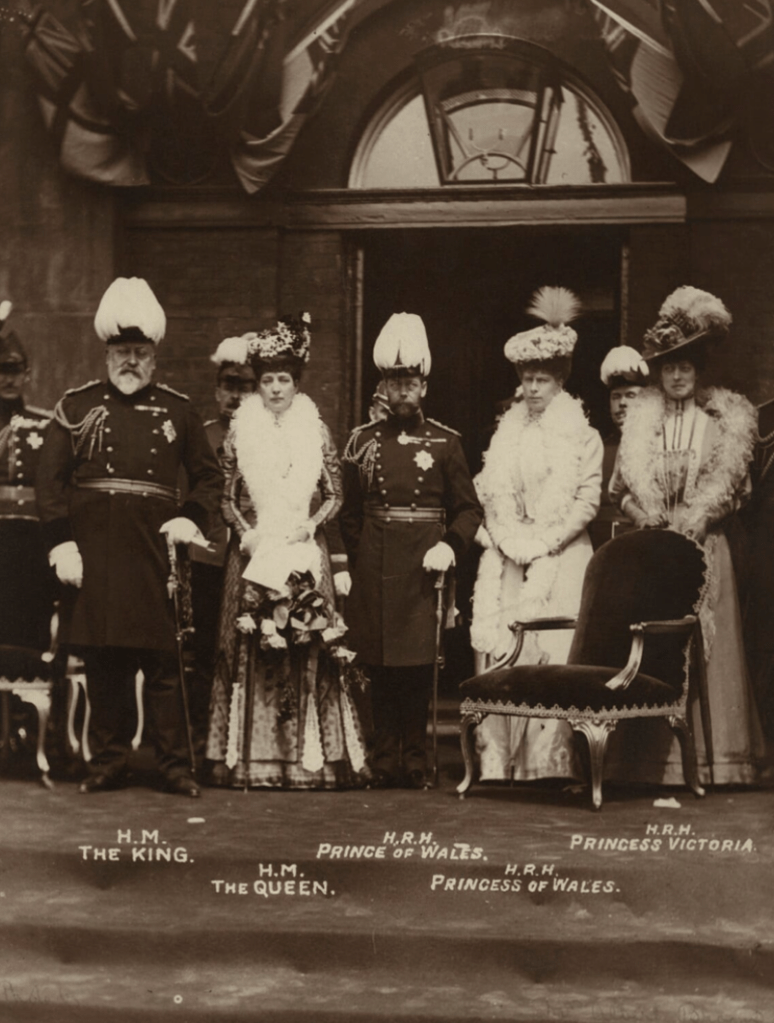
This may account for the enduring resonance of her work. Broom’s images do not overwhelm the viewer or prescribe an emotional response. They invite attention rather than shock. Even her photographs of royalty are marked by moments of proximity, where the distance between subject and spectator briefly narrows. These moments do not undermine authority so much as situate it within a shared field of visibility.
To view Christina Broom’s photographs today is to encounter a model of political photography that feels both historically specific and instructive. In a visual culture saturated with crisis, her work reminds us that political life is sustained not only through rupture, but through the ordinary practice of appearing together. Broom’s achievement lies in showing how public life is built quietly, through sustained acts of presence, in the space between private lives and the shared world they help to maintain.
References
Canovan, Margaret, ‘Politics as Culture: Hannah Arendt and the Public Realm’, History of Political Thought, 6 (1985), 671 – 642.
Neale, Shirley, ‘Broom [née Livingstone], Christina [known as Mrs Albert Broom](1862-1939), Oxford Dictionary of National Biography (2004).
Perez, Vanessa and Reid, Darcy, ‘Christina Broom’ in Extraordinary Women with Cameras (United States: Rocky Nook, 2022).
Sparham, Anna, Soldiers and Suffragettes: The Photography of Christina Broom (London: Philip Wilson Publishers, 2015).
 Bluestocking Oxford