By Maisie Corkhill
Sex sells, and the weirder the better. Emerald Fennell realised this in Saltburn (2023), and the success of those tantalising, enclosed, rage-baiting scenes in her second film comes to bear on the marketing – if not the substance – of her adaptation of “Wuthering Heights” (2026). For over a year, audiences have been promised a shocking and ‘aggressively provocative’ version of Emily Brontë’s classic and beloved novel. Back in August, the Guardian wrote about a test screening of Fennell’s then unfinished film that features ‘horse-rein sex, suggestive egg yolks and necrophile nuns’. While the horse-reins and egg yolks have stayed, Fennell has dispensed with the ‘nun fondling the corpse’s visible erection’ at the public hanging that opens the film (the erection, however, stays). This film has been long in the making and it has maintained an animated discourse throughout, ever since Fennell published that teaser image on X: a beautiful and strange gothic line drawing of what looks like skeletons engaging in oral sex.
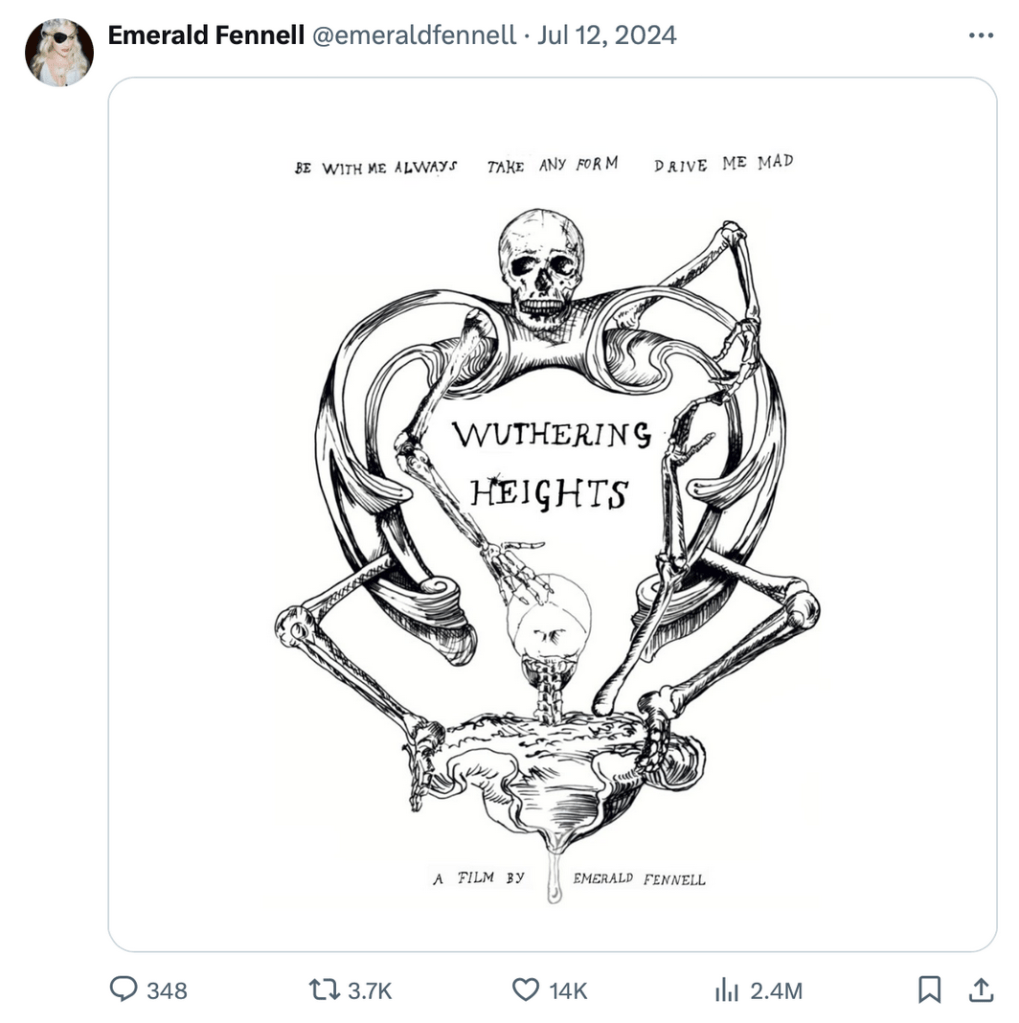
© Emerald Fennell on X
In the lead up to the film audiences have been spoon-fed content. A ‘first-look’ at Catherine’s wedding dress – just anachronistic enough to fan the flames. More costume releases: a cellophane inspired wedding-night dress, the red ‘latex’ dress, all designed by Oscar-winning Jacqueline Durran, responsible for the looks in Barbie (2023) and the ball gowns in Little Women (2019). Teaser trailers that front-load Fennell’s characteristically visceral close-ups, the sensual kneading, dirty fingers in egg yolks. More recently the standard influencer-led social media campaign, where creators unboxed “Wuthering Heights” PR packages including products like a ‘better with sex’ Last Crumb cookie, Quickies x Wuthering Heights press on nails, and the Maude ‘come undone’ candle. This is not to mention collaborations with luxury brands like Aspinal and Hunter. Apparently, if you plan to wander on the moors after seeing this film, you need to do it in Hunter wellies.
© Hunter on Instagram
The aggressive marketing campaign has simultaneously courted controversy with book purists and targeted a mainstream audience with ‘the greatest love story of all time’, with viewers encouraged to consume all the products that come with it. This approach, however, has paid off. “Wuthering Heights” opened to around $76.8M globally and surpassed the $100M milestone within ten days. It has already recouped a production budget of $80M and looks on track to cover the marketing budget of reportedly $80-100M. Considering that period dramas are often a high risk genre that can struggle to achieve mainstream attention, Fennell has been extremely successful in bringing the story to a whole new generation and market of people. Compared with recent female-directed period pieces, the commercial outcome for Fennell’s film exceeds many of its indie counterparts. Frances O’Connor’s Brontë biopic Emily (2022), for example, was a modest arthouse performer grossing $3.5M from a $40,000 budget. O’Connor’s film did well on its own terms, and did not provoke Brontë purists, despite taking massive creative license with Emily Brontë’s life and also abounding with sex on the moors. But at this scale it probably didn’t generate a 469% rise in sales of the book, as Penguin reported in the lead up to Fennell’s film.
This may all sound cynical, but I genuinely believe that the marketing campaign has been the undoing of what had the potential to be an exciting adaptation. We were promised a really weird “Wuthering Heights”. What we got was altogether more formulaic: a traditional love story with some soft BDSM. Fennell’s actual use of BDSM for shock factor does not perform anything revolutionary for the story. As Emma Flint compellingly wrote for the Guardian, Fennell has ‘grotesquely’ reshaped Isabella’s narrative from sexual abuse survivor in the book to compliant dog on a chain in the film. To take a character who is really too inexperienced to consent and use that character to facilitate a submission kink in the film is not daring, just disappointing. Perhaps this is unsurprising given Fennell’s unnuanced ‘eye for an eye’ approach to sexual violence in Promising Young Woman (2020). The only other supposedly shocking scene is Joseph and Zillah’s horse-play, leaving the rest of the film a rather standard, romanticised romp. The outcome is something closer to the ‘viral’ period drama of Bridgerton than the gritty, disturbing energy of Brontë’s original text.
Bridgerton was hugely successful precisely because it gave people the language to talk about it in a short-form way, with a marketable sex element that can be boiled down to one or two words such as “the spoon scene”, “the carriage scene”, “the mirror scene”. Everyone is very excited for “the bathtub scene” in season four. Of course, Emerald Fennell has her own “bathtub scene” in Saltburn, and has clearly noticed how powerful it can be to have a clear synecdochal phrase that can drive the discourse. “Wuthering Heights” also has a “carriage scene”. Even the press run for “Wuthering Heights” was similar to Bridgerton season three, in hyping up how outrageously sexy it will be. Nicola Coughlan said that in the carriage scene they didn’t hear cut so they just kept going, just as Margot Robbie said that she had her girlfriends over for a screening and they howled like hyenas when they saw the scenes between her and Elordi.
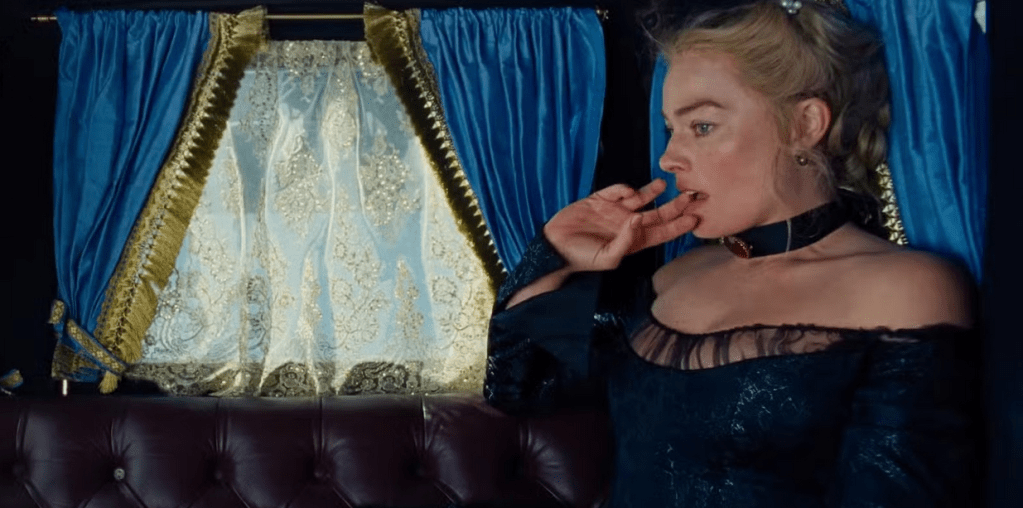
(controversially) cast as Catherine Earnshaw
© Warner Brothers, 2026
There is nothing inherently wrong with this, but when you set up expectations for something outrageous, of course the reality is at risk of falling flat. In “Wuthering Heights” this has regrettably happened to Fennell’s key stylistic marker, that is the heightened, concentrated images of foods, fluids and textures that ultimately imply sex – most of which were included in the teaser and full trailer, along with the marketing materials. Generally, things can only shock us the first time that we see them. It is such a shame that every scene that has the potential to shock in “Wuthering Heights” has already been shown to us before we enter the cinema.
There are aspects of “Wuthering Heights” that are strikingly original, like the set of the house, indented into the landscape like something from Tolkien’s Mordor. This film is strongest at its most gothic, and I wonder why Fennell set up this bedlam of a house if not to pay it off with a ghost. Cathy is called a ghost, once, but it is only when Isabella sees her spying. The final scene sees Heathcliff lying beside Cathy’s corpse on her deathbed in her pastel pink ‘skin room’ (which you can now rent on Airbnb). Funnily enough, the position of the two lovers is almost identical to Ellen and Count Orlock in Nosferatu (2024) and I wonder if it was deliberate to evoke that actually shocking gothic sex scene from recent cinema.
The very first teaser image Fennell shared promised us sex and death. The end of “Wuthering Heights” felt extremely tame, especially with what could have happened given the inherent strangeness of the book. The day that Cathy is buried (in the book) Heathcliff takes a shovel and starts digging up her grave, until he feels Cathy’s ghost near and is guided back to the house. Twenty years later, when a grave is being dug for his son Linton, Heathcliff has Cathy unearthed. He looks into her face, which he recognises as ‘hers yet’ despite the time that has elapsed, and has the side taken out of her coffin so when he is buried he can reach her and they can decompose together. Remembering what happens to a grave in Saltburn, there is an expectation that Fennell would have made the most of the material that was right there for her.
After all, in a heightened, cinematic version Fennell really could have had Heathcliff doing anything once he’s in the grave with Cathy. That really would have been shocking, and far more artistically bold and challenging than the ending we got. Brontë’s actual text offered Fennell the opportunity to get really weird, and I’m disappointed that she didn’t. But perhaps this is not entirely Fennell’s fault: after all, for this film to do well commercially (which it has), it had to fulfil certain acceptability criteria. It was only rated 15, and think of all those teenagers eager to see the adaptation after getting their first taste of Brontë’s novel. If Fennell had leaned into Brontë’s text and given us a truly weird version it could have been groundbreaking – but would it have been so very marketable?
References
Emily Brontë, Wuthering Heights (London: Penguin, 2003).
https://www.theguardian.com/film/2025/aug/07/emerald-fennell-wuthering-heights
https://www.the-numbers.com/movie/Wuthering-Heights-(2026)#tab=summary
 Bluestocking Oxford