By Selvi Nicholls
The divisions that formed within the Pankhurst family during their socio-political campaigns are often overshadowed by the monumental achievement of women’s enfranchisement. Still, these rifts warrant study. The divide between the two most well-known of Emmeline Pankhurst’s daughters, Sylvia and Christabel, provides significant insight into the limits of a single-minded form of feminism, as well as the impossibility of a universalist approach to women’s emancipation from patriarchy.
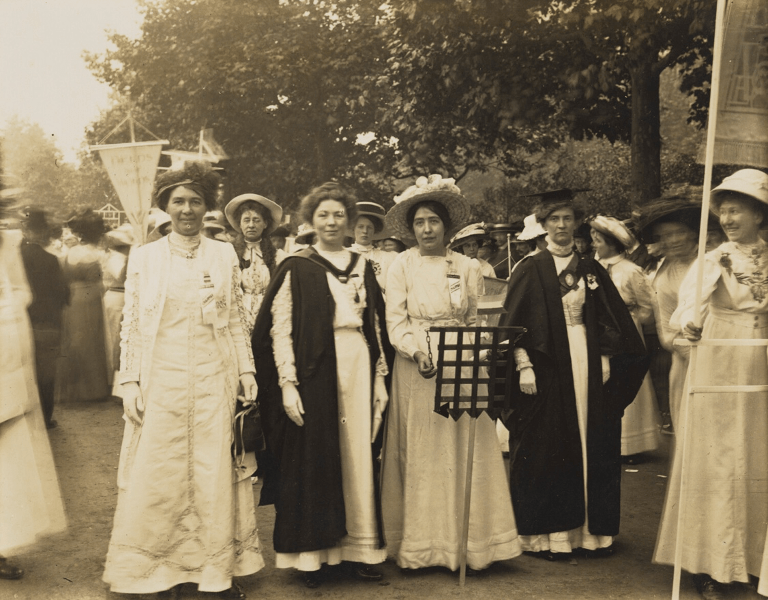
Photographed by Christina Broom, 1910
© National Portrait Gallery, London
Sylvia’s alienation from the dogma of the Women’s Social and Political Union (WSPU) emerged most clearly following her growing attention to working-class issues in London’s East End in 1912. The goal of the WSPU was the construction of a single-issue movement in support of women’s suffrage. It had distanced itself from both the Labour Party and the broader labour movement, despite the 1910-14 ‘Great Labour Unrest’, characterized by strikes and trade-union militancy with the goal of higher wages, better working conditions, and trade union recognition. Whilst Emmeline and Christabel believed the labour unrest was a distraction from the women’s cause, Sylvia chose to work in the East End specifically because it was a homogenous working-class area. Her goal was to work toward a wider understanding of women’s emancipation than just the vote: overcoming the economic and social inequality that faced these communities through dismantling the system that supported it. Her exit from the WSPU came at the behest of her sister, Christabel. The inciting incident involved Sylvia’s speech at a mass rally in August 1913 supporting the workers involved in the Dublin lockout, who were fighting for improved working conditions and the right to unionise. Christabel condemned this from her residence in Paris. Her letter to Sylvia was indicative of the size of the rift that had formed between them: “it is essential for the public to understand that you are working independently of us”.
The ideological split between the two sisters deepened following the outbreak of the First World War. Sylvia’s work in the East End continued, and her East London Federation of Suffragettes (ELFS), which was officially consolidated in January 1914, did relief work for the community, including opening a day nursery and multiple mother and baby clinics. The group was unique in that its work was not indicative of support for the war effort; in fact, Sylvia opposed it. Indeed, whilst she was initially hesitant to take a strong pacifist stance as many of her peers had lost family to the war, Sylvia eventually made her feelings known. She considered the role of the ELFS to be a revolutionary one, and consequently condemned support of a war that she believed only benefitted an imperialist state.

Self-portrait, chalk, circa 1907-10
© National Portrait Gallery, London
As the war drew to an end, and the 1918 Representation of the People Act gave a select proportion of women the vote, Sylvia’s feminism shifted focus even further. 1917 saw her Woman’s Dreadnought paper renamed the Workers’ Dreadnought, whilst ELFS underwent two name changes: first to the Workers’ Suffrage Federation in 1916, and second to the Workers’ Socialist Federation (WSF) in 1918. Sylvia is often accused by historians of subordinating women’s issues to those of class, yet this could not be further from the truth. Instead, she had formed a broader, more coherent view of structural oppression. Her close connection to the labour movement, alongside her admiration for workers’ movements in Russia, led her to an understanding of how class and gender-based oppressive structures interacted, and that neither could be dismantled without also dismantling the other.
In contrast, Christabel wholeheartedly supported the war. The Suffragette, the WSPU newspaper, was renamed Britannia, disseminating imperialist and nationalist literature. Christabel condemned all pacificists, arguing that they were funded by or supported the German state. Articles in Britannia argued for a kind of ‘patriotic feminism’, with the aim of cementing women’s worth in British society through loyalty to the nation. The group’s broader outlook toward social and economic progress is best understood through a collection of articles published by Christabel in 1918, named Industrial Salvation.
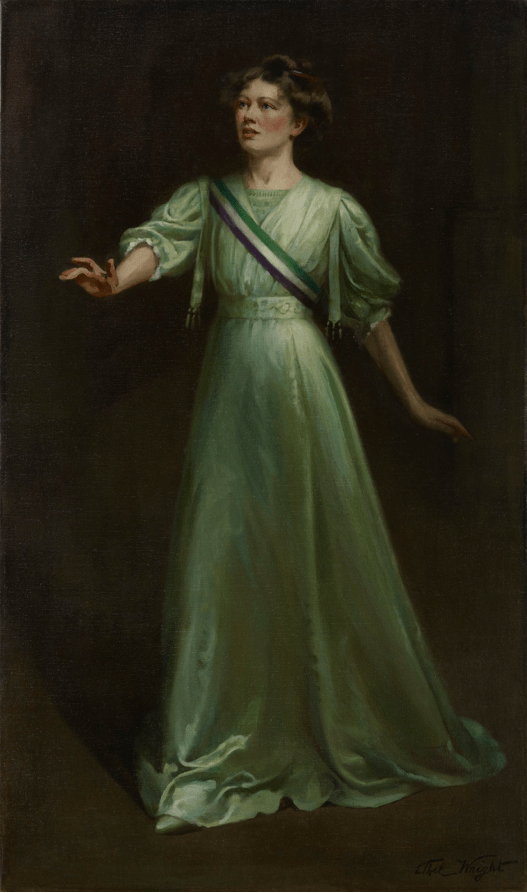
By Ethel Wright, oil on canvas, exhibited 1909
© National Portrait Gallery, London
Industrial Salvation claimed to provide a route for post-war recovery that both avoided the ‘evils’ of Bolshevism and ensured the wellbeing of the women that were brought into work during the war. Contrary to her sister’s socialist doctrine, Christabel argued that the proletariat should not be valorised, but instead abolished. According to her, the conditions experienced by the bourgeoisie were aspirational. She disputed the necessity of wealth redistribution, and instead argued that in order to raise the standards of the proletariat to that of the bourgeoisie, consumption by the former must increase. The path to doing so required women to remain in the workplace – Christabel argued that they will both increase production to its necessary level, and increase consumption due to their apparent natural proclivity to do so. She also asserted that an increase of living standards cannot occur through shop steward – and therefore, union – leadership. Describing the Bolshevik threat as a German one, she contended that the ‘democratization of the workplace’ concealed a plot to decrease production, and consequently sabotage British industry.
Christabel’s imperialist, anti-union beliefs initially appear to vastly contradict her claimed feminist stance. However, the intricacies of her form of feminism, when placed into contrast to that of Sylvia, demonstrates how separatist feminism can naturally lead toward a fascist worldview. Christabel insisted that her aim was to unite women universally, regardless of class boundaries. The nature of the WSPU as a single-issue movement, alongside its rift with the broader labour movement, meant that the significance of these class boundaries was ignored. Universalist feminisms appear in good faith, yet ignorance of the roots of the oppression faced by working-class women led to Christabel’s rejection of them. She believed that working-class people were unfit to democratically organize in their workplaces, let alone run a women’s movement, and this consistent belief of middle- and upper-class superiority led to Christabel’s goal of ‘civilising’ the working-class, instead of emancipating them. In contrast, Sylvia’s involvement with socio-political working-class problems in the East End led to her understanding that there is no such thing as a women’s movement without a labour movement, which itself cannot exist without a broader understanding of the horrifying nature of imperialism.
Ultimately, the rift between Sylvia and Christabel is a valuable study of the dangers of a movement that lacks intersectionality at its core. Both Sylvia and Christabel did valuable work towards the goal of women’s enfranchisement, yet the latter was led astray due to her failure to understand the foundation of the oppression she claimed to fight against.
References
Darlington, Ralph. “The Pre-First World War British Women’s Suffrage Revolt and Labour Unrest: Never the Twain Shall Meet?” Labor History 61, no. 5-6 (October 24, 2020): 1–20. https://doi.org/10.1080/0023656x.2020.1836612.
Davis, Mary. Sylvia Pankhurst : A Life in Radical Politics. London: Pluto Press, 1999.
Pankhurst, Christabel. “Industrial Salvation.” Britannia, August 30, 1918.
Purvis, June. “The Women’s Party of Great Britain (1917–1919): A Forgotten Episode in British Women’s Political History.” Women’s History Review 25, no. 4 (March 21, 2016): 638–51. https://doi.org/10.1080/09612025.2015.1114328.
 Bluestocking Oxford