by Clare Qu
Reading is a haunting experience in Australia. The handful of bush ballads rote learned in primary school – plodding iambs blending with those of English poems and nursery rhymes – quickly sediments beneath heapings of Austen, Browning, and Conrad. Colonial Australian writing falls within the remit of History class, and only recently has First Nations literature been sprinkled into curricula: tokenistic hundreds-and-thousands. No wonder literary identity is a blank for so many Australians. We are caught between self-parody and cultural amnesia, able to refer only to what Evelyn Araluen caustically calls ‘This Delightful Bush™ | which lends its dappled light | to our important tales’.
Finding the works of Barbara Baynton (1857-1929) filled in a missing piece of this disorienting landscape for me. An intriguingly liminal figure, Baynton bridges several of the binaries that have served to separate (a stereotype of) Australian literature from the Eurocentric mainstream. Her small fictional output, consisting of two collections of stories, Bush Studies (1902) and Cobbers (1917), and one novel, Human Toll (1907), brings together proto-nationalist and cosmopolitan outlooks, realist and fantastic modes, and Victorian and modernist narrative styles. Though often elided from histories of Australian writing, Baynton made her mark at a key moment of that history in the notorious Bulletin magazine, home of the ‘bush’ mythos that still clings to Australian culture like ectoplasm. Into this publication dominated by the ‘racist and masculinst’ voices of Henry Lawson, Joseph Furphy, and A.B. Paterson, Baynton infuses a Gothic strain, revealing the harsh and distinctly untriumphant experiences of bush women.
‘Squeaker’s Mate’, one of the short stories published in Bush Studies, portrays in painful detail the collapse of a colonial home without a woman’s work – not in the sense of her moral duty as an ‘angel in the house’, but in terms of careful economy and taxing physical labour. Squeaker’s unnamed ‘mate’, badly injured in a logging accident, suffers under her companion’s desultory care and household mismanagement. When, paralysed, she asks for a cigarette, Squeaker impatiently tosses the lit stick so it
'slowly roasted the flesh [on her arm] [...] The pipe had fallen from her lips; there was blood on the stem.
"Did yer jam yer tongue?" he asked.
[...]
Her eyes were turned unblinkingly to the heavens, her lips were grimly apart, and a strange greyness was upon her face.'
Such startling instances of cruelty are trumped by the horror of the longer ordeal facing Squeaker’s mate, a chilling scenario of gradual resource depletion:
‘Her supplies, a billy of tea and scraps of salt beef and damper (her dog got the beef), gave out the first day, though that was as nothing to her compared with the bleat of the penned sheep, for it was summer and droughty, and her dog could not unpen them’.
Bedridden, fading, and with her life’s work on the property disintegrating, Bayton’s pitiful character becomes ghosted. Her very spectrality, however, speaks for those real bush women whose lives do not register, or register too faintly, in printed memory.
Baynton’s best-known story, ‘The Chosen Vessel’, first published in the Bulletin as ‘The Tramp’ (1896), presents similar preoccupations with the difficulties of bush life, adding a vein of sexual threat that highlights the essential genderedness of these concerns. Appearing two years after Lawson’s ‘The Drover’s Wife’, and in the same periodical, Baynton’s tale has often been read as a direct reply to the earlier story. Their plots are initially very similar: in both, a mother and child are left alone in a rural hut to weather the terrors of the night. But whereas Lawson’s wife faces nothing worse than a snake, Baynton’s character is absolutely vulnerable; for her, the dangers of the bush are not to be staved off with a club, a sewing basket, and ‘a copy of the YOUNG LADIES’ JOURNAL’. The victim of a swagman’s lust and violence, she embodies a stark refutation of the colonial optimism trumpeted by Lawson and many others of the Bulletin circle. Helen Garner, introducing the Text Publishing edition of Bush Studies (2012), says of the story: ‘I have never got over it’.
Bayton’s spare yet dramatic style leads critics and scholars to debate the merits of her writing. While Sally Krimmer and Alan Lawson, editors of the portable Barbara Baynton, are oddly stinting in their praise of what they see as her ‘quest for reality’ in depicting the bush, seeing in her writing ‘echoes’ of ‘what Lawson and Paterson felt’, A.A. Phillips sees her as ‘something more than a realist’, while Susan Sheridan directly compares her use of tension with ‘[t]he Gothic, the fantastic, the literature of terror’. Baynton’s place within a more cosmopolitan literary sphere is another question that appears fleetingly in studies of her work. The stories in Bush Studies were apparently polished in accordance with Bulletin sub-editor A.G. Stephens’ opinion that:
The book that lives is the book that costs a life and takes a life-time. We want an Australian author to spend, like Flaubert, years in meditation before spending years in execution; the local writer, so far, is too hasty, too scrappy; he will not take […] ample time – create a masterpiece.
The volume’s publication as part of Duckworth & Co.’s Greenback Series provides a paratextual link between Baynton and other figures of global modernism featured in the series, including Maxim Gorky and W.H. Hudson, supporting Kate Krueger’s re-evaluation of the Australian author as a contributor to ‘colonial modernism’. With her terse, Gothically-tinged realism, Baynton reshapes colonial experience, adding substance and cosmopolitan depth to Australia’s nascent ‘voice from the bush’. ‘Home’, never a stable term, is built up in her work through undulating layers of fear, discomfort, and necessity. The unsettlement her writing captures – in the senses of both colonial unease and mobile modern networks of influence, trade, and migration – accounts for a crucial aspect of Australian literary and cultural production, having conditioned the nation’s birth.
References
Araluen, Evelyn, Dropbear (St Lucia: University of Queensland Press, 2022)
Baynton, Barbara, Bush Studies (Melbourne: Text Publishing, repr. 2012)
Garner, Helen, ‘Gall and Barefaced Daring’ [introduction], Bush Studies (Melbourne: Text Publishing, 2012), pp. vii-xiv.
Hackforth-Jones, Penne, Barbara Baynton: Between Two Worlds (Ringwood: Penguin Books, 1989)
Lawson, Henry, ‘The Drover’s Wife’, Bulletin, 12, no. 649, 23 July 1892, pp. 21-22.
Phillips, A. A, Barbara Baynton and the Dissidence of the Nineties (Melbourne: Oxford University Press, 1971)
Further Reading
Krimmer, Sally, and Alan Lawson, eds., Barbara Baynton (St Lucia, Queensland: Queensland University Press, 1980)
Krueger, Kate, British Women Writers and the Short Story, 1850-1930: Reclaiming Social Space. (Basingstoke and New York: Palgrave Macmillan, 2014)
Sheridan, Susan, Along the Faultlines: Sex, Race and Nation in Australian Women’s Writing 1880s-1930s (St Leonards: Allen & Unwin, 1995)
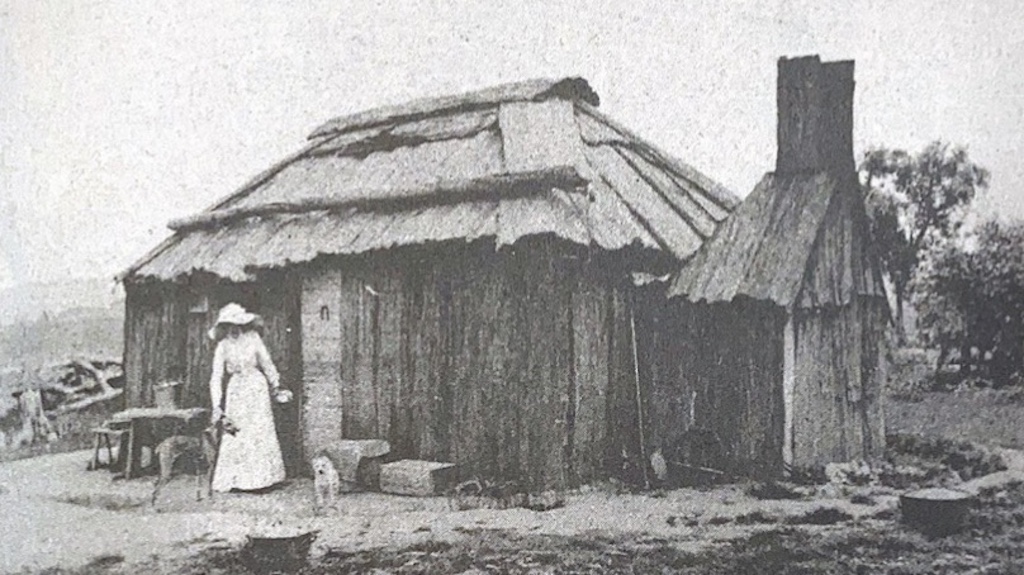
Featured image: C19th woman outside her bush home. Date and place unknown. Credit: No Place for a Nervous Lady: Voices From the Australian Bush, by Lucy Frost.
 Bluestocking Oxford